



Why Floods in Lagos Are Not an Accident
Lagos does not flood because of rain.Lagos floods because of choices. That sentence unsettles people because it shifts the conversation away from nature and places it squarely where it belongs: in...

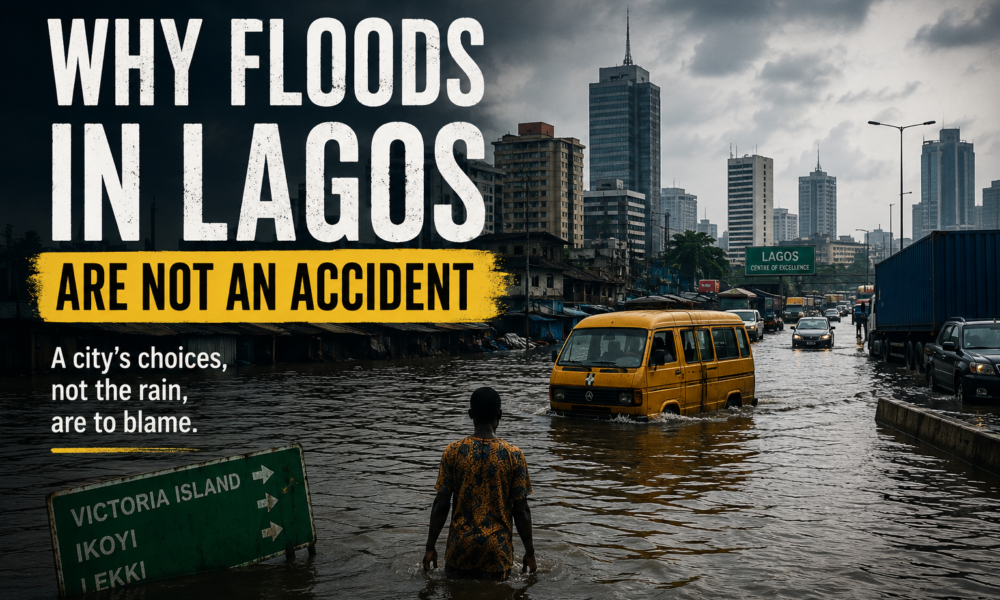
Lagos does not flood because of rain.
Lagos floods because of choices.
Table Of Content
That sentence unsettles people because it shifts the conversation away from nature and places it squarely where it belongs: in the realm of human decision-making. Rain has always fallen on this city. Long before colonial maps, long before concrete flyovers, long before glossy brochures selling “waterfront living”, the skies opened over this stretch of land. What has changed is not the rain, but what we have done with the land that receives it.
As a Nigerian scholar, and as a Lagosian who has watched floodwaters creep into homes, markets, classrooms and places of worship, I find it increasingly dishonest to frame flooding as an unfortunate natural disaster. Flooding in Lagos is political. It is social. It is planned—sometimes deliberately, sometimes through neglect—but rarely accidental.
A City Built Against Its Own Geography
Lagos is a coastal city, a lagoon city, a wetland city. Its natural ecosystem was designed to absorb water, redirect it, and release it slowly back into the sea. Wetlands were not empty spaces waiting to be “developed”; they were infrastructure—living infrastructure.
Yet, over the decades, wetlands have been reclaimed and converted into estates. Natural waterways have been narrowed, diverted, or blocked entirely by concrete. Drainage channels have become dumping grounds, not because residents are inherently careless, but because waste systems were never designed to serve everyone equally. Communities have been built in floodplains without alternatives being offered, and then blamed when the water returns to its ancestral routes.
When the rain comes, the water simply goes where it has always gone.
The science is clear. Hydrologists have said it repeatedly. Environmental planners have written reports that now gather dust on government shelves. The problem is not a lack of knowledge; it is a lack of political will to act on that knowledge in ways that centre ordinary people rather than elite interests.
Flooding as a Question of Power
In many African cities, flooding tells a story about who matters and who does not. When a high-income estate floods, emergency responses are swift, pumps arrive, and explanations are offered. When informal settlements flood, the language changes. Residents are described as “illegal”, “encroachers”, or “the problem”.
But one must ask: who approved the developments that blocked the waterways upstream? Who issued permits for estates on reclaimed land? Who benefits from land-use decisions that ignore environmental impact assessments?
Flooding, in this sense, becomes a visible expression of inequality. Water follows gravity, yes—but it also follows power. It flows away from protected spaces and settles in neglected ones. It punishes those with the least capacity to recover, reinforcing cycles of poverty, displacement, and vulnerability.
Climate Change Is Not an Excuse
Climate change is real, and it is intensifying rainfall patterns. But in Lagos, climate change has become a convenient excuse to avoid accountability. It is easier to blame “global warming” than to interrogate local planning failures. Easier to describe floods as “acts of God” than as consequences of policy.
Other coastal cities experience heavy rainfall without routine devastation because they plan with water, not against it. They respect floodplains. They invest in drainage as public good, not as political favour. They treat environmental management as a continuous process, not a reaction after tragedy.
Lagos, by contrast, often responds after the damage is done—after homes are destroyed, livelihoods disrupted, and lives sometimes lost.
Listening to the People Who Live There
Perhaps the most painful aspect of Lagos flooding is that the people most affected are rarely included in the conversations about solutions. Urban planning meetings happen in conference rooms far removed from flood-prone communities. Policies are announced without consultation. Evictions are proposed without resettlement plans.
Yet, residents understand their environment intimately. They know where water used to flow. They remember when certain canals were open, when mangroves still stood, when flooding was seasonal but manageable. Ignoring this lived knowledge is not just arrogant; it is dangerous.
Sustainable solutions must emerge from dialogue between climate science and community experience. Anything less is performative governance.
Flooding Is a Choice—So Is Change
If flooding is the result of choices, then different choices can produce different outcomes. Lagos can still rethink how it builds, where it builds, and who it builds for. It can restore wetlands, enforce planning laws consistently, invest in waste management, and prioritise resilience over aesthetics.
But that requires courage—the courage to challenge powerful interests, to admit past mistakes, and to govern for the long term rather than the next election cycle.
The rain will keep falling. That is inevitable.
What is not inevitable is the suffering that follows.
Floods in Lagos are not an accident. They are a mirror. And what they reflect is the kind of city we have chosen to create.
The question now is whether we are ready to choose differently.

No Comment! Be the first one.