



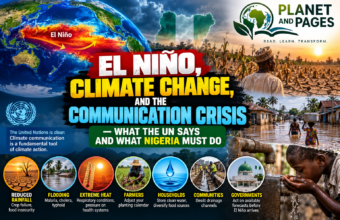
El Niño, Climate Change, and the Communication Crisis: What the UN Says and What Nigeria Must Do
There is a climate pattern forming in the Pacific Ocean right now. Thousands of kilometres from Lagos. Thousands of kilometres from Kano, Sokoto, Bayelsa, and every other Nigerian community going...

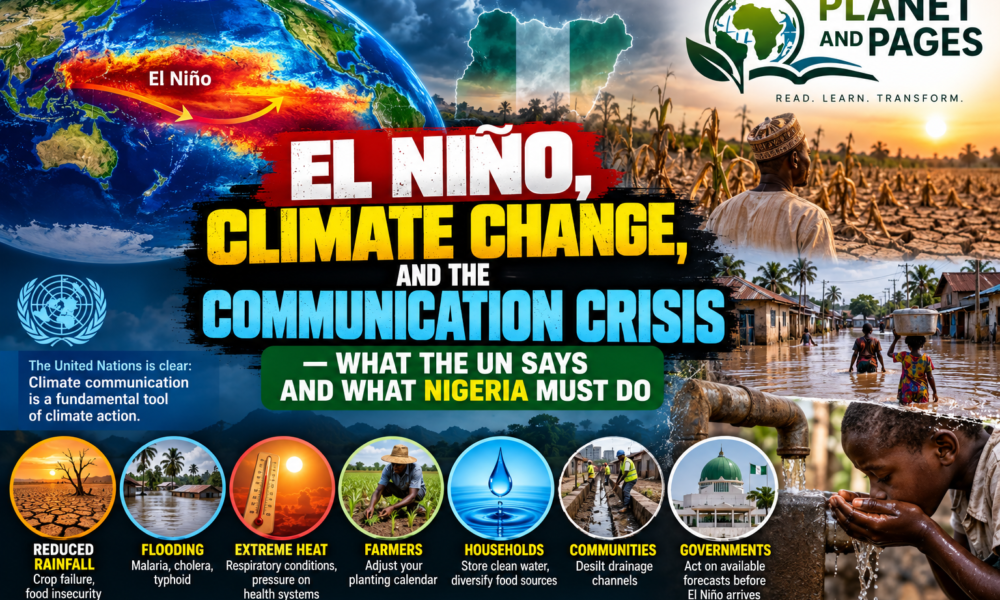
There is a climate pattern forming in the Pacific Ocean right now.
Table Of Content
Thousands of kilometres from Lagos. Thousands of kilometres from Kano, Sokoto, Bayelsa, and every other Nigerian community going about the ordinary business of life. And yet what is happening in those distant waters has the potential to affect your harvest, your health, your family’s water supply, and the stability of the communities you live and work in.
It is called El Niño. And Nigeria needs to pay attention — not just to the science, but to whether that science is actually reaching the people who need it most.
What Is El Niño, and Why Does It Matter Now?
El Niño is a naturally occurring climate phenomenon. It happens when surface temperatures in the central and eastern tropical Pacific Ocean become unusually warm — disrupting the atmospheric circulation patterns that govern rainfall, temperature, and seasonal weather across the entire globe. Some regions experience drought. Others experience flooding. Temperatures rise in some areas and fall in others. The timing and intensity of agricultural seasons shift in ways that can devastate communities whose livelihoods depend on the predictability of the rains.
None of this is new. El Niño events have been occurring for centuries, and their influence on African weather patterns has been documented and studied for decades. What is new — and what makes the current situation genuinely alarming — is the context in which El Niño is now occurring.
Climate change has fundamentally altered the baseline against which El Niño operates. As global temperatures rise, driven by the accumulation of greenhouse gases in the atmosphere, El Niño events are intensifying. The World Meteorological Organisation warned in 2023 that the combination of El Niño and human-induced climate change was pushing global temperatures into territory for which there is no modern precedent. Average global temperatures during the 2023–2024 El Niño period broke records that scientists had not expected to see broken for another decade.
For Africa — the continent that has contributed least to the accumulation of atmospheric greenhouse gases, and yet faces some of the most severe consequences of climate change — this convergence is not a distant scientific concern. It is an immediate, present, and in some cases already unfolding reality.
Nigeria is not exempt. And the time to act is now — before the full force of El Niño conditions arrives, not in the aftermath of the damage they produce.
The United Nations Has Been Clear
Before I discuss what El Niño means specifically for Nigeria, I want to spend a moment on something that I believe is as important as the meteorological science itself: what the United Nations has said about the role of communication in climate action.
The United Nations Framework Convention on Climate Change — the UNFCCC, which Nigeria has signed and ratified — has consistently and explicitly positioned climate communication as a fundamental instrument of climate action. Not a supplementary activity. Not a nice-to-have addition to the more serious work of policy and technology. A fundamental instrument.
The logic behind this position is not difficult to follow. Climate action — whether in the form of mitigation, adaptation, or disaster preparedness — ultimately depends on human behaviour. And human behaviour is shaped, in decisive ways, by what people know, what they understand, and whether the information available to them is trusted, accessible, and actionable.
When communities do not understand what is coming, they cannot prepare. When farmers do not have timely, accessible information about shifting seasons and rainfall patterns, they cannot adjust their planting calendars. When local government officials are not equipped with clear, specific guidance on flood preparedness, they cannot deploy resources effectively. When the general public cannot access reliable climate information in the languages they speak and through the channels they trust, the most sophisticated early warning systems in the world produce precisely nothing.
The United Nations Sustainable Development Goal 13 — climate action — makes this explicit. It calls on all signatory countries, including Nigeria, to improve education, awareness, and human and institutional capacity on climate change mitigation, adaptation, impact reduction, and early warning. This is not aspirational language. It is a commitment that Nigeria has made to the international community. And it is a commitment that the arrival of El Niño now makes urgently relevant.
El Niño is not just a weather event. It is a communication test. And whether Nigeria passes that test will depend not only on the quality of its meteorological forecasting, but on the quality of its communication infrastructure — its ability to translate scientific knowledge into community understanding, and community understanding into timely, appropriate action.
What El Niño Means for Nigeria — Region by Region
Nigeria is a geographically, ecologically, and climatically diverse country. The El Niño phenomenon does not affect all of its regions in the same way. Understanding the specific risks facing different parts of the country is the starting point for any meaningful preparedness effort.
Northern Nigeria
The northern states — already among the most climate-vulnerable parts of Nigeria, facing the dual pressures of advancing desertification from the Sahara and the steady shrinkage of Lake Chad — are particularly exposed to the drought and below-average rainfall conditions that El Niño typically brings to the West African sub-region.
When rainfall is reduced and erratic, the consequences cascade rapidly through the agricultural system. Planting seasons shorten. Crops fail. Food reserves deplete. Pastoralists and farmers, already competing over diminishing productive land, come into sharper conflict. And the nutritional consequences of reduced agricultural output fall hardest on the communities that were already most food-insecure.
The health dimension of this picture is frequently underreported, but it is serious. As water sources shrink and become more concentrated, the risk of waterborne diseases — including cholera, typhoid, and dysentery — rises sharply. Communities that depend on surface water sources, boreholes, or shallow wells are particularly vulnerable. And in the meningitis belt that runs across northern Nigeria, the hot, dry, dusty conditions associated with drought and El Niño have long been associated with elevated risk of bacterial meningitis — a disease that can kill within hours and leave survivors with permanent disabilities.
Southern Nigeria
The picture in southern Nigeria is different in character, though not in severity. While northern Nigeria faces the risk of too little water, southern Nigeria — particularly the Niger Delta and coastal communities — faces the risk of too much, arriving in the wrong way at the wrong time.
El Niño can disrupt the timing and intensity of rainfall in ways that overwhelm drainage infrastructure, saturate soils, and trigger flooding events of unusual severity. In communities that already experience regular seasonal flooding, El Niño conditions can extend the flooding season, increase the depth and duration of inundation, and push communities into displacement.
The health consequences of flooding in southern Nigeria are well documented. Stagnant floodwater creates ideal breeding conditions for mosquitoes, dramatically increasing the transmission of malaria — which remains one of the leading causes of morbidity and mortality in Nigeria. Flooding also contaminates water sources, triggering outbreaks of cholera, typhoid, and other waterborne diseases. Skin diseases proliferate in communities where people are living in or wading through contaminated water. And in a healthcare system where the distance between a community and the nearest functional health facility can already be measured in hours rather than minutes, a surge in climate-related illness can overwhelm local capacity with devastating consequences.
Children and the elderly are the most vulnerable in both contexts — their immune systems and physical resilience least equipped to absorb the additional burden of climate-related health stress.
Nigeria as a Whole
Across the country, the broader climatic signature of El Niño — elevated temperatures, disrupted atmospheric circulation, increased frequency of extreme weather events — produces health consequences that cut across regional lines.
Heat stress is a growing and significantly underestimated public health challenge in Nigeria. As ambient temperatures rise, the human body’s ability to thermoregulate is compromised — particularly in urban areas, where the urban heat island effect amplifies ambient temperatures, and in communities without access to cooling infrastructure. Heat stress can trigger cardiovascular events, worsen respiratory conditions, and increase occupational injury risks for outdoor workers. In a country where most agricultural, construction, and informal sector work is conducted outdoors, and where reliable electricity for cooling is far from universal, the health burden of elevated temperatures is both real and largely invisible in national health statistics.
The pressure on Nigeria’s already stretched health systems — inadequately funded, unevenly distributed, and chronically understaffed in the communities most exposed to climate risk — represents perhaps the most acute dimension of the El Niño challenge at the national level.
What Nigeria Must Do — And When
I want to be very clear about the timing of what I am about to say.
Preparation for El Niño conditions is not something that can be left until the evidence of impact is already visible. By the time crop failure is apparent, the planting window has closed. By the time drainage channels are overwhelmed, the material needed to desilt them is already beneath floodwater. By the time health facilities are reporting a surge in malaria cases, the mosquitoes have already bred in the water that accumulated while nobody was acting.
Preparation must begin now.
For farmers, the most critical action is information — specifically, accessing and acting on the seasonal climate outlooks produced by the Nigerian Meteorological Agency, NiMet. These forecasts provide advance guidance on expected rainfall patterns, temperature ranges, and seasonal onset and cessation dates. Adjusting planting calendars in line with forecast information — planting earlier or later, shifting to shorter-cycle or drought-resistant crop varieties, expanding food storage capacity — are decisions that must be made before the planting window, not during it.
For communities, the priority actions are practical and immediate. Store clean water while sources are reliable and abundant. Desilt drainage channels and clear waterways of accumulated waste — particularly plastic waste, which is one of the primary causes of drainage blockage and flooding in Nigerian urban and peri-urban environments. Identify and prepare community meeting points and evacuation routes for potential flood scenarios. And engage local government health departments and community health workers to understand what disease surveillance and treatment resources are available and how to access them.
For governments at federal, state, and local levels, the responsibility is both policy and communication. Nigeria has NiMet. Nigeria has the data. Nigeria has the seasonal forecasts. What is frequently lacking is the political will and institutional capacity to translate those forecasts into timely, specific, actionable guidance that reaches the communities most at risk — in the languages they speak, through the channels they trust, at the time when the information can still make a difference.
The NiMet seasonal climate outlook must not remain a document circulated among technical agencies in Abuja. It must reach the farmer in Sokoto. The fishing community in Bayelsa. The local government health officer in Benue. The market woman in Onitsha who needs to know whether to invest in additional food storage before the dry season deepens. That translation — from technical forecast to community-level actionable information — is the work of climate communication. And it is work that is currently being done at a fraction of the scale and quality that the situation demands.
The Communication Crisis at the Heart of Nigeria’s Climate Vulnerability
I want to name something directly, because I think it is the most important point in this entire discussion.
Nigeria’s vulnerability to El Niño — and to climate change more broadly — is not primarily a knowledge crisis. The science exists. The forecasts are produced. The risks are understood, at least within the technical and policy communities that have access to the relevant information.
Nigeria’s vulnerability is, in very large part, a communication crisis.
When the UNFCCC says that climate communication is a fundamental tool of climate action, it is not making a rhetorical gesture. It is identifying a real and specific gap between what the science knows and what affected communities understand and can act upon. A seasonal forecast that does not reach the farmer in Sokoto is not a forecast. It is a document. A flood preparedness plan that exists only in a local government office is not a plan. It is a file. An early warning system whose alerts never reach the people in the path of the hazard is not a warning system. It is infrastructure built for the illusion of preparedness.
The gap between Nigeria’s existing climate knowledge and the communication of that knowledge to the communities who need it is not a minor inefficiency. It is the difference between a population that can adapt and a population that absorbs damage that was preventable.
Closing that gap requires investment — in community radio broadcasting in Hausa, Yoruba, Igbo, Ijaw, and the dozens of other languages in which Nigerians live their lives. In training community health workers and agricultural extension officers to communicate climate risk in culturally resonant and practically useful ways. In social media content that translates complex seasonal forecasts into simple, shareable, actionable guidance. In partnerships between NiMet, the Federal Ministry of Environment, state governments, local government authorities, civil society organisations, religious leaders, and community media — the full ecosystem of trusted voices through which information actually moves in Nigerian communities.
None of this is impossible. Some of it is already happening, in pockets and at limited scale. What it requires is the political recognition that climate communication is not a soft activity that happens after the serious policy work is done. It is part of the serious policy work. It is, in a country as large, as diverse, and as climate-exposed as Nigeria, one of the most consequential policy investments the government can make.
A Final Word
El Niño will arrive on its own schedule. The Pacific Ocean is not waiting for Nigeria’s communication infrastructure to catch up. The question that matters — the only question that matters, from the perspective of the communities most at risk — is whether the knowledge that exists will reach them in time to make a difference.
The United Nations has spoken. The science has spoken. Seasonal forecasts are being produced. The evidence of what is coming is available to anyone with the institutional access to find it.
Now it is time for communication to do its work.
Not in the conference rooms of Abuja.
In the farming communities of Sokoto. In the fishing villages of Bayelsa. In the flood-prone neighbourhoods of Lagos, Ibadan, Kano, and every other Nigerian community that will feel the weight of what is forming, right now, in the Pacific Ocean thousands of kilometres away.
They deserve to know what is coming.
And they deserve the chance to survive it.
Dr Moshood Olawale Ajibola is an environmental communicator and scholar specialising in climate narratives, power, and Africa-centred environmental discourse. He is the founder of Planet and Pages and BrandLift Communication Consult, both based in Lagos, Nigeria. Follow his work on Planet and Pages across YouTube, Instagram, TikTok, Facebook, and X.

No Comment! Be the first one.