



I Went Back to the Classroom. Here Is What I Learned.
There is a particular kind of humility that a PhD does not teach you. It is not the humility of not knowing enough — the doctorate, for all its demands, does an admirable job of acquainting you with...


There is a particular kind of humility that a PhD does not teach you.
Table Of Content
It is not the humility of not knowing enough — the doctorate, for all its demands, does an admirable job of acquainting you with the vastness of what you do not know. And it is not the humility of being wrong — good research training builds a fairly robust tolerance for discovering that your initial assumptions were mistaken, and for revising accordingly.
The humility I am talking about is more specific. It is the humility of recognising that knowing and doing are not the same thing. That having a sophisticated theoretical understanding of community engagement is not the same as being genuinely good at it. That being able to write compellingly about the importance of listening to communities does not automatically mean that you listen as well as you should, as consistently as you should, or with the kind of structured intentionality that produces real results.
It was in pursuit of that humility — and the practical skills that go with it — that I went back to the classroom four weeks ago.
The Course and Why I Chose It
The Climate Education and Community Engagement course — known by its acronym, CECE — is offered by the Civic Ecology Lab at Cornell University. It is designed for practitioners, educators, communicators, and researchers who work at the intersection of environmental knowledge and community action. Its central proposition is straightforward but consequential: that climate education, to be effective, must be rooted in community relationship, participatory design, and practical action rather than information transmission alone.
When I came across the course, I was in the middle of what I would describe as a productive period of professional restlessness. My PhD was complete. Several publications were in circulation or in progress. Planet and Pages, the Africa-centred environmental media platform I founded, was developing its content and reach. My consultancy, BrandLift Communication Consult, was active.
By most conventional measures, things were going well. And yet I found myself returning, again and again, to a question that my formal training had not fully answered.
I know a great deal about climate change communication. I have researched it, written about it, and built a platform dedicated to it. But am I as effective as I could be at the actual, on-the-ground work of engaging communities — of moving people not just to awareness but to sustained, collective action?
The honest answer was: probably not as effective as I want to be.
CECE seemed like exactly the right place to address that gap. So I enrolled.
What Four Weeks at Cornell Taught Me
Let me be clear about the format of this learning experience. CECE is not a residential programme. It is an intensive online course — structured, demanding, and rigorous in the best sense of that word. Over four weeks, participants engage with course content, complete assignments, reflect on their own practice, and connect with a cohort of fellow practitioners from around the world. The Cornell name carries genuine weight, and the Civic Ecology Lab’s intellectual framework is serious and carefully developed.
What I did not expect was how personally the course would land.
The central insight of CECE — the one that recurs throughout the curriculum in different forms and from different angles — is that effective climate action is not primarily an information problem. We tend to treat it as one. We assume that if people only knew more about the science, or were better exposed to the evidence, or had access to clearer and more compelling communication, they would act differently. And so we produce more reports, more campaigns, more content, more data visualisations, more social media posts.
The evidence, as CECE makes clear with considerable rigour, does not support this assumption.
What actually moves communities — what produces the kind of sustained, participatory engagement that leads to real behavioural and environmental change — is relationship. It is the quality of the connection between the communicator and the community. It is the degree to which community members feel genuinely heard, genuinely respected, and genuinely involved in the design of solutions rather than merely consulted after the fact. It is the extent to which education is rooted in local knowledge and local need rather than imposed from outside with good intentions and limited understanding.
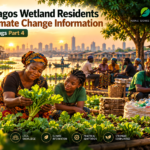
None of this was entirely new to me intellectually. My PhD research had demonstrated precisely this dynamic in the Lagos wetland communities I studied — communities whose sophisticated, experiential climate knowledge had been consistently overlooked by formal communication and policy frameworks. I had written about it. I had spoken about it. I had built an entire media platform around the conviction that African voices and African knowledge systems deserve to be centred in the climate conversation.
But CECE asked me to do something more demanding than write about it. It asked me to examine my own practice with the same critical eye I apply to the systems I critique. And that examination was, at times, uncomfortable in exactly the way that genuine learning tends to be.
The Practical Requirement — and Why It Matters
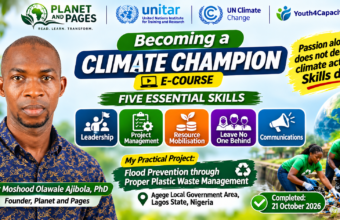
One of the features that distinguishes CECE from many professional development courses is its insistence on practical application. The course does not conclude with a certificate and a set of reflective notes. It requires participants to design and implement a real community education project — to take the principles and frameworks developed over four weeks and apply them in an actual community context, with real people, around a real environmental challenge.
When I considered where to direct this project, the answer came quickly and clearly.
Agege.
Agege Local Government Area, in the heart of Lagos State, is where much of my community-facing work is rooted. It is a densely populated, largely working-class area that embodies many of the most pressing urban environmental challenges facing Lagos — and, by extension, many West African cities. It is a place I know well, a place where relationships already exist, and a place where the environmental challenges are not theoretical.
My CECE community project focuses on flood prevention through proper plastic waste management.
The choice of this focus was not arbitrary. It emerged directly from understanding how flooding actually works in communities like Agege. The drainage channels that run through residential neighbourhoods — channels that are supposed to carry rainwater safely away from homes, markets, schools, and roads — are frequently blocked. And the primary material blocking them is plastic waste. Sachets, bottles, bags, packaging of every description, discarded in the channels, on roadsides, and in any available open space, accumulate until they form barriers that the rains cannot overcome. When the rains come — and in Lagos, they come hard — the water has nowhere to go. Streets flood. Homes flood. Businesses flood. Children wade through contaminated water to reach school. Families who cannot afford to lose what the flood takes, lose it anyway.
This is a cycle that repeats, with depressing regularity, every rainy season. And while it has structural dimensions that require governmental response — inadequate drainage infrastructure, absent waste collection, weak environmental enforcement — it also has a community dimension that community engagement can genuinely address.
If residents understand the direct, specific connection between how they dispose of plastic waste and whether their street floods, behaviour changes. Not universally, not immediately, not without sustained effort — but meaningfully. The evidence for this, from community engagement research across multiple contexts, is reasonably robust. What has been lacking, in many cases, is the quality of the communication and engagement effort itself.
That is what my CECE project is designed to address.
From Communication to Collaboration
The most important conceptual shift that CECE produced in my thinking is one that I want to name explicitly, because I believe it matters for everyone working in climate communication and community development.
There is a difference between communicating with communities and working with them.
Communicating with communities — however well-intentioned, however carefully designed, however culturally sensitive — still positions the communicator as the agent and the community as the audience. Information flows in one direction. The communicator has something to give. The community is invited to receive it. Even at its best, this model limits the depth of engagement and the durability of its effects.
Working with communities is something different. It means entering the relationship as a learner as well as a teacher. It means designing interventions collaboratively, with community members as genuine co-designers rather than consulted stakeholders. It means being willing to have your assumptions challenged, your timelines disrupted, and your pre-formed ideas about solutions revised by people who understand the local context more intimately than you ever will.
This is harder. It is slower. It is less amenable to the kind of neat project reporting that funders and institutions often prefer. But it is, the evidence consistently suggests, far more effective at producing the kind of sustained behavioural change that the climate crisis actually requires.
CECE did not tell me anything I had not, on some level, already believed. But it gave me a structured framework for translating that belief into practice. And it gave me the space — four weeks of deliberate, focused attention — to examine honestly where the gap between my stated values and my actual practice had been wider than I would like to admit.
What Comes Next
I am under no illusion that a four-week course, however excellent, produces transformation. Learning of the kind that changes practice takes time, repetition, feedback, and the kind of accumulated experience that only comes from doing the work in real conditions with real communities.
But CECE has given me something valuable: a clearer framework, a more honest self-assessment, and a concrete project through which to begin putting new thinking into practice.
The Agege flood prevention project is in its early stages. I will be sharing updates as it develops — the process of community engagement, the challenges and discoveries that emerge, the adaptations that become necessary when theory meets neighbourhood reality. I intend to document this work honestly, which means documenting not only the successes but the moments of friction, misunderstanding, and revision that any genuine community engagement process involves.
Because one of the things CECE reinforced most powerfully is this: the process is the point. Not just the outcome. The quality of the relationship, the depth of the participation, the degree to which community members move from being objects of education to being agents of it — these are not merely instrumental values on the way to a measurable environmental result. They are the result.
A community that has been genuinely engaged around plastic waste and flooding does not just change its disposal behaviour for the duration of a project. It develops new relationships, new norms, new confidence in its own capacity to address environmental challenges. That is the kind of change that outlasts the intervention. And that is the kind of change that the climate crisis demands.
A Final Word
I want to end with something that feels both personal and, I think, professionally important.
Going back to the classroom at this stage of my career was a choice. Nobody required it of me. It did not come with a salary increase or an institutional mandate or a performance review requirement. It came from a recognition — honest, if slightly uncomfortable — that there was more to learn, and that the learning would make me better at work I care deeply about.
I would encourage every climate communicator, every environmental practitioner, every researcher who has spent years developing expertise in what they know, to periodically ask themselves a harder question.
Are you as good at what you do as you are at writing about what you do?
The answer, for most of us, most of the time, is probably: not quite.
That gap is not a cause for embarrassment. It is an invitation.
And I, for one, intend to keep accepting it.
Dr Moshood Olawale Ajibola is an environmental communicator and scholar specialising in climate narratives, power, and Africa-centred environmental discourse. He is the founder of Planet and Pages and BrandLift Communication Consult, both based in Lagos, Nigeria. Follow his work on Planet and Pages across YouTube, Instagram, TikTok, Facebook, and X.




No Comment! Be the first one.