



Climate Champions Are Not Born, They Are Built: Five Skills That Turn Climate Passion into Climate Action
There is a conversation I have had many times with students, colleagues, young volunteers and community leaders across Lagos. It usually begins with passion. “I care deeply about the environment,”...

There is a conversation I have had many times with students, colleagues, young volunteers and community leaders across Lagos. It usually begins with passion.
Table Of Content
- Why Another Course?
- The Five Skills
- 1. Leadership: Because Climate Action Needs People Who Can Inspire Others to Move
- 2. Project Management: Because a Good Idea Without a Plan Remains Only an Idea
- 3. Resource Mobilisation: Because Even the Best Project Needs People, Partners and Funding to Survive
- 4. Leave No One Behind: Because Climate Action Must Include Women, Youth and the Communities Most Often Overlooked
- 5. Communications: Because If People Do Not Understand Your Project, They Cannot Support It
- From the Classroom to Agege
- What I Hope to Do, and What I Do Not Claim
- Why This Matters for Africa
- A Closing Word
“I care deeply about the environment,” someone tells me. “I want to do something about climate change.”
I never doubt the sincerity. In Nigeria, where floods, heat and waste are daily realities, caring is not difficult. But I have learnt, sometimes through uncomfortable experience, that caring and delivering are different things. I have watched well-meaning initiatives collapse because nobody planned the budget. I have seen community clean-ups attract dozens of volunteers once and none the second time. I have sat in meetings where an excellent idea died because nobody could explain it in terms the community understood.
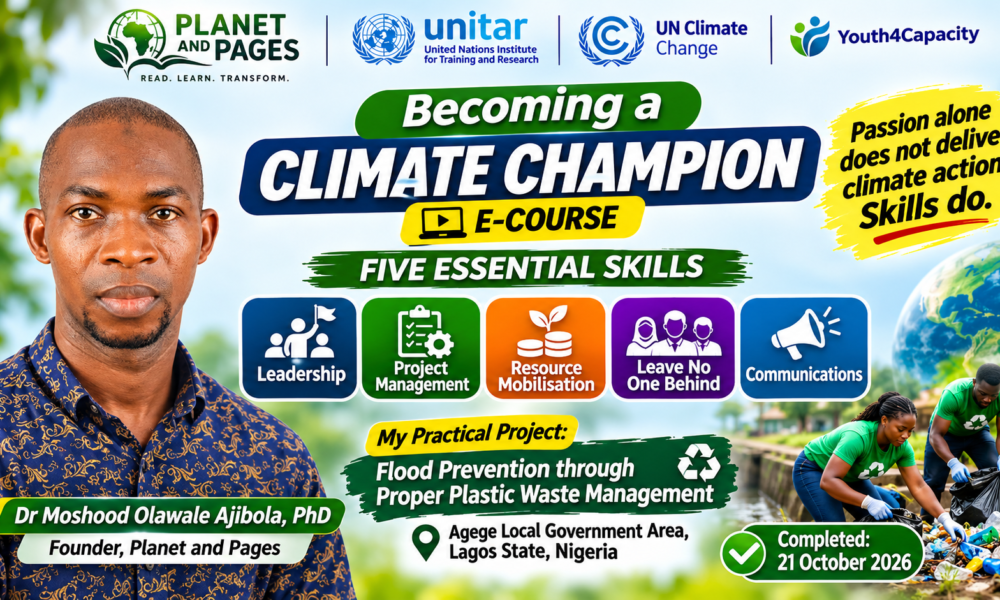
Passion alone does not deliver climate action. Skills do.
That conviction led me, in October 2026, to complete the Becoming a Climate Champion e-course, offered by the United Nations Institute for Training and Research (UNITAR) in partnership with UN Climate Change and Youth4Capacity. This article reflects on what the course taught me, why its design matters for African climate practitioners, and how I am applying it in Agege, Lagos.
Why Another Course?
It is a fair question, particularly from someone who has just completed a doctorate, published in the field and built a media platform around environmental communication. Why return to the classroom, again?
My answer is that scholarship and practice are not the same discipline. My PhD research examined what residents of Lagos wetland communities know about climate change, where they get their information and what they do with it. It taught me a great deal about knowledge, communication and trust. But understanding a problem is one thing. Designing, leading, funding and communicating a project that addresses it is another.
The Becoming a Climate Champion course is explicitly built to close that gap. It is an e-course of five modules and a final assessment, with an estimated learning time of three to three and a half hours. That is modest in duration, but the structure is deliberate. By its completion, participants are expected to be able to devise an inclusive climate action project, outline a brief communications plan, identify the resources needed for implementation, and understand what it takes to make climate initiatives inclusive and gender-responsive. A minimum grade of 70 per cent on the knowledge assessment is required for the certificate.
What I appreciated most was its honesty about what climate action actually requires. Not just good intentions, but a toolkit.
The Five Skills
1. Leadership: Because Climate Action Needs People Who Can Inspire Others to Move
The first module deals with leadership, and it challenged an assumption many of us carry: that leadership belongs to people with titles.
In my experience across Nigerian communities, the most effective environmental leaders are often not officials. They are the market association chairwoman who persuades traders to stop dumping waste in the drain. They are the youth leader who mobilises volunteers on a Saturday morning. They are the elder whose word settles disputes and shapes what a community considers acceptable.
Leadership in climate action, as the course frames it, is the ability to inspire others to act, and to sustain that action over time. That is a skill that can be learnt and practised, and it is available to anyone willing to take responsibility.
2. Project Management: Because a Good Idea Without a Plan Remains Only an Idea
I say this with some humility: academics are not always good at project management. We are trained to analyse, to question, to refine. We are less often trained to define objectives, set timelines, allocate responsibilities, manage risks and measure results.
The project management module brought welcome discipline. A climate initiative needs a clear goal, defined activities, a realistic schedule, a way of knowing whether it is working and a plan for when things go wrong, as they inevitably do. Without these, even the most compelling idea remains a conversation.
Nigeria has no shortage of good ideas about climate and the environment. What we often lack is the unglamorous machinery that carries ideas into implementation.
3. Resource Mobilisation: Because Even the Best Project Needs People, Partners and Funding to Survive
The third module addresses what many climate practitioners in Africa find hardest: securing the resources to make a project real.
Resources, importantly, are not only money. They include people, skills, partnerships, materials, community goodwill and institutional support. A project that depends on a single funder is fragile. A project that draws on community contributions, local partnerships and a diversity of support is far more likely to survive.
For African practitioners, who often work with limited funding and in competitive grant environments, this module is especially valuable. It encourages us to think carefully about what a project genuinely needs, who might help provide it, and how to make a credible case for support.
4. Leave No One Behind: Because Climate Action Must Include Women, Youth and the Communities Most Often Overlooked
If I were asked which module resonates most with my research, it would be this one.
Leave No One Behind is a founding principle of the United Nations’ 2030 Agenda, and the course applies it to climate action with practical seriousness. Climate impacts are not evenly distributed. Women, young people, older persons, persons with disabilities and residents of informal settlements often bear the heaviest burden and are least consulted in designing responses.
My own work has returned to this theme repeatedly. When I studied wetland communities in Lagos, I found residents who held real, experiential climate knowledge, yet whose voices rarely reached formal policy or planning. The communities most exposed to flooding and environmental degradation were frequently the least represented in decisions about how to address them.
An inclusive project is not simply more ethical. It is more effective. When women, youth and marginalised residents help shape a project, it reflects the realities of the people it is meant to serve, and it earns their trust and participation. The course made this case clearly, and gave practical guidance on how to put it into practice.
5. Communications: Because If People Do Not Understand Your Project, They Cannot Support It
The final module is the one closest to my professional home, yet I found it valuable precisely because it approached communication as a practical project skill rather than a theoretical subject.
A climate project does not succeed merely because it is well designed. People must understand what it is, why it matters, what is being asked of them and how they can participate. Funders, partners, local authorities and community members each need to hear the message in a form that makes sense to them.
My earlier research found that awareness of climate change among Lagos residents is relatively high, yet that awareness does not automatically translate into sustained action. Trust, relevance and participation make the difference. The course reinforced this by treating communication not as an afterthought, to be attended to once the real work is done, but as part of the real work from the beginning.
From the Classroom to Agege
The course does not end with a certificate. As part of its requirements, participants must carry out a practical project session in their own community. For me, the choice was straightforward.
I have chosen Agege Local Government Area in Lagos State, Nigeria. My focus is flood prevention through proper plastic waste management, the same focus I chose for my practical project in the Cornell University Climate Education and Community Engagement (CECE) course.
Some readers may wonder why I would return to the same theme. The answer lies in how the two courses complement each other. CECE strengthened my understanding of how to engage communities: listening, building relationships, and working with residents rather than merely communicating to them. The Becoming a Climate Champion course strengthens my capacity to organise and deliver: to plan, mobilise resources, ensure inclusion and communicate clearly. Together, they offer a fuller preparation for a single, practical task.
The choice of focus is deliberate. In many Lagos communities, plastic waste blocks drainage channels. When the rains arrive, the water has nowhere to go. Streets flood, homes are damaged, businesses lose income, and the risk of waterborne disease rises. The problem has structural dimensions that require governmental response, including drainage infrastructure, waste collection systems and enforcement. Yet it also has a community dimension that residents can address directly through how they dispose of waste, how they organise collectively and how they hold one another accountable.
Plastic waste blocking drains is one of the most solvable causes of flooding. I do not say this lightly, nor do I suggest that structural investment is unimportant. I say it because the behaviours involved are within reach of ordinary people. That makes it an ideal subject for community-level climate action: tangible, visible and capable of producing results that residents can see for themselves.
What I Hope to Do, and What I Do Not Claim
I want to be careful here, because honesty matters more than enthusiasm.
A short e-course does not make anyone an expert, and a single community session will not end flooding in Agege. Flooding in Lagos has deep structural causes that no community project can resolve on its own. What I can reasonably hope for is more modest, and perhaps more meaningful: that the session will help residents see clearly the connection between plastic waste and flooding, create an opening for collective action, and demonstrate what a well-planned, inclusive and clearly communicated community initiative can look like.
I intend to apply what the course taught. The project will have clear objectives. It will identify the resources it needs and the partners who might help provide them. It will deliberately involve women, young people and others who are too often overlooked. And it will be communicated in language and through channels that Agege residents trust.
I will also document what I learn honestly, including what works and what does not. Practice has a way of testing theory, and I would rather share an honest account of that testing than a polished narrative of success.
Why This Matters for Africa
The title of this reflection, Climate Champions Are Not Born, They Are Built, is more than a slogan. It makes a claim about how climate action should be understood on our continent.
Africa contributes least to the global emissions driving climate change, yet bears some of its heaviest consequences. That injustice is real, and it demands international accountability. But justice alone will not build resilience in Lagos, Kano or Nairobi. That depends on people at community, city and national levels who have the skills to lead, plan, mobilise resources, include others and communicate effectively.
Such skills are not talents bestowed on a lucky few. They can be taught, learnt and shared. Each person who acquires them, and applies them in a real community, extends the continent’s capacity to respond to a crisis it did not create.
This is why courses like this one matter. Not because a certificate impresses, though recognition from the United Nations system is something I value. They matter because they widen the circle of people equipped to turn concern into action.
A Closing Word
I completed the Becoming a Climate Champion e-course on 21 October 2026. I am carrying its five skills, leadership, project management, resource mobilisation, inclusion and communications, into Agege, and I hope in time across Nigeria and the wider continent.
To anyone who cares about the climate and does not know where to begin: begin by building your skills. Learn to lead, plan, find resources, include others and communicate. Then choose a problem in your own community, small enough to tackle and real enough to matter.
Passion opens the door. Skills carry you through it.
Climate champions are not born. They are built.
And the work starts now.
Dr Moshood Olawale Ajibola is an environmental communicator and scholar specialising in climate narratives, power and Africa-centred environmental discourse. He is the founder of Planet and Pages and BrandLift Communication Consult, both based in Lagos, Nigeria. Follow his work on Planet and Pages across YouTube, Instagram, TikTok, Facebook and X.



No Comment! Be the first one.