



Makoko: What a Floating Community Tells Us About Climate, Justice and the Stories We Choose Not to Tell
Climate Justice | Urban Vulnerability | Environmental Communication Introduction: The Road That Is a River Right now, somewhere in Lagos, a child is paddling a canoe to school. Not because it is an...

Climate Justice | Urban Vulnerability | Environmental Communication
Introduction: The Road That Is a River
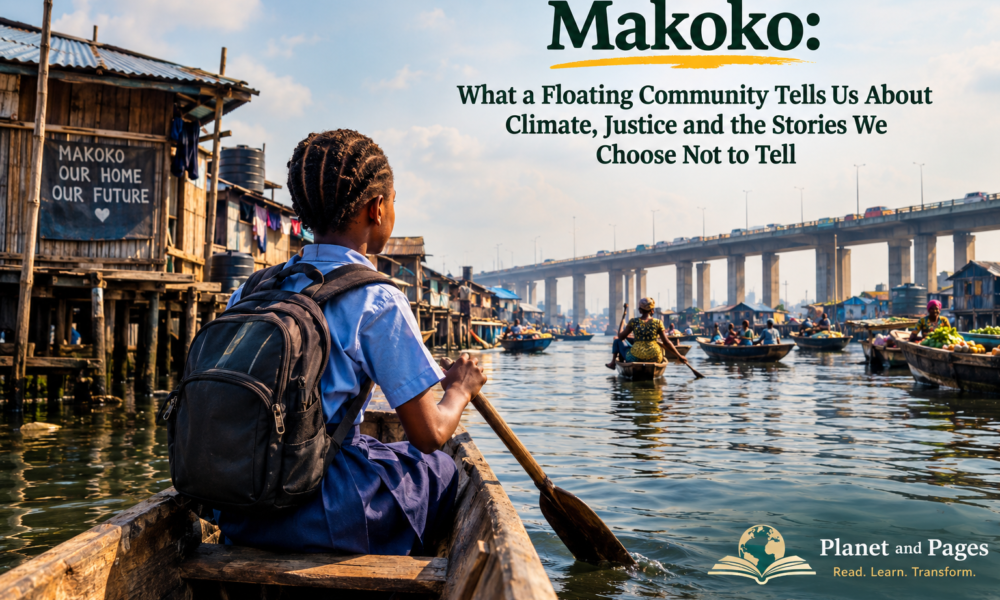
Right now, somewhere in Lagos, a child is paddling a canoe to school.
Not because it is an adventure. Not because it is a school trip, or a cultural experience, or a photograph waiting to be taken by a passing journalist with a wide-angle lens and an international commission. Because it is the only road available. Because the community this child lives in does not have roads. It has water. It has always had water. And the systems that are supposed to protect this child — the early warning systems, the adaptation plans, the evacuation routes, the climate finance commitments — have been designed, with remarkable consistency, as if this child does not exist.
This article is about Makoko. But it is also about something larger than Makoko. It is about the gap between the climate crisis as it is documented and discussed in the institutions that claim to be addressing it, and the climate crisis as it is actually lived in the communities bearing its heaviest consequences. It is about whose suffering is legible to the systems designed to respond to suffering, and whose remains invisible — not because it is hidden, but because the systems have not been built to see it.
It is, in the most direct and urgent sense, a story about communication.
A Community the City Forgot to Count
Makoko sits on the Lagos Lagoon, directly beneath the Third Mainland Bridge — one of the longest bridges in Africa, a piece of infrastructure that carries thousands of vehicles daily above a community that most of those vehicles’ occupants have never thought seriously about. The community was established in the 18th century by Egun fishermen who migrated from Badagry and what is today the Republic of Benin, settling on the water’s edge and eventually, as the community grew, on the water itself. What began as a fishing settlement became, over generations, a fully functioning waterfront community — a place where people are born, grow up, work, marry, raise children, grow old, and die. A place that is, by any meaningful definition of the word, home.
Today, Makoko is home to an estimated 85,000 to 300,000 people. The extraordinary range of that estimate is itself revealing. It reflects not uncertainty about whether people live here — they manifestly do, in their hundreds of thousands — but the absence of the systematic counting and documentation that would allow anyone to say precisely how many. Makoko has never been formally included in a Nigerian census. It has never been mapped with the precision that its population size would ordinarily demand. And the consequence of not being counted is, in the world of policy and planning, approximately equivalent to not existing. Communities that do not appear in the data do not appear in the plans. Communities that do not appear in the plans do not receive the infrastructure. Communities that do not receive the infrastructure are left to manage, with whatever resources they possess, the consequences of a crisis that the infrastructure was supposed to address.
If Makoko’s population were counted as a city, it would rank among the most populated urban centres in several Nigerian states. It would be the size of a city that commands attention, investment, and political consideration. But Makoko is not counted. And so it does not command these things. It absorbs them — or rather, it absorbs their absence — and continues to exist in the gap between what Nigerian governance promises and what it delivers.
The Geography of Risk
Makoko is not merely a community that experiences climate risks. It is a community that embodies, in concentrated and daily form, the full range of climate vulnerabilities that researchers spend careers studying and that policymakers spend summits discussing. Rising sea levels. Flooding. Waterborne disease. Extreme heat. The community sits at the intersection of every major climate hazard documented for coastal West African cities — and it navigates all of them, simultaneously, without the infrastructure, early warning systems, or institutional support that the formal city considers basic provisions.
The physical structure of Makoko makes its climate vulnerability immediately legible to anyone who has spent time there. The community is built on stilts — wooden structures rising from the lagoon, connected by narrow waterways and walkways, accessed primarily by canoe. It is divided into six villages, four of which float on water and two of which sit on land at the water’s edge. The land-based sections flood regularly during the rainy season. The water-based sections are, by definition, always flooded — their relationship with water is not seasonal but permanent, not a crisis but a condition.
This distinction matters enormously for how climate risk is understood and communicated. When researchers and communicators describe flooding as a climate risk, they typically mean an event — a flood that arrives, causes damage, and recedes. For Makoko, flooding is not an event. It is the baseline state of existence. The question is not whether the community floods. It is whether the water rises above its habitual level, and by how much, and for how long, and what that means for the households in the lowest-lying areas and the most structurally precarious buildings.
Sea level rise poses a specific and documented threat. The Lagos coastline is subsiding at a rate that researchers have estimated at between 1.5 and 8.7 centimetres per year in some areas, driven by a combination of groundwater extraction, sediment compaction, and the weight of urban development on a naturally low-lying coastal plain. For a community already built at water level, the incremental rise of that water level is not a distant projection. It is a present reality, registering in the gradual encroachment of the lagoon on structures that were, when they were built, safely above it.
The Numbers Beneath the Water
The data on living conditions in Makoko is, by the standards of most Nigerian communities, unusually well documented — a consequence, in part, of the international media attention that the community’s photogenic setting has attracted. But documentation is not the same as action, and the gap between what the data shows and what has been done about it is one of the most striking features of Makoko’s story.
More than 75 per cent of households in Makoko live in a single room. This figure does not describe a population making do with less than ideal accommodation. It describes a population living in conditions of severe spatial deprivation — conditions in which the entire domestic life of a family, including sleeping, cooking, childcare, and the storage of the tools and materials on which livelihoods depend, is compressed into a single room above a lagoon. In these conditions, the arrival of a disease, the birth of an additional child, the loss of an income source, or an unexpected rise in water level does not merely create inconvenience. It creates crisis.
Only 10 per cent of Makoko’s households have access to piped water. The rest depend on water sourced from the lagoon — the same lagoon into which the community’s waste is disposed, given the absence of any formal sanitation infrastructure — or on water purchased from vendors at prices that represent a significant proportion of daily earnings. The irony of a community surrounded by water and yet unable to access clean water is one that climate scholars have noted across waterfront informal settlements in the Global South. It is also one of the most damning illustrations of the gap between resource proximity and resource access that defines the lived experience of urban poverty.
Electricity is largely absent. Most households that have any access to power obtain it through informal connections or small generators — arrangements that are expensive, unreliable, and frequently hazardous. The absence of electricity has consequences that extend far beyond the inconvenience of darkness. It affects food safety, through the inability to refrigerate perishable goods. It affects children’s ability to study after dark. It affects healthcare, through the unavailability of the basic equipment that electricity powers. And it affects the safety of the community during flood events, when the combination of rising water and unregulated electrical connections creates conditions that are potentially lethal.
Less than 10 per cent of Makoko’s children attend primary school. This is not primarily a reflection of parental indifference to education. It is a reflection of the specific barriers that a waterfront location imposes — the need for a boat to travel to school, the cost of that boat, the time it takes, the competing demands of household and economic survival — alongside the absence of adequate educational facilities within the community itself. The Makoko Floating School, an innovative structure designed by Kunlé Adeyemi and completed in 2013, offered a partial solution — until it collapsed in 2016 during a storm, an event that illustrated with tragic precision the physical vulnerability of the infrastructure on which the community depends.
The economic profile of Makoko is defined by the lagoon. Fishing, timber trading, and sand dredging from the lagoon floor constitute the primary livelihoods. Most residents earn less than one dollar per day — a figure that places them well below Nigeria’s already inadequate national poverty line, in a state that generates approximately 25 per cent of Nigeria’s entire GDP. Lagos is, by every conventional economic metric, Nigeria’s most productive territory. Makoko is Lagos. And Makoko earns less than a dollar a day.
Disease, Climate, and the Body as Frontline
The health consequences of Makoko’s living conditions are severe, well-documented, and directly connected to the climate dynamics that the global community is ostensibly addressing through its adaptation commitments.
Typhoid, malaria, cholera, and dysentery are not occasional visitors to Makoko. They are features of the community’s health landscape — conditions so common that many residents treat them as part of the ordinary risk of existence rather than as events requiring formal medical intervention. This normalisation of disease burden is itself a consequence of the absence of adequate healthcare facilities within the community and the cost and difficulty of accessing healthcare elsewhere.
The connection between these disease burdens and climate change is specific and documented. Malaria transmission is sensitive to temperature and rainfall patterns — conditions that climate change is altering in ways that expand the geographic range and seasonal duration of Anopheles mosquito breeding. Cholera and other waterborne diseases are directly linked to the contamination of water sources, a risk that is heightened by flooding events that overflow sanitation systems and contaminate water supplies. In Makoko, where the sanitation system is the lagoon and the water supply is the same lagoon, the contamination pathway is not occasional. It is structural.
Extreme heat presents an additional and under-discussed health burden. The density of Makoko’s built environment — structures packed closely together above the lagoon, with limited air circulation — creates conditions of heat intensity that exceed ambient temperatures in more open parts of the city. For households without electricity and therefore without fans or cooling devices, the health consequences of extreme heat are borne in the body: heat exhaustion, dehydration, and the exacerbation of existing respiratory and cardiovascular conditions.
There is no functional public health facility inside Makoko. There is no resident doctor, no permanent clinic staffed with trained personnel, no emergency response capacity. Most residents, when they need medical attention, rely on patent medicine vendors operating within the community — informal healthcare providers whose knowledge and resources are significant relative to the absence of any alternative, but who are not equipped to manage serious or complex health conditions. The gap between the health burden that climate change is imposing on Makoko and the health resources available to address it is not a gap that can be bridged by better communication alone. But it is a gap that communication failures have consistently allowed to remain invisible to the institutions with the resources to narrow it.
The Communication Failure: Who Gets to Be a Crisis?
Here is where the story of Makoko converges with the broader argument that Planet and Pages was built to make: the crisis that a community is experiencing and the crisis that the media and institutional systems choose to amplify are not the same thing. And the gap between them has consequences.
When Lagos floods make international headlines — as they do, with increasing frequency, as climate change intensifies the rainfall events that overtax the city’s drainage infrastructure — the images that accompany those headlines are almost always the same. Submerged cars on expressways. Flooded luxury apartments. Middle-class families wading through knee-deep water in residential estates. These are real events, documenting real suffering, and they deserve to be reported. But they are not the full picture. And the part of the picture they consistently exclude is Makoko — where flooding is not a seasonal inconvenience but a permanent condition of life, where there are no cars to submerge because there are no roads, and where the community has been managing its relationship with rising water for centuries without the infrastructure, resources, or institutional attention that the formal city mobilises in response to a single flood event.
This representational gap is not neutral. It shapes what policymakers and climate finance institutions understand to be the urgent problems requiring attention and resource allocation in Lagos. When Makoko does not appear in the media coverage of flooding, it does not appear in the conversations that follow about what needs to be done. When those conversations produce adaptation plans, the plans do not include Makoko. When the plans allocate infrastructure investment, Makoko does not receive it. The communication gap produces the adaptation gap, and the adaptation gap produces the continued exposure of hundreds of thousands of people to climate risks that the formal system has the capacity to mitigate and the political will to ignore.
The 2012 demolition makes this argument with particular force. In July of that year, the Lagos State Government issued Makoko residents a 72-hour notice to vacate, then demolished hundreds of structures and displaced thousands of families. The official justification was that the community constituted an illegal settlement — a category that, in the bureaucratic language of urban governance, positions the state as the aggrieved party and the residents as trespassers, rather than acknowledging that these are human beings who have lived in this location for generations and whose displacement creates suffering that the demolition order does not address. Three people reportedly died during the demolition. The community partially rebuilt. And the underlying issues — the absence of land tenure, the absence of infrastructure, the absence of formal recognition — remained entirely unresolved.
The 2012 demolition was widely covered internationally, in part because it happened rapidly and dramatically enough to be photographed and reported before it was complete. But the coverage it received was largely framed in humanitarian rather than climate justice terms — a story about urban poverty and state violence rather than a story about the deliberate exclusion of a climate-vulnerable community from the planning and governance systems that could protect it. The climate communication frame — the one that connects Makoko’s vulnerability to the global dynamics of emissions, sea level rise, and the unequal distribution of climate harm — was largely absent. And its absence allowed the story to be filed and forgotten rather than integrated into the ongoing conversation about what climate justice requires of urban governance.
Makoko and the Global Climate Justice Argument
The story of Makoko is not merely a Lagos story or a Nigerian story. It is a precise illustration of a global pattern that the climate justice movement has been documenting for decades and that mainstream climate discourse has been insufficiently integrating into its frameworks and its finance commitments.
The pattern is this: the communities most severely affected by climate change are, with remarkable consistency, the communities that have contributed least to the emissions driving it, that hold the least political power to demand redress for the harms they are experiencing, and that are the least represented in the institutional processes — the adaptation planning cycles, the climate finance allocation mechanisms, the early warning system design processes — that determine who receives protection and who does not.
Makoko did not industrialise. Makoko did not burn fossil fuels at the scale that produced the atmospheric carbon now altering the climate of the Lagos coast. Makoko’s residents earn less than one dollar per day — a figure that represents, in energy consumption terms, one of the lowest carbon footprints of any urban community anywhere in the world. And yet Makoko experiences, in concentrated daily form, the consequences of a climate crisis whose causes lie elsewhere — in the industrial economies of the Global North, in the energy consumption patterns of middle and upper-income urban populations, in the accumulated emissions of a century of economic growth from which Makoko was entirely excluded.
This is the moral geometry of climate change that the global community has repeatedly acknowledged in principle and repeatedly failed to act upon in practice. And it is the geometry that Makoko renders visible with a clarity that no amount of policy language can obscure.
What Justice Would Require
What would it mean to take Makoko seriously as a subject of climate justice rather than a subject of humanitarian concern? The distinction matters, because the institutional responses it demands are different.
Humanitarian concern produces relief — temporary interventions designed to alleviate immediate suffering without addressing the structural conditions that produce it. Climate justice produces rights — a framework in which communities like Makoko are understood to have enforceable claims on the resources, infrastructure, and institutional recognition that their climate vulnerability demands.
Taking Makoko seriously as a climate justice subject would require, at a minimum, the following: formal enumeration of the community in the systems that determine resource allocation and infrastructure investment; inclusion in Lagos State’s climate adaptation plans and disaster risk reduction frameworks; the design of early warning and evacuation systems that are specifically configured for a community navigating by canoe; investment in water, sanitation, healthcare, and educational infrastructure commensurate with the community’s size and vulnerability; and secure land tenure for residents whose investment in the improvement of their homes and community is currently irrational because the threat of eviction makes long-term investment a form of financial risk.
None of these requirements is technically impossible. They require political will, institutional commitment, and the recognition that Makoko’s residents are citizens whose welfare is the state’s responsibility — not trespassers whose inconvenient presence on state land is a problem to be managed through demolition.
Conclusion: The Incomplete Report
Makoko is called the Venice of Africa by those who photograph it from a distance. The comparison is not entirely without basis — there is a visual similarity between a city of canals and a community built on water, between gondoliers and Makoko’s fishermen, between the reflective surfaces of the Grand Canal and the Lagos Lagoon at dawn. But Venice has sea walls, built at a cost of six billion euros, designed to protect the city from the rising Adriatic. Venice has infrastructure — water, electricity, healthcare, education — provided by a government that understands that the city’s survival is a public responsibility. Venice has a place in every climate resilience plan, every coastal adaptation framework, every conversation about what it means to protect a city from the water that surrounds it.
Makoko has a lagoon, a fishing net, and a city that has not yet decided it deserves to survive.
The climate report that does not include Makoko is an incomplete report. The adaptation plan that does not address Makoko’s vulnerability is an incomplete plan. The climate justice framework that does not recognise Makoko’s residents as rights-holders — as people whose exposure to climate harm creates enforceable obligations on the part of those with the power to address it — is an incomplete framework.
The most important contribution that climate communication can make to Makoko is not to describe its suffering more vividly. It is to change the frame through which Makoko is understood — from an illegal settlement to be managed, to a climate-frontline community to be protected; from a humanitarian problem to be relieved, to a justice problem to be addressed; from a story at the margins of the climate narrative, to a story at its centre.
Because the communities most affected by climate change are not at the edges of the climate story.
They are the story.
And until the reports, the plans, and the conversations reflect that — they remain incomplete.
The author writes on climate communication, environmental justice, and urban vulnerability in Africa. This article is part of the Planet and Pages series on climate justice and African voices.

No Comment! Be the first one.