



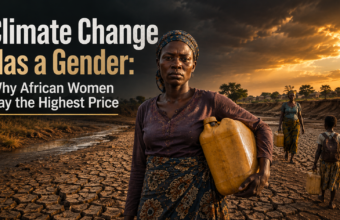
Climate Change Has a Gender: Why African Women and Girls Are Paying the Highest Price for a Crisis They Did Not Create
Gender | Climate Justice | Environmental Communication Introduction: The Crisis Within the Crisis There is a conversation happening across the world about climate change. It takes place in conference...

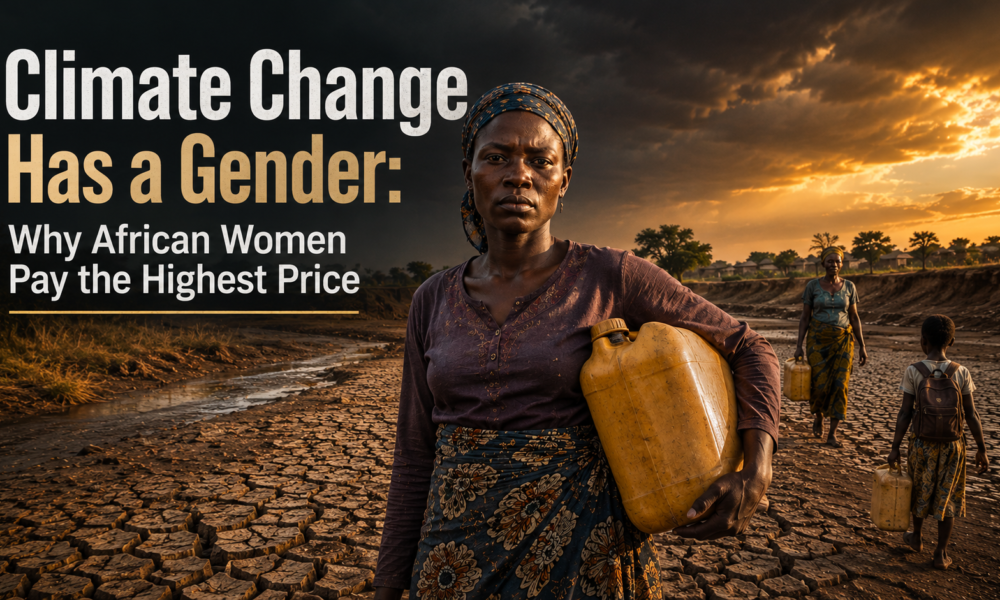
Gender | Climate Justice | Environmental Communication
Introduction: The Crisis Within the Crisis
There is a conversation happening across the world about climate change. It takes place in conference halls in Glasgow and Dubai, in policy papers circulated between ministries, in the carefully worded communiqués that emerge from international summits after days of negotiation. It uses the language of emissions targets, carbon budgets, adaptation finance, and loss and damage. It is, in the technical sense, a serious conversation.
And it is, in a very specific and consequential way, an incomplete one.
Because when you follow the data — when you trace the actual pathways through which climate change lands on human bodies, human livelihoods, and human futures — you arrive, again and again, at the same group of people. Women. Girls. The demographic that contributes least to the emissions driving the crisis, bears the heaviest share of its consequences, and remains the least represented in the rooms where responses are designed.
This is not a peripheral observation about climate change. It is a central one. And the fact that it continues to occupy the margins of mainstream climate discourse — appearing, when it appears at all, in footnotes, in supplementary gender chapters, in side events at conferences where the main stage belongs to someone else — is itself a communication failure of the first order.
This article is an attempt to bring it to the centre. To name, with the specificity the subject deserves, what climate change is doing to African women and girls — and to ask, with equal specificity, why the communication systems designed to protect them are failing so comprehensively to do so.
Water, Work, and the Expanding Burden
Begin with water, because water is where the climate crisis becomes most immediately physical for African women.
Between 46 and 90 per cent of adult women across 24 sub-Saharan African countries are the primary collectors of water for their households. This is not a marginal role. It is the foundational domestic labour on which entire households depend — the activity that must happen before anything else can happen, the task that structures the day before the day has properly begun. And it is a task that climate change is making progressively more gruelling, more time-consuming, and more dangerous.
As droughts intensify and water sources recede, the distances women must travel to collect water increase. Research conducted across rural communities in sub-Saharan Africa has documented women walking up to six hours per day to access water during drought periods — six hours that are taken directly from farming, from income generation, from caring for children, from rest, and from the kind of sustained mental and physical recovery that human beings require to function with dignity.
The implications compound. When women spend more time collecting water, they have less time to farm. When they farm less, household food production falls. When household food production falls, the family’s nutritional resilience to the next climate shock is already diminished before that shock arrives. The climate crisis does not arrive as a single catastrophic event for most African women. It arrives as an accumulating series of incremental deprivations, each one manageable in isolation and collectively devastating.
And there is a dimension of this burden that rarely appears in the water security literature: safety. The extended journeys that drought forces upon women and girls are not made in safety. They are made along routes that pass through areas where sexual violence is a documented risk — a risk that increases, research consistently shows, as displacement and resource competition intensify under climate pressure. The act of collecting water, already a significant labour burden, becomes an act of exposure in ways that the men who design water security policy have been insufficiently attentive to.
Food Insecurity and the Hierarchy of Hunger
Food security is the second major pathway through which climate change lands disproportionately on African women — and here the data is particularly unsparing.
Research on the relationship between climate shocks and household food security in sub-Saharan Africa has consistently found that food insecurity increases by between 5 and 20 percentage points following significant flood or drought events. These are large numbers — the kind of numbers that translate, in the lives of real families, into genuine hunger, into reduced meal frequency, into nutritional deficiencies that have long-term consequences for health and development.
But the aggregate food insecurity figure obscures a distribution that is anything but equal. Within households facing food stress, the evidence is consistent: women and girls eat last. This is not a biological inevitability. It is a social arrangement — a set of cultural norms about priority and entitlement that predate the climate crisis but are dramatically exacerbated by it. When there is enough food, the arrangement is invisible. When climate change reduces the food available, the arrangement becomes a mechanism of harm.
The health consequences for women are specific and severe. Women tend to suffer higher rates of chronic malnutrition during climate shocks, with heightened sensitivity to climate-induced food and nutrition insecurity that is particularly acute during pregnancy and breastfeeding. A woman who is nutritionally depleted during pregnancy carries a higher risk of complications, of low birth weight, of preterm delivery, of maternal mortality. The food security crisis and the maternal health crisis are not separate phenomena. They are the same phenomenon, expressing itself at different points in a woman’s life.
Education, Migration, and the Girls Who Were Pulled Out of School
In Ethiopia, during what was documented as the most severe drought the country had experienced in 40 years, a pattern emerged that has since been observed across multiple climate-affected contexts in sub-Saharan Africa. As household resources collapsed under the pressure of the drought, as water sources receded and crop yields fell and livestock died, families made the kinds of decisions that crisis forces upon people. Men and adolescent boys migrated to urban centres in search of income. And girls — daughters who had been attending school, who had been accumulating the education that changes the trajectory of a life — were pulled out of the classroom to take on the domestic and agricultural labour that the departing men had left behind.
This is a climate story. It is also an education story, a gender equality story, and a communication story — because the girls who lost their schooling during that drought were not part of any early warning communication that might have helped their families plan differently. They were not included in the community-level conversations about adaptation that might have identified their education as something worth protecting. They were the consequence of a crisis that the communication systems around them had failed to adequately prepare for, in communities where women and girls were already marginal to the conversations that determined how resources were allocated and how risks were managed.
The Ethiopian example is not exceptional. Research across drought and flood-affected communities in Nigeria, Kenya, Mozambique, and Chad has documented similar patterns — girls’ education functioning as a household coping mechanism, something that can be traded for immediate survival when the climate forces a choice. The invisibility of this pattern in mainstream climate discourse is telling. It suggests that the people designing climate communication campaigns are not asking the right questions of the right people — and that the communities most affected by this specific form of climate harm are not represented in the rooms where responses are planned.
Violence, Displacement, and the Numbers the World Should Know
Here is a figure that deserves to be in every climate communication briefing, every government adaptation plan, and every international climate finance discussion: every one degree rise in global temperature is associated with a 4.7 per cent increase in intimate partner violence.
Let that settle for a moment. Not a vague correlation. Not a suggested relationship. A documented, peer-reviewed, statistically significant association between the warming of the planet and the violence experienced by women in their own homes.
The mechanism is not mysterious. Extreme weather events — floods, droughts, heatwaves — produce economic stress, displacement, and the collapse of social structures and support networks that normally provide some degree of protection. Men under acute economic and psychological stress, in communities where masculine identity is tied to the capacity to provide and where institutional accountability mechanisms are weak or absent, direct that stress towards the women closest to them. Climate change does not create gender-based violence. It amplifies the conditions under which gender-based violence thrives.
The projections that follow from this documented relationship are sobering in the extreme. In sub-Saharan Africa, the United Nations Population Fund projects that intimate partner violence could nearly triple — from 48 million women affected in 2015 to 140 million by 2060 — if global temperatures continue rising at their current trajectory. One hundred and forty million women. In a single region. By 2060. This is not a distant hypothetical. It is a trajectory already in motion, already registering in the lives of women in communities across the continent.
Beyond intimate partner violence, climate displacement creates additional vectors of harm. Research on populations displaced by floods, droughts, and desertification has consistently documented elevated rates of sexual violence in displacement camps and informal settlements, increased rates of child marriage as families seek economic security through the marriage of daughters, and elevated rates of human trafficking and sexual exploitation in the chaos of humanitarian crisis. The sexual and reproductive health needs of adolescent girls are frequently neglected in humanitarian and climate crisis responses — rendering visible the gap between the scale of the problem and the seriousness with which it is addressed. ScienceDirect
Maternal Health at the Intersection
Nigeria has one of the highest maternal mortality rates in the world — 1,047 deaths per 100,000 live births, according to UNFPA’s 2023 State of World Population report. Nigeria is also, according to the INFORM Climate Change Risk Index, one of the 14 countries in the world most vulnerable to climate change.
This is not a coincidence. It is a relationship — one that the research is increasingly documenting with precision and that the policy community is still insufficiently acting upon.
Climate change affects maternal health through multiple pathways, both direct and indirect. Directly, extreme heat during pregnancy increases the risks of preterm birth, stillbirth, low birth weight, and maternal hypertension — conditions that are already elevated in contexts of nutritional stress and limited healthcare access. Indirectly, climate disasters disrupt access to maternal health services: roads become impassable, health facilities are damaged or overwhelmed, healthcare workers are displaced, and the supply chains that deliver essential medications and equipment are interrupted. A woman in active labour during a flood, in a community where the nearest functional health facility is now unreachable, faces a level of risk that has nothing to do with the quality of care available under normal conditions and everything to do with the climate event that has made normal conditions impossible.
In many of the countries most vulnerable to climate change, women and girls face the greatest risks of dying during pregnancy and childbirth, child marriage and adolescent birth rates are among the highest in the world, and women and girls experience extreme levels of gender-based violence. The clustering of these vulnerabilities in the same countries is not accidental. It reflects the intersection of pre-existing gender inequality and climate vulnerability — a combination that is more dangerous than either factor alone. United Nations Population Fund
The Communication Failure at the Heart of Everything
All of the above — the water burden, the food insecurity, the educational disruption, the violence, the maternal health crisis — is, in one sense, a story about the physical impacts of climate change on African women. But it is equally a story about communication failure. Because none of these harms are inevitable. Each of them can be mitigated — by early warning systems that reach women in time and in languages they understand, by adaptation plans that account for the specific vulnerabilities women face, by climate communication that treats women as active participants in the climate response rather than passive recipients of information designed by and for someone else.
The research on climate communication and gender in Africa is unambiguous on this point. Women — particularly in rural communities — consistently receive less climate information than men. They have lower access to the radio programmes, mobile phone networks, and formal community structures through which climate information is most commonly distributed. They are less likely to be included in community-level climate planning processes, less likely to be consulted by extension workers and development organisations, and less likely to be represented in the local governance structures that make decisions about how climate risks are managed and how adaptation resources are allocated.
This communication exclusion is not incidental to the other harms described in this article. It is structural to them. When women are excluded from climate information and climate decision-making, the adaptation strategies that emerge from those processes reflect the priorities and vulnerabilities of the people who were included — and fail to account for the specific, documented, severe vulnerabilities of the people who were not. The result is adaptation plans that invest in the things men need and overlook the things women need: water infrastructure that reduces collection distances, early warning systems that reach women in their homes and fields, healthcare facilities that can function during climate emergencies, and community safety mechanisms that reduce the risk of gender-based violence during displacement.
The communication gap and the adaptation gap are the same gap. Closing one requires closing the other.
What Genuine Inclusion Would Require
The argument that women need to be included in climate communication and climate planning is not new. It has been made, with increasing urgency, by gender and climate scholars for at least two decades. What is less commonly addressed — and what deserves direct attention — is what genuine inclusion actually requires, as distinct from the performative inclusion that tends to pass for progress in this area.
Genuine inclusion begins with the recognition that women in climate-affected communities in Africa are not merely passive victims of climate change. They are active observers of their environments, holders of indigenous knowledge about weather patterns and ecological change, and experienced managers of household and community responses to climate variability. The woman who knows that the river behaves differently in the weeks before a major flood — who has watched that river for twenty years and can read its signals in ways that no meteorological instrument captures — is a climate communicator. She is also, in virtually every existing climate communication framework, invisible.
Genuine inclusion requires early warning systems designed from the ground up around the realities of women’s lives — delivered in local languages, through trusted community channels, at times and in formats that account for the fact that many rural women have limited access to formal media and digital platforms. It requires adaptation planning processes that explicitly seek out and act upon women’s knowledge and women’s priorities, rather than treating gender as a box to be ticked in the methodology section. And it requires climate finance that flows to the community-level organisations and women-led initiatives that are doing the actual work of adaptation in the places where it is most needed.
More than 1.2 million of the people currently affected by drought in Somalia are women and girls of reproductive age. They are not waiting for the international community to finish its conversations about gender mainstreaming. They are managing a crisis, with the resources available to them, right now. The least the climate communication community can do is ensure that the information, resources, and recognition they need reach them — clearly, promptly, and in a form they can actually use.
Conclusion: Telling the Full Story
Climate change has a gender. This is not a metaphor or a rhetorical device. It is a documented empirical reality, supported by decades of research across multiple disciplines, registered in the bodies and lives of millions of women and girls across the African continent.
The failure to place this reality at the centre of climate communication — to tell it clearly, repeatedly, and with the specificity it deserves — is not merely a gap in coverage. It is an act of omission with material consequences. When climate communicators tell incomplete stories, they produce incomplete understanding. When they produce incomplete understanding, they enable incomplete responses. And when responses to climate change are incomplete, the people who pay the price are the people whose experiences were left out of the story in the first place.
The climate communication field in Africa — and globally — needs to make a deliberate, sustained, and adequately resourced commitment to gender-responsive communication: to producing and distributing climate content that reflects the specific realities of women and girls, that amplifies their voices and their knowledge, and that treats their safety, health, and dignity as non-negotiable priorities rather than supplementary considerations.
Because until the climate story includes everyone it affects, it is not the climate story. It is a partial account of a crisis — and partial accounts, in a crisis of this magnitude, are a luxury none of us can afford.
The author writes on climate communication, gender, and environmental justice in Africa. This article is part of the Planet and Pages series on climate justice and African voices.

No Comment! Be the first one.