



Using Pop Culture to Teach Climate Literacy: What Afrobeats, Nollywood, and Memes Already Know
Let me ask you something. Do you remember the first time you heard Fela Kuti’s “Water No Get Enemy”? Or watched a Nollywood film where the rains came too hard, too late, or not...

Let me ask you something.
Table Of Content
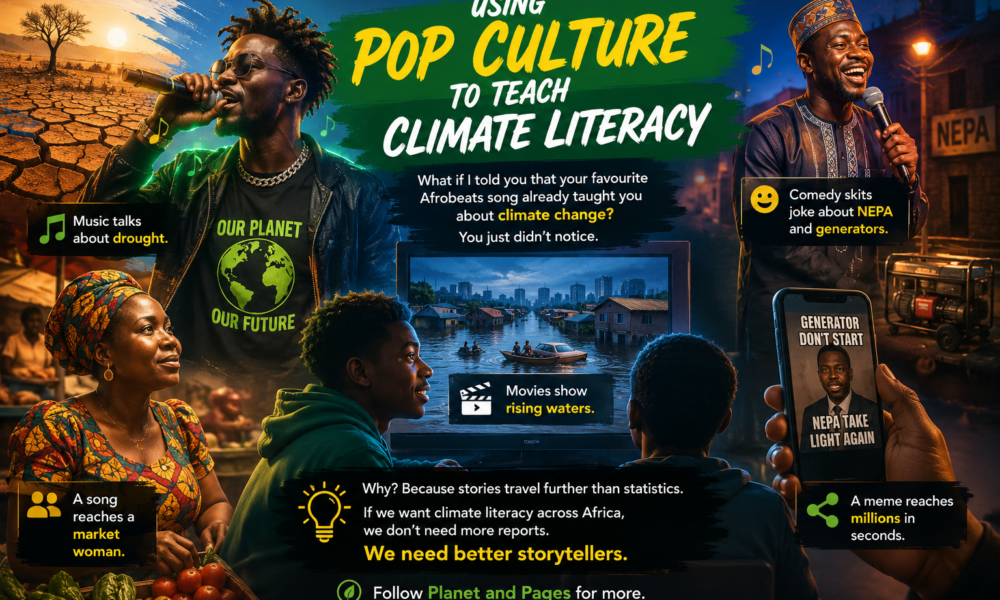
Do you remember the first time you heard Fela Kuti’s “Water No Get Enemy”? Or watched a Nollywood film where the rains came too hard, too late, or not at all? Or laughed at a Twitter meme about NEPA cutting light in the middle of harmattan, the generator refusing to start, and the entire neighbourhood swallowed in fumes?
You probably filed those moments under entertainment.
But here is what I want you to consider: you were also receiving a climate education. You just weren’t told that was what it was.
The Report Nobody Reads
Every year, scientists, researchers, and international organisations produce thousands of pages of climate literature. Detailed. Rigorous. Peer-reviewed. Urgent. And largely unread by the people whose lives depend most on what those pages contain.
This is not an indictment of the researchers. The science is necessary. The data is critical. But somewhere between the journal abstract and the woman selling tomatoes in Onitsha market, something gets lost. The language becomes too technical. The framing too distant. The recommendations too abstract for someone whose immediate concern is whether the borehole behind her house will last through the dry season.
We have a communication crisis dressed up as a knowledge crisis.
And until we address the communication side honestly, no amount of additional research will close the gap.
What Pop Culture Has Always Known
Here is the thing about culture: it does not wait for permission.
Long before climate change entered the vocabulary of Nigerian policy discourse, our musicians were already singing about it. Farmers in Yoruba folk songs described seasons that had shifted beyond recognition. Highlife lyrics from the 1970s mourned rivers that had grown shallow. Contemporary Afrobeats artists reference heat, drought, displacement, and environmental loss — sometimes directly, more often obliquely — woven into metaphors about love, survival, and longing.
Nollywood, Africa’s most prolific film industry, has for decades set its stories against backdrops of flooding, food scarcity, community conflict over land and water, and the slow unravelling of ecosystems that once held villages together. These are not incidental details. They are the lived environment rendered on screen, recognised immediately by audiences who see their own realities reflected back at them.
Comedy, too, has carried this weight. The generator skit is practically its own genre in Nigerian social media. The joke about NEPA — the chronic, almost mythological unreliability of public electricity — is so embedded in our cultural vocabulary that most Nigerians do not consciously connect it to energy poverty, fossil fuel dependency, or its contribution to urban air pollution. But the connection is there. Every single time.
Pop culture has been doing climate communication for decades. We simply have not been paying attention.
Why Stories Travel Further Than Statistics
There is a reason the parable outlasted the policy brief throughout human history.
Stories are how human beings make sense of the world. Not spreadsheets. Not projections. Not percentage points on a graph. Stories. Specifically, stories with characters we recognise, situations we have lived, and emotions we cannot easily dismiss.
When a climate scientist tells you that average temperatures in sub-Saharan Africa are projected to rise by two degrees Celsius above the global average by mid-century, your brain receives that as information. When a grandmother in a Nollywood film sits on her porch and tells her grandchild that the mango trees used to fruit twice a year, and now they struggle to fruit once — your brain receives that as truth. Felt truth. The kind that stays.
This is not anti-intellectual. It is neuroscience. Human beings are wired for narrative. Emotion is not the enemy of understanding; it is frequently the doorway to it.
A song reaches a market woman who has never sat in a lecture hall. A short film reaches a teenager who skips the news and consumes content exclusively on a six-inch screen. A well-crafted meme reaches millions within hours, crossing language barriers, age gaps, and educational divides that formal climate communication has never successfully bridged.
The medium is not just the message. The medium is the access point.
The Storyteller’s Responsibility
None of this means we abandon rigour. Quite the opposite.
The most powerful climate storytelling is the kind rooted in evidence, shaped by community, and delivered with cultural intelligence. It is the kind that a researcher and a filmmaker make together. That a climate scientist and a musician develop in conversation. That a data analyst and a comedian translate into something that makes you laugh, and then think, and then act.
What we need are not fewer scientists. We need more translators.
We need communicators who understand the science deeply enough to carry it accurately, and who understand their audiences deeply enough to make it land. In Nigeria alone, we have the raw material: one of the world’s most creative film industries, a music ecosystem that reaches every corner of the continent and beyond, a social media culture that is inventive, irreverent, and extraordinarily fast.
The infrastructure for mass climate literacy already exists. We simply have not deployed it with intention.
What This Looks Like in Practice
Imagine a collaboration between climate researchers at a Nigerian university and the writers’ room of a popular Nollywood series — building accurate, culturally grounded climate storylines into prime-time drama watched by millions.
Imagine an Afrobeats artist releasing a track about the shrinking of Lake Chad, with liner notes that connect the lyrics to documented environmental data, and a QR code that leads to a community resource.
Imagine a WhatsApp sticker pack — the kind that spreads virally across Nigerian family groups — built around climate facts made funny, relatable, and impossible to ignore.
These are not fantasies. Some version of each already exists, somewhere. What is missing is scale, coordination, and the deliberate institutional will to treat storytelling as a legitimate climate intervention rather than a soft add-on to the real work.
A Different Kind of Literacy
Climate literacy, as it is traditionally defined, is about understanding the science: what is changing, why it is changing, and what the consequences are.
But there is a deeper literacy that matters just as much — the ability to see your own life, your own culture, your own community within the climate story. To recognise that this is not something happening to distant polar bears or unnamed Pacific islanders. It is happening here. In the dry wells. In the failed harvests. In the flooding that comes earlier every year to streets that were never designed to drain.
Pop culture is already telling that story. It has been for a long time.
Our task now is to tell it better. More deliberately. With greater accuracy, greater creativity, and a genuine belief that the people we are trying to reach deserve both the truth and the dignity of receiving it in a form they can actually use.
We do not need more reports.
We need better storytellers.
And Africa, of all places, has never been short of those.
Dr Moshood Ajibola is an environmental communicator and scholar specialising in climate narratives, power, and Africa-centred environmental discourse. Follow his work on Planet and Pages across YouTube, Instagram, TikTok, X and Facebook.

No Comment! Be the first one.