



The Lagos Wetland Communities Already Doing What the World Says Cannot Be Done
Let me tell you something that my PhD research taught me — something that has stayed with me long after the thesis was submitted, the viva was passed, and the certificate was framed. The people the...

Let me tell you something that my PhD research taught me — something that has stayed with me long after the thesis was submitted, the viva was passed, and the certificate was framed.
Table Of Content
The people the world is most worried about, are already doing the work.
I do not mean this in the abstract, feel-good way that development reports sometimes gesture toward when they want to seem community-centred without actually being so. I mean it in the concrete, documented, empirically grounded sense. The residents of Lagos wetland communities — the men and women who build their lives on water’s edge, in the neighbourhoods that flood first and recover last, in the communities that rarely appear in climate policy documents except as populations to be managed — are already adapting to climate change.
Quietly. Practically. Without waiting for permission.
And almost nobody is paying attention.
The Question Nobody Was Asking
When I began my PhD research at the University of Ibadan, I entered the Lagos wetlands with a set of research questions that, in hindsight, were shaped by the same assumptions that shape most academic work in this area. I wanted to know what wetland residents knew about climate change, where they got their information from, and how they thought about the causes and consequences of environmental change.
These were useful questions. And answering them produced findings that I have shared in earlier parts of this series.
But somewhere in the process of sitting with communities, conducting interviews, facilitating focus group discussions, and spending time in the kind of unhurried, attentive fieldwork that academic timelines rarely allow enough of, I began to feel the inadequacy of those questions.
Because knowing things and doing things are not the same.
And the question that began to press itself forward — the one that felt increasingly urgent the deeper I went into the fieldwork — was this: what are these communities actually doing with what they know?
It is a question that most climate research stops short of asking. The field is extraordinarily well developed on the measurement of awareness, on the assessment of knowledge levels, on the documentation of risk perception and information behaviour. But the translation question — the bridge between knowing and doing — receives far less systematic attention, particularly in African urban contexts.
So I asked it. And what I found became, in my own assessment, the most important and most moving finding of the entire PhD.
What I Found: Four Forms of Quiet Action
The residents of Lagos wetland communities are utilising climate change information in four distinct and meaningful ways. Let me walk through each of them — not as abstract categories, but as the living, breathing activities they actually are.
The first is the adjustment of farming activities.
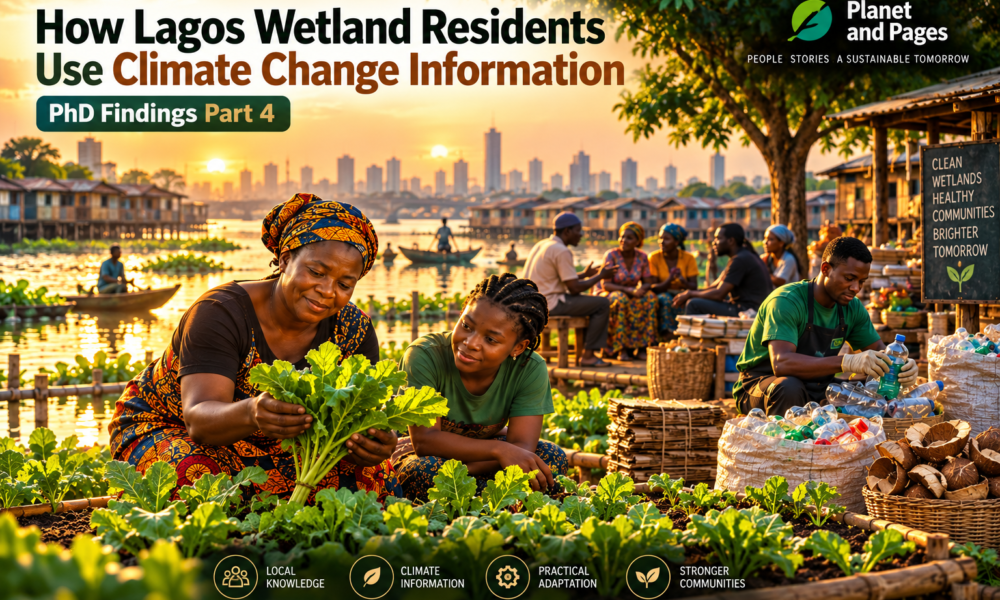
Farmers in these wetland communities are changing their planting and harvesting schedules in response to the environmental signals they observe around them. They are noticing shifts in rainfall patterns — rains that arrive later than they once did, dry seasons that extend further into periods that used to be reliably wet, temperatures that sit differently on the body than they did a generation ago. And they are responding by shifting their agricultural calendar accordingly.
This is not guesswork. It is sophisticated, real-time environmental reading, developed over years of close observation and refined through the kind of intergenerational knowledge transfer that no formal agricultural extension programme has yet managed to replicate. When a farmer tells you that she now plants her tomatoes two weeks later than her mother did, and explains why in terms of changing rainfall and soil moisture patterns, she is describing an adaptive strategy that is, by any reasonable definition, climate-responsive behaviour. The fact that it did not emerge from a government programme or an NGO intervention does not make it less significant. If anything, it makes it more so.
The second is the careful preservation of farm produce.
This finding connects directly to the first. As seasons become less predictable and the risk of crop loss from erratic weather events increases, wetland farmers are paying closer attention to the preservation of what they harvest. They are employing traditional and locally developed methods of extending the shelf life of produce — methods that buffer against the economic shock of a failed season or a flood that arrives at the wrong moment.
What struck me most about this finding was not the behaviour itself, but the understanding that underpins it. These farmers know, from lived experience across years and decades, what an erratic season costs a family. They have absorbed that knowledge through loss, through watching neighbours struggle, through calculating the gap between what a good harvest year provides and what a bad one leaves behind. And they are acting on that knowledge — not because a communication campaign told them to, but because the environment itself has been teaching them, in the most direct and unmediated way imaginable.
The third is the recycling and repackaging of waste materials.
Some wetland residents are going further still. They are collecting and processing waste materials — plastics, papers, coconut shells — and repackaging them for sale, creating small but meaningful income streams from what would otherwise be environmental liabilities.
This finding deserves particular attention because it represents something that climate communication theorists and practitioners frequently aspire to but rarely achieve: the conversion of environmental awareness into economic behaviour. These residents have made the connection between waste management, environmental health, and personal livelihood. They have translated that connection into practical activity. And they have done so in a context where they receive little formal support, no carbon credits, no recycling infrastructure, and no recognition from the institutional frameworks that are nominally responsible for their environmental wellbeing.
The coconut shells stayed with me. There is something about that specific detail — the transformation of a natural byproduct of everyday life into a commercial material through awareness and ingenuity — that captures the essence of what this finding means. This is not resilience as a metaphor. It is resilience as a livelihood strategy.
The fourth is peer-to-peer education and awareness creation.
Perhaps the most powerful finding of all is the simplest. Community members are teaching each other.
Without government programmes. Without NGO facilitation. Without formal curricula or trained educators or communication budgets. Neighbours are sharing what they know about the causes of climate change, about the importance of avoiding behaviours that generate greenhouse gas emissions, about agricultural practices that can help mitigate the environmental changes they are living through. They are doing this in the spaces where community life happens — at water points, in markets, under shade trees, in the corridors between houses.
The emergence of regenerative agricultural knowledge within these informal educational networks was particularly striking. The idea that farming practices can be designed to work with the environment rather than against it — to restore rather than deplete — has entered the discourse of Lagos wetland communities not through academic papers or policy documents, but through the slow, horizontal spread of practical experience and observed outcomes.
This is, at its most fundamental, how human communities have always learned to survive. It is how environmental knowledge has always moved. And it is, in my view, one of the most important and most overlooked channels of climate communication available to researchers, practitioners, and policymakers working in African urban contexts.
What This Means — And Why It Matters
Let me be clear about what I am not saying.
I am not saying that community-level adaptation is sufficient. The structural challenges facing Lagos wetland communities — inadequate drainage infrastructure, absent early warning systems, unresponsive governance, economic precarity, and the accelerating intensity of climate impacts driven by emissions they did not produce — are real and serious. Individual and community adaptation cannot substitute for the systemic interventions that these communities urgently need and that are not arriving.
I am also not romanticising poverty or reframing the consequences of institutional neglect as admirable resourcefulness. The adaptive behaviours documented in this research are not evidence that everything is fine. They are evidence that people find ways to survive even when the systems that are supposed to support them have failed — and that finding this evidence should provoke urgency, not complacency.
What I am saying is something specific, and I think it matters enormously for how we approach climate communication and climate policy in African contexts.
These communities are not ignorant. They are not passive. They are not waiting to be saved. They are already doing the intellectual and practical work of climate adaptation, with the resources available to them, in conditions that are frequently difficult and sometimes dangerous. And the knowledge they are deploying in that work — knowledge that is experiential, intergenerational, locally calibrated, and continuously updated — is knowledge that formal climate communication systems have largely failed to recognise, engage with, or build upon.
This is a failure of listening. And it has costs.
When climate communication positions communities as recipients of information rather than holders of it, it misses the most valuable resource available: the adaptive intelligence that already exists within the communities it is trying to reach. When policy frameworks treat informal settlements as problems to be managed rather than knowledge systems to be engaged, they waste both the intelligence of the communities and the opportunity to build communication strategies on the foundation of trust and cultural familiarity that already exists within them.
The people least represented in climate policy are often the ones doing the most sophisticated climate thinking.
A Different Story About African Communities
There is a narrative about African communities and climate change that appears with depressing regularity in international discourse. It positions African people — and particularly poor, urban, informal-settlement-dwelling African people — as vulnerable populations: passive, underprepared, awaiting rescue from better-resourced actors elsewhere.
This narrative is not only inaccurate. It is actively harmful. It shapes the design of communication strategies that talk at communities rather than with them. It shapes policy frameworks that plan for communities rather than with them. It shapes research agendas that study communities as objects rather than engaging them as partners.
What my PhD research found in the wetlands of Lagos is a direct challenge to that narrative. Not a denial of the genuine vulnerability that these communities face — that vulnerability is real, and it is the product of real structural failures that need real structural responses. But a demonstration that vulnerability and agency coexist. That the communities facing the sharpest edge of the climate crisis are also, in many cases, the communities developing the most immediate and sophisticated responses to it.
The solutions Africa needs are often already being lived by the people the world overlooks.
That is not a slogan. It is a research finding.
And it is one that should reshape how we listen, how we communicate, how we design policy, and how we tell the story of climate change in Africa — if we are serious about getting any of it right.
What Comes Next
This is Part 4 of my PhD findings series. In the next instalment, I will explore the role of opinion leaders — pastors, politicians, community heads — in shaping what wetland residents believe about climate change and how they respond to it. As you might imagine, the findings there are equally illuminating, and equally challenging.
In the meantime, I want to leave you with an invitation.
The next time you encounter a story about African communities and climate change that positions those communities primarily as victims — however well-intentioned the story — ask the question that my PhD taught me to ask.
What are these people already doing?
The answer, more often than you might expect, will change the story entirely.
Dr Moshood Olawale Ajibola is an environmental communicator and scholar specialising in climate narratives, power, and Africa-centred environmental discourse. His PhD research examined climate change knowledge, information sources, and utilisation among wetland communities in Lagos State, Nigeria. Follow his work on Planet and Pages across YouTube, Instagram, TikTok, Facebook, and X.

No Comment! Be the first one.