



Climate Communication for People Who Hate Science: Why Feeling It Is Where Change Begins
Raise your hand if climate change bores you. Go on. No judgment here. Because if your hand went up — even slightly, even guiltily — I want you to know something that most climate scientists will not...

Raise your hand if climate change bores you.
Table Of Content
Go on. No judgment here.
Because if your hand went up — even slightly, even guiltily — I want you to know something that most climate scientists will not tell you: the problem is not you. The problem, in large part, is how climate change has been communicated. And as someone who has spent years studying environmental communication, researching how African communities receive and use climate information, and watching the gap between scientific knowledge and public action grow wider with each passing year, I feel a responsibility to say that clearly.
We have a communication crisis. And it is costing us time we do not have.
The Graph Nobody Felt
Let me ask you something honest.
When did you last sit through a climate presentation — a graph, a projection, a table of carbon statistics — and genuinely feel something? Not intellectually acknowledge something. Not nod politely at a pie chart. But feel it, in the way you feel a story about someone you recognise, in a place you know, facing something you understand?
For most people, the answer is never.
And yet we keep producing the graphs. We keep publishing the reports. We keep convening the summits, issuing the communiqués, and then expressing surprise — or worse, contempt — when the general public remains unmoved.
This is the central paradox of climate communication: we have more data than at any point in human history, and yet the emotional and behavioural response to that data remains stubbornly, dangerously inadequate. Not because people are foolish. Not because they do not care about their futures or their children’s futures. But because the dominant mode of climate communication speaks a language that most human beings were never designed to respond to.
Numbers do not move people. Stories do.
What You Already Know
Here is what my research in Lagos wetland communities taught me, and what I suspect is true of communities across Africa and beyond.
People already know.
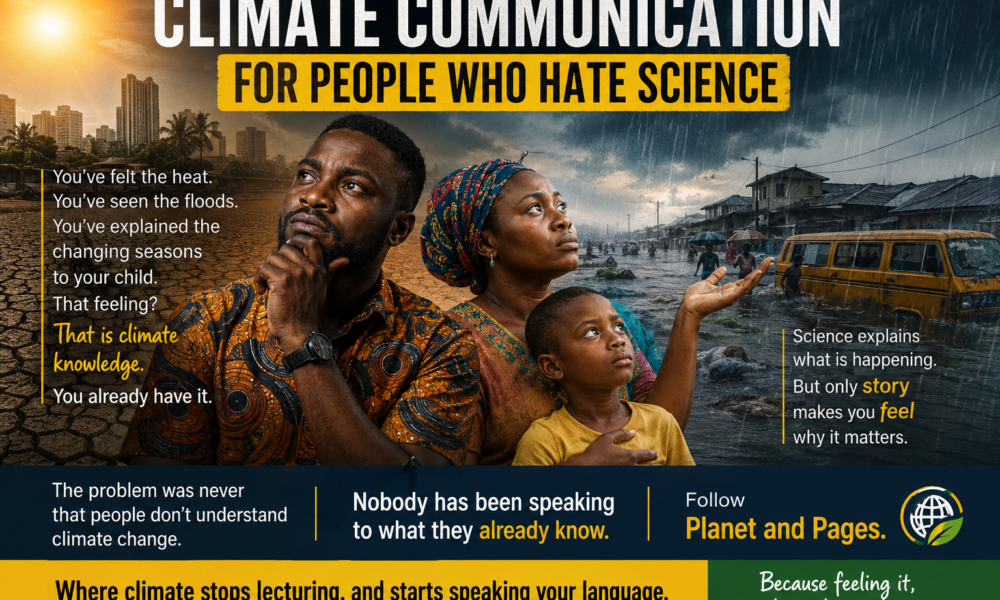
Not in the language of parts per million or radiative forcing. Not in the vocabulary of IPCC reports or NDCs or loss-and-damage frameworks. But in the language of lived experience, which is arguably the oldest and most reliable form of knowledge that exists.
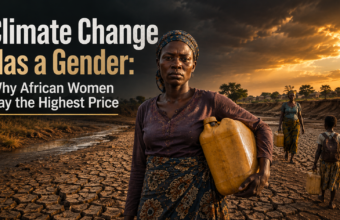
They have felt the heat that did not used to be this bad. The kind of dry season heat that sits in the body differently now, heavier and more insistent, arriving earlier and leaving later than the generation before them remembers.
They have watched neighbourhoods flood — their own streets, their own markets, their own children’s schools — and wondered, with a frustration that hardens over time into resignation, why nothing ever changes. Why the drains are never fixed. Why the warnings are never acted upon. Why the water comes back, every year, as if governance itself has given up.
They have tried to explain to their children why the harmattan is lasting longer than it used to. Why the mango trees fruit at the wrong time. Why the rains that grandparents described with such certainty and rhythm now arrive unpredictably, too much at once or not at all.
That accumulated experience — that felt, embodied, generational knowledge — is climate knowledge. It is not anecdote. It is not ignorance dressed up in local colour. It is data, gathered over decades, stored not in journals but in bodies and memories and conversations around evening fires and kitchen tables.
The problem was never that people do not understand climate change.
The problem is that nobody has been speaking to what they already know.
The Communication Gap Nobody Wants to Name
There is a particular kind of institutional arrogance embedded in the way climate change has traditionally been communicated, and I say this as someone who deeply respects the science and the scientists behind it.
The assumption, rarely stated but consistently enacted, is that the public’s failure to act on climate change is a deficit of knowledge. That if we can only get more information to more people in more formats, the behaviour change will follow. This is sometimes called the information deficit model, and it has been comprehensively dismantled by communication researchers for decades.
People do not fail to act on climate change because they lack information.
They fail to act because the information they receive does not connect to their identity, their values, their daily concerns, or their sense of what is possible. Because the stories they are told place them as passive recipients of a crisis they did not cause and cannot individually solve, rather than as knowledgeable agents with genuine capacity to contribute. Because the communication, however well-intentioned, consistently positions African and other Global South communities as problems to be managed rather than partners to be engaged.
This is not simply a stylistic failure. It is a strategic one. And it has consequences.
Story as Climate Infrastructure
I want to make an argument that may seem unconventional coming from an academic.
Storytelling is not a soft supplement to serious climate communication. It is infrastructure. It is the load-bearing wall without which everything else collapses.
Human beings are, at the most fundamental neurological level, narrative creatures. We process the world through story. We make moral decisions through story. We remember, persuade, grieve, celebrate, and mobilise through story. The scientific method is extraordinary at generating knowledge. But it was never designed to move hearts, and moving hearts is precisely what the climate crisis demands of us right now.
A graph tells you that average temperatures in sub-Saharan Africa are projected to rise faster than the global average. A story tells you about the cassava farmer in Ogun State who has watched his planting calendar shift by three weeks over fifteen years, who now plants by guesswork where his father planted by certainty, who feeds his family on yields that diminish incrementally each season and calls it the will of God because nobody has ever offered him another explanation.
Which one stays with you?
Which one makes you feel the urgency?
Which one, if it appeared on your timeline tonight, would you share?
What African Climate Communication Must Do Differently
The implications of all this for African climate communicators — and I count myself among them — are both challenging and energising.
We must stop waiting for permission to tell our own stories. The dominant climate narrative has been shaped overwhelmingly by institutions and voices from the Global North, reflecting their priorities, their aesthetics, and their assumptions about what constitutes credible knowledge. African communicators have both the right and the responsibility to reframe that narrative, not by rejecting the science, but by rooting it in the lived realities and knowledge systems of African communities.
We must speak in the languages people actually use. Not only in terms of literal language, though that matters enormously in a continent of extraordinary linguistic diversity, but in terms of cultural register, reference points, and forms of expression. Climate change communicated through Afrobeats, through Nollywood, through community radio, through the language of market women and farmers and mechanics and teachers, will reach places that no IPCC report ever will.
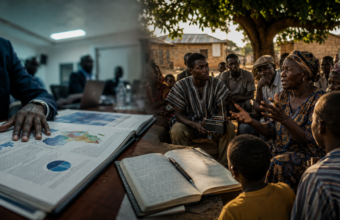
We must position community members as knowledge holders, not merely as recipients of expert information. When my research revealed that Lagos wetland residents already held sophisticated understanding of both the human-driven and natural dimensions of climate change, it confirmed something I had long suspected: the gap is not between the informed and the uninformed. It is between the heard and the unheard.
And perhaps most importantly, we must tell stories that leave room for agency. The most paralysing climate narratives are those that present the crisis as total, the solutions as impossibly distant, and the individual as irrelevant. The most powerful ones show ordinary people making consequential choices, communities organising around shared knowledge, and change emerging not from the top down but from the ground up.
A Final Word to the Person Who Raised Their Hand
If you raised your hand at the beginning of this piece — if climate change has ever bored you, overwhelmed you, or simply felt like someone else’s problem — I want to leave you with this.
You are not the failure of climate communication. You are its evidence.
The boredom you feel is a rational response to being spoken at rather than spoken to. The distance you feel is the predictable result of a narrative that has consistently left people like you out of the story. And the moment you felt something reading about the farmer, or the flooded neighbourhood, or the child asking why the harmattan is lasting longer — that was the moment climate communication finally did its job.
Science explains what is happening.
But only story makes you feel why it matters.
And feeling it, I remain convinced, is where change begins.

No Comment! Be the first one.