



When Awareness Is Not Enough: What Our New Research Reveals About Climate Communication in Lagos
I want to share something with you today that I believe matters — not just to academics and researchers, but to every person who has ever wondered why Lagos keeps flooding, why the warnings keep...

I want to share something with you today that I believe matters — not just to academics and researchers, but to every person who has ever wondered why Lagos keeps flooding, why the warnings keep coming, and why so little seems to change.
Table Of Content
My colleagues and I have just published a new paper. And the findings, if taken seriously, have the potential to reshape how we think about climate communication across Nigeria and the wider Global South.
But before I get into the details, let me start where most important conversations should start — with a question.
Have you ever known something was dangerous, and still done nothing about it?
If you have — and most of us have, at some point — then you already understand the central challenge this paper explores.
The Paper and What Prompted It
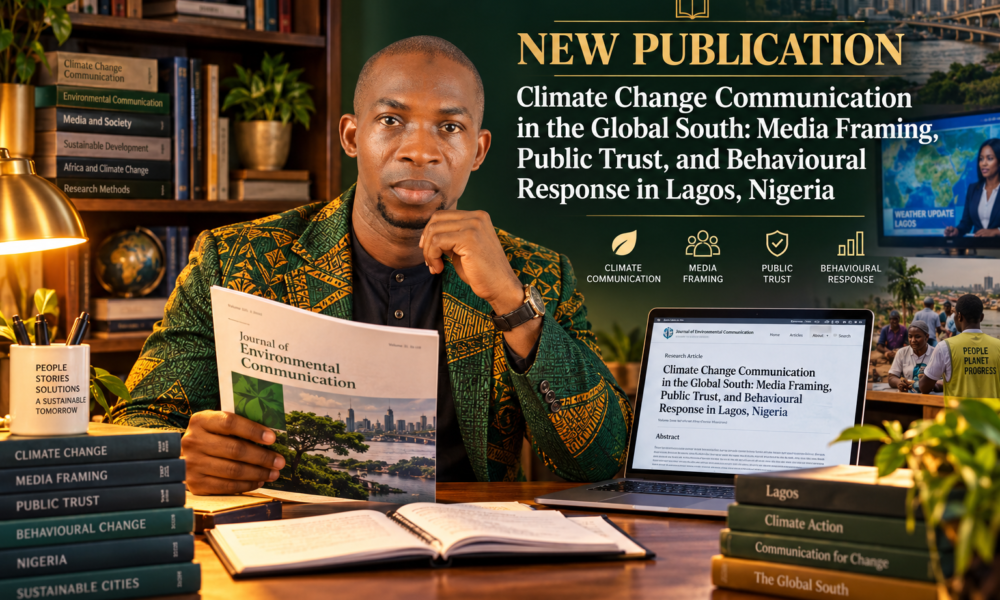
The study is titled Climate Change Communication in the Global South: Media Framing, Public Trust, and Behavioural Response in Lagos, Nigeria. It was published on the 12th of September 2026, in the International Journal of Research and Innovation in Social Science (IJRISS), and was co-authored by myself, Professor Olusola Oyeyinka Oyewo, and Dr Noeem Taiwo Thanny, both of Lagos State University, Ojo.
The question that drove the research was deceptively simple: does the way Nigerian media frames climate change actually influence what people believe, who they trust, and whether they act?
It sounds like a straightforward question. But the more we dug into it, the more layers we uncovered. And what we found tells a story that goes far beyond Lagos — a story about the structural failings of climate communication in rapidly urbanising cities across the developing world, and about what needs to change if communication is ever going to translate into the kind of sustained behavioural response that the climate crisis urgently demands.
What We Did
The study combined two research methods, which we treated not as separate exercises but as complementary lenses on the same question.
The first was a quantitative content analysis of climate-related reporting published between January 2019 and December 2022 in three of Nigeria’s most widely read national newspapers — The Guardian, Punch, and Vanguard. We selected these publications deliberately: they command significant national reach, carry real agenda-setting influence, serve a substantial Lagos-based readership, and maintain accessible online archives that allowed for rigorous, replicable analysis. Using a keyword-driven retrieval strategy, we identified and coded 383 climate-related articles — a sample size that exceeds conventional thresholds for this type of research and enabled meaningful comparisons across different newspapers and different climatic cycles.
The second component was a cross-sectional survey of 420 Lagos residents, designed to measure their awareness of climate change, their risk perception, their trust in various information sources, and their reported behavioural responses to climate change communication. Respondents were drawn from across Lagos State using a multi-stage sampling strategy that ensured geographic spread, reaching residents across different local government areas, household types, and neighbourhood profiles.
Together, the two methods gave us something that most previous studies in this space have not attempted — a direct comparison between how climate change is being told in the media and how it is being received, understood, trusted, and acted upon by the people the media is supposed to be reaching.
What the Newspapers Are Doing — and What They Are Not
The content analysis produced findings that were striking, if not entirely surprising to anyone who pays close attention to environmental journalism in Nigeria.
Of the 383 articles coded, more than a third — 37.7 percent — fell into the disaster or flooding frame category. These were articles that reported climate change primarily through the lens of catastrophic events: floods, storms, extreme heat episodes, and the immediate human suffering that follows. Scientific and expert framing accounted for 24 percent, with most of these articles anchoring the climate story in IPCC reports, international summits, and the language of global technical discourse. Government policy frames made up almost 20 percent, covering official announcements, policy commitments, and international declarations.
What was almost entirely absent was solution-oriented content. Stories that focused on adaptation strategies, citizen agency, community-led initiatives, or local mitigation efforts together accounted for just 7.6 percent of the entire sample. Human-interest frames — the kind of storytelling that puts ordinary people at the centre of the climate narrative — barely reached 10 percent.
The implications of this pattern are significant. When climate change is framed almost exclusively as disaster and catastrophe, it positions the crisis as something that happens to people, not something that people can influence or respond to. It creates what communication scholars sometimes call fatalism — a sense that the situation is beyond the reach of ordinary action. And when disaster frames are sustained over years, as our data shows they have been in Lagos, they risk producing not urgency but exhaustion. Not mobilisation but inertia.
Different newspapers showed distinct editorial patterns worth noting. The Guardian demonstrated a clear preference for scientific and expert-driven framing, reflecting its reputation as a paper of record oriented toward policy and intellectual discourse. Punch, with its populist editorial sensibility, leaned heavily on disaster and flooding narratives — particularly during the rainy seasons of 2019, 2020, and 2021, when flooding events generated reactive, event-driven coverage that rarely followed through into sustained, solutions-oriented reporting. Vanguard showed lower overall volume, but a marginally higher proportion of solution-oriented content — though even this was sporadic rather than systematic.
What the three newspapers share is this: a reactive rather than proactive relationship with the climate story. Coverage follows events. It does not anticipate them, contextualise them within a longer narrative of environmental change, or equip readers with the knowledge and confidence to respond.
What Lagos Residents Know — and What They Do With It
The survey findings added a layer of complexity that the content analysis alone could not have captured.
Awareness of climate change among Lagos residents was, by most measures, relatively high. Sixty-two percent of respondents demonstrated high-level awareness, citing flooding, extreme heat, waste accumulation, and erratic rainfall as evidence of climate change. Another 26 percent showed moderate awareness. Only 12 percent reported limited awareness, most of whom confused climate change with seasonal weather variation or general environmental pollution.
On one level, these figures are encouraging. The idea that climate change is a distant, abstract concern that has not penetrated public consciousness in Lagos is simply not supported by the evidence. Lagos residents know something is happening. Many of them know why. And virtually all of them have felt it in some form — in their bodies, their homes, their livelihoods, and their streets.
But here is the problem. Knowledge was not translating into action.
When we asked residents about their climate-related behaviours, the picture became considerably less encouraging. Waste reduction and informal recycling were the most commonly reported behaviours, practiced by 38 percent of respondents. Energy conservation followed at 31 percent. Flood preparedness measures — such as clearing drainage channels or elevating household structures — were reported by just 22 percent. And community climate action, including participation in clean-ups, advocacy, or collective adaptation efforts, reached only 17 percent.
The gap between what people know and what people do is one of the most persistent puzzles in behaviour change research. And this study offers an important part of the explanation.
Trust: The Variable Nobody Is Talking About
The most significant finding of this study — and the one with the most profound implications for climate communication practice — is the role of trust.
Trust in information sources emerged as a critical moderating variable in the relationship between media exposure and behavioural response. To put it plainly: it was not enough for residents to be exposed to climate information. What determined whether that exposure led to behavioural change was whether they trusted the source delivering it.
The trust data itself revealed a telling hierarchy. Television and newspapers enjoyed relatively high trust — 48 and 52 percent high-trust ratings respectively — attributed primarily to professional journalistic standards and editorial oversight. Radio followed at 44 percent. Government statements, by contrast, were trusted highly by only 27 percent of respondents, with 42 percent expressing low trust — a figure that speaks to years of policy announcements that were never followed through. Social media showed the lowest trust of all, with 40 percent of respondents expressing low trust, citing sensationalism, misinformation, and conflicting narratives as their primary reasons.
The regression analysis we conducted went further, demonstrating statistically that trust does not merely correlate with behavioural change — it moderates the relationship between media exposure and behaviour. Residents who consumed climate content through sources they trusted were significantly more likely to report climate-responsive behaviours than those who consumed the same or greater volume of content through sources they distrusted. The implication is direct and uncomfortable: if people do not trust the channel, the message does not land. And in a media environment characterised by institutional distrust, misinformation, and political perceived bias, the default assumption among many Lagos residents is scepticism.
Information that people do not trust is, for all practical purposes, information that changes nothing.
What This Means for Climate Communication in Lagos and Beyond
The recommendations that flow from these findings are, in our view, both practical and urgent.
The first is a fundamental shift in framing. Nigerian media — and climate communicators more broadly — must move away from the chronic over-reliance on disaster and catastrophe frames. Not because these frames are false, but because sustained disaster framing reinforces passivity rather than agency. The climate story needs to be told through the lens of solutions, adaptation, and community action. It needs to show Lagos residents not only what is happening to their city, but what people like them are doing about it, and what they too can do.
The second recommendation is to route climate communication through trusted voices. Our data is clear: trust follows relationship, consistency, and cultural familiarity. Community radio, broadcasting in Yoruba or Pidgin English, reaches the residents of informal settlements in ways that broadsheet newspapers never will. Religious leaders — pastors, imams, community elders — command the kind of trust that government agencies and international organisations have long since forfeited. Climate communication that works in Lagos must go where the trust already lives.
The third recommendation is to communicate in the language of the people. English-language climate content, however well crafted, exercises limited reach in communities where Yoruba, Pidgin English, or other local languages are the primary medium of daily life and social connection. The BBC Yoruba and Pidgin services demonstrate what is possible when this principle is applied with commitment and creativity. It needs to become a standard, not an exception.
And the fourth recommendation is perhaps the most structural. Community engagement cannot continue to be treated as a supplementary activity, bolted onto the end of communication campaigns as an afterthought. Structured community dialogues — spaces where residents share their own climate knowledge, experiences, and local adaptation strategies — are not just good for trust. They are good for the quality of the climate narrative itself, because the knowledge that already exists in Lagos communities is, as our wider research has consistently shown, deeper and more sophisticated than most formal communication strategies have given it credit for.
A Word on What This Research Represents
This paper is, in one sense, a contribution to an academic conversation about communication theory — about framing, agenda-setting, and the moderating role of trust in media effects research. We believe it advances that conversation in meaningful ways, particularly by grounding it in the Lagos context and demonstrating that salient media coverage alone is insufficient to achieve climate mobilisation in Global South megacities.
But it is also something more personal than that. It is the product of years of work rooted in the conviction that research about African cities, conducted by African scholars, with African communities as partners rather than subjects, has a distinctive and necessary contribution to make to global climate knowledge.
Lagos is not a case study in failure. It is a megacity of extraordinary resilience, creativity, and human resource, facing climate challenges of genuine severity with inadequate infrastructure and persistent governance gaps. The residents of Lagos deserve communication that meets them where they are, speaks their language, channels their existing knowledge, and trusts them enough to frame them as agents rather than victims.
That is what this research is for.
And that is the conversation Planet and Pages exists to continue.
The full paper — Ajibola, M.O., Oyewo, O.O., & Thanny, N.T. (2026). Climate Change Communication in the Global South: Media Framing, Public Trust, and Behavioural Response in Lagos, Nigeria. International Journal of Research and Innovation in Social Science (IJRISS), Volume X, Issue VIII. DOI: https://doi.org/10.47772/IJRISS.2026.100800583 —



No Comment! Be the first one.