



The Man Who Stopped the Desert With a Hole in the Ground: Yacouba Sawadogo, the Zaï Technique, and the Climate Communication Lesson the World Keeps Missing
Environmental Communication | Indigenous Knowledge | Climate Justice Introduction: The Story That Should Have Been on Every Agenda There is a particular kind of climate story that never makes it to...

Environmental Communication | Indigenous Knowledge | Climate Justice
Introduction: The Story That Should Have Been on Every Agenda
There is a particular kind of climate story that never makes it to the main stage at COP. It does not arrive with a polished PowerPoint presentation, a delegation of suited officials, or a communiqué drafted in the careful language of international diplomacy. It arrives, if it arrives at all, quietly — in the footnotes of academic papers, in the margins of development reports, in the oral accounts of communities that have been solving problems the world has not yet thought to ask them about.
The story of Yacouba Sawadogo is one of those stories. And the fact that most people reading this article are encountering it for the first time — despite it being one of the most remarkable land restoration achievements of the past half century — tells us something important, not just about what happened in the province of Yatenga in northern Burkina Faso in the 1980s, but about the systems that decide which stories get told, which knowledge gets amplified, and whose solutions the world chooses to take seriously.
This is a story about a farmer, a hole in the ground, and a technique old enough to have outlasted every development intervention the international community has thrown at the Sahel. But it is also, inescapably, a story about communication — about how knowledge travels, who gets to carry it, and what the climate crisis stands to lose when the wrong people are given the microphone.
The Sahel in 1980: A Landscape Declared Dead
To understand what Yacouba Sawadogo did, you need to understand what he was working against — not just in the soil, but in the imagination of an entire era.
The Sahel region of West Africa experienced some of the most devastating droughts of the twentieth century between the late 1960s and the mid-1980s. In Burkina Faso’s northern provinces, the consequences were particularly severe. The combination of prolonged rainfall failure, overgrazing, and the removal of vegetation cover had produced a phenomenon that soil scientists call ferruginous crusting — the hardening of the topsoil into a layer so impermeable that when rain did fall, it simply ran off the surface, carrying what little remaining topsoil existed with it, rather than infiltrating the earth where crops needed it.
The result was land that looked, and in many respects functioned, like concrete. Seeds planted into it either failed to germinate or produced such meagre yields that the effort of planting was itself a form of loss. Wells dried up. Livestock died. And the people of Yatenga — a province in the north of Burkina Faso where population density had long placed pressure on already fragile land — began to leave.
By the early 1980s, one quarter of the residents of Ranawa, a village in Yatenga, had migrated southward to regions with higher rainfall. This was not a decision taken lightly. These were communities with generations of connection to their land, with ancestral knowledge embedded in its specific contours and seasons. Leaving meant abandoning not just a livelihood but an identity. The fact that they left at all speaks to the severity of what the land had become.
The international development community, for its part, was not absent from this crisis. Reports were commissioned. Expert assessments were conducted. Frameworks for Sahelian development were drafted in air-conditioned offices in Geneva, Paris, and Washington. Reforestation campaigns were launched, with saplings planted in rows by project workers who departed when the funding cycle ended — leaving behind trees that, without the water retention infrastructure to support them, died in the next dry season. The pattern was as familiar as it was demoralising: external intervention, short-term visibility, long-term failure.
Into this landscape — physical and institutional — walked Yacouba Sawadogo. With a hoe.
The Man and the Technique
Yacouba Sawadogo was born around 1946 in Gourga, in the province of Yatenga. He attended Koranic school in Mali before returning to his home region to work as a market trader. He was not, by any conventional measure, a scientist or an agronomist. He was a farmer — a man whose relationship with the land was practical, intimate, and inherited across generations.
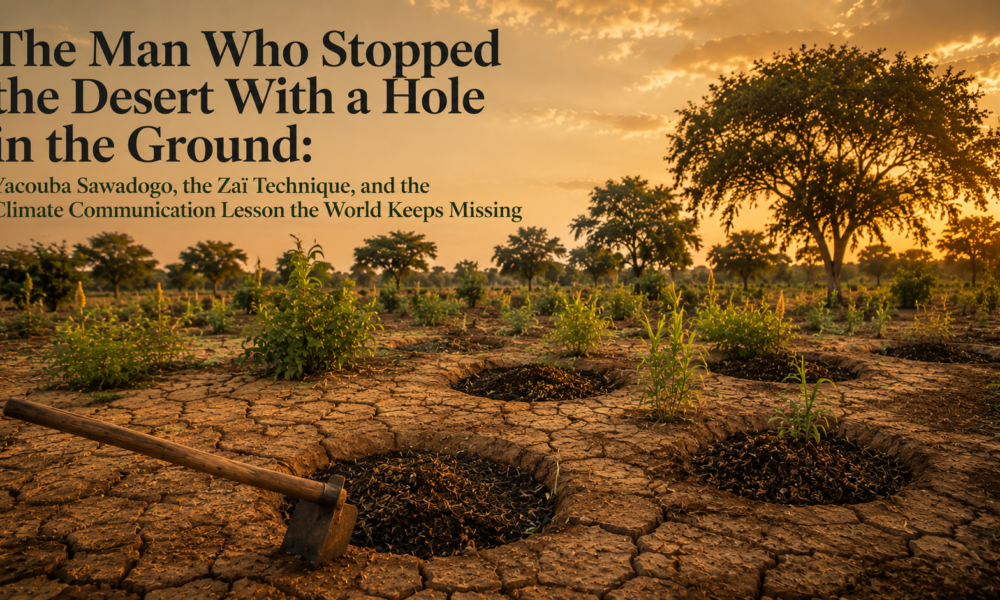
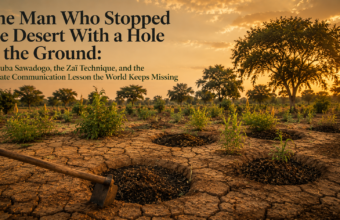
When the droughts of the early 1980s devastated the farmland of Yatenga, Sawadogo did not reach for an imported solution. He reached for something older. An indigenous planting technique called zaï — a word drawn from the Mossi language that translates, with a precision that feels almost philosophical, as to start early. The zaï technique, in its traditional form, involved digging small planting pits into degraded soil at the start of the rainy season — creating micro-catchments that trapped rainfall and concentrated nutrients in the specific spots where seeds were planted, rather than allowing both water and fertility to dissipate across the hardened surface.
The technique had existed in Burkina Faso for generations. But like so many indigenous agricultural practices across Africa, it had fallen out of widespread use — crowded out by the arrival of modern agricultural methods, by the assumption that traditional practices were by definition inferior to imported ones, and by the social pressures that accompany the adoption of anything labelled as new and scientific in contrast to anything labelled as old and local.
Sawadogo revived it. And then he improved it.
His modifications were deceptively simple but agronomically significant. He made the pits wider and deeper than the traditional version — typically 20 to 30 centimetres in diameter and 10 to 15 centimetres deep — so that they could hold more water and more organic material. He filled them with compost and manure, concentrating soil fertility in precisely the locations where it was needed. And crucially, he introduced termites into the pits — a decision that struck his neighbours as eccentric but that proved, in practice, to be one of the most important innovations of his approach. Termites, burrowing through the hardened soil beneath the pits, broke up the ferruginous crust and created channels through which water could infiltrate the deeper soil layers, rather than pooling on the surface and evaporating. He also began digging during the dry season rather than waiting for the rains — allowing the pits to be ready to receive the first rainfall immediately when it arrived, rather than losing critical early-season moisture to runoff whilst preparation was still underway.
The results, when they came, were not subtle.
What the Data Shows
Peer-reviewed research published in the journal Sustainability, in a study examining soil and water conservation in Burkina Faso, documented that zaï pits increase crop yields by more than 100 per cent on restored land — even in years of significantly below-average rainfall. According to the United Nations Environment Programme, water collected in the pits increased crop yields by up to 500 per cent in some documented cases. These are not marginal improvements. They are the difference between hunger and food security, between staying and leaving, between a community that survives a drought and one that is destroyed by it.
On Sawadogo’s own land, the transformation was even more dramatic in its visible dimensions. Over four decades of patient, consistent work, he created a 40-hectare forest on land that had been classified as permanently degraded — a forest comprising more than 60 species of trees and bushes, providing shade, fodder for livestock, fuel, food, and biodiversity in a landscape that had, within living memory, supported none of these things. By 2016, the United Nations estimated that the zaï technique had restored the productive capacity of tens of thousands of hectares in Yatenga and the neighbouring province of Gourcy alone. Across Burkina Faso’s Central Plateau more broadly, 300,000 hectares of degraded land had been restored to agricultural productivity — a figure that represents not just a recovery of land but a recovery of livelihoods, of food security, of the capacity of families to remain on the land that their ancestors worked.
The technique subsequently spread well beyond Burkina Faso’s borders. Today, zaï pits are used by farmers across a 6,000-kilometre stretch of the African continent — from Senegal in the west to Ethiopia in the east — having travelled not through development programmes or government extension services, but through the oldest and most reliable communication channel in agricultural history: one farmer showing another farmer what works.
The Communication Lesson Nobody Is Teaching
This is the dimension of Sawadogo’s story that deserves far more analytical attention than it typically receives — and it is the dimension that is most directly relevant to the practice of climate communication across Africa today.
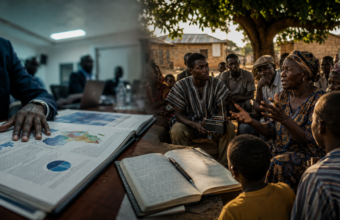
The zaï technique did not spread because an international organisation endorsed it. It did not spread because a government ministry included it in a national agricultural strategy. It did not spread because it was featured in a peer-reviewed journal — the academic documentation came decades after the practice had already transformed hundreds of thousands of hectares. It spread because Yacouba Sawadogo talked to his neighbours. Because he invited visitors to his farm and showed them, physically, with their own eyes, what the technique had produced. Because he trained thousands of farmers from across the region — not in a classroom or a workshop with printed materials and participation certificates, but in a field, with soil under their fingernails and the evidence of restoration visible all around them.
This is what climate communication scholars call experiential and peer-mediated communication — the transmission of knowledge through direct demonstration, trusted social relationships, and shared cultural context. It is, the research consistently shows, amongst the most effective forms of communication for producing genuine behavioural change — far more effective, in most contexts, than mass media campaigns, government advisories, or expert-led public education programmes.
And yet it is precisely this form of communication that climate institutions consistently underinvest in and undervalue. The dominant model of climate communication — from international bodies down to national governments across Africa — remains fundamentally top-down: experts producing information, institutions disseminating it, and communities receiving it. The assumption embedded in this model is that the primary problem is one of information deficit — that communities do not act on climate risks because they do not have enough knowledge, and that the solution is therefore to produce and deliver more knowledge.
Sawadogo’s story exposes the limits of this assumption with devastating clarity. The communities of Yatenga in 1980 did not lack knowledge. They lacked the institutional recognition of the knowledge they already possessed, the resources to act on it at scale, and the communication infrastructure to share it effectively beyond their immediate social networks. What changed the situation was not the arrival of new information from outside, but the activation and amplification of indigenous knowledge from within — knowledge that had existed all along, waiting to be taken seriously.
Recognition, Belatedly Given
The international community eventually caught up with what the farmers of Yatenga had known for decades. In 2018, Yacouba Sawadogo received the Right Livelihood Award — widely regarded as the alternative Nobel Prize — for demonstrating how farmers can regenerate their soil through innovative use of indigenous and local knowledge. In 2020, the United Nations Environment Programme named him a Champion of the Earth in the category of Inspiration and Action. The United Nations Convention to Combat Desertification honoured him as one of its first ever Global Dryland Champions.
These are significant recognitions. They are also, it must be said, recognitions that arrived forty years after the work began — four decades during which the zaï technique spread across the continent largely without institutional support, four decades during which the communities practising it did so in the margins of the international climate and development conversation rather than at its centre.
Yacouba Sawadogo passed away on the 3rd of December 2023, at approximately 77 years of age, in Ouahigouya, Burkina Faso. He did not live to see his technique fully integrated into the mainstream of global climate adaptation policy. But the forests he grew on land that everyone else had written off continue to stand. The knowledge he shared continues to travel. And the 300,000 hectares of restored land on Burkina Faso’s Central Plateau continue to feed families who might otherwise have joined the growing tide of climate displacement that the world’s policy papers spend so much time describing and so little time preventing.
What This Means for African Climate Communication
The story of Yacouba Sawadogo is not merely an inspiring anecdote about individual determination. It is a case study in the systemic failures of the global climate communication architecture — and a demonstration of what becomes possible when those failures are, even partially, overcome.
Several conclusions follow directly from this case, each with implications for how climate communication is practised across Africa.
The first is that indigenous knowledge must be treated as a primary source, not a supplementary one. The zaï technique was not a curiosity to be documented and filed. It was — and is — a sophisticated, evidence-based, climate-adapted agricultural technology that outperformed decades of externally designed interventions. Climate communication that continues to position Western scientific knowledge as the primary source of climate solutions and indigenous African knowledge as a colourful footnote is not merely culturally disrespectful. It is strategically self-defeating.
The second conclusion is that peer-mediated, community-based communication is not a soft alternative to rigorous climate communication. It is, in many contexts, the most rigorous form available. The spread of the zaï technique across 6,000 kilometres of Africa without institutional support is not evidence that institutions are unnecessary. It is evidence that when communities trust the messenger, understand the message in their own language and cultural context, and can see the evidence with their own eyes, they act. That is a communication success story that no government campaign in the region has come close to replicating.
The third conclusion is that the climate communication field in Africa needs to invest seriously in documenting, amplifying, and creating platforms for the exchange of indigenous climate knowledge — not as a charitable gesture towards cultural diversity, but as a strategic imperative for climate adaptation at scale. There are Yacouba Sawadogos across this continent — farmers, fishermen, pastoralists, and community leaders who have developed sophisticated responses to climate variability over generations, and who are sharing that knowledge right now through the peer networks that the international community has not yet thought to tap. Finding them, listening to them, and giving them the platforms and resources to share what they know more widely is not an optional enrichment of the climate communication agenda. It is the agenda.
Conclusion: The Loudest Voice in the Room
When Yacouba Sawadogo walked to his neighbours in Yatenga in the early 1980s and showed them what a zaï pit could do, he was not performing an act of charity. He was practising the most fundamental form of climate communication: sharing knowledge that saves lives, through relationships built on trust, in a language that everyone in the room already spoke.
The climate crisis will not be solved in the corridors of international institutions alone. It will be solved — is already being solved, in ways that rarely make it into the reports — in fields and fishing communities and forests across the African continent, by people whose names the world does not yet know and whose knowledge it has not yet thought to ask for.
Our task, as climate communicators and scholars, is to change that. To build the platforms, the research programmes, and the communication infrastructures that connect what African communities already know to the audiences that need to hear it. To treat indigenous knowledge not as a story to tell after the real business of climate policy is done, but as the centre of the conversation itself.
Yacouba Sawadogo stopped a desert with a hole in the ground and a willingness to share what he knew.
Imagine what becomes possible when we finally decide to listen.
The author writes on climate communication, indigenous knowledge systems, and environmental justice in Africa. This article is part of the Planet and Pages series on African climate solutions.

No Comment! Be the first one.