



Lagos and Its Waste: A Conversation We Need to Have Together
I want to talk about something that does not often make it into academic journals or international climate discussions, but that shapes the daily lived experience of millions of people in one of...

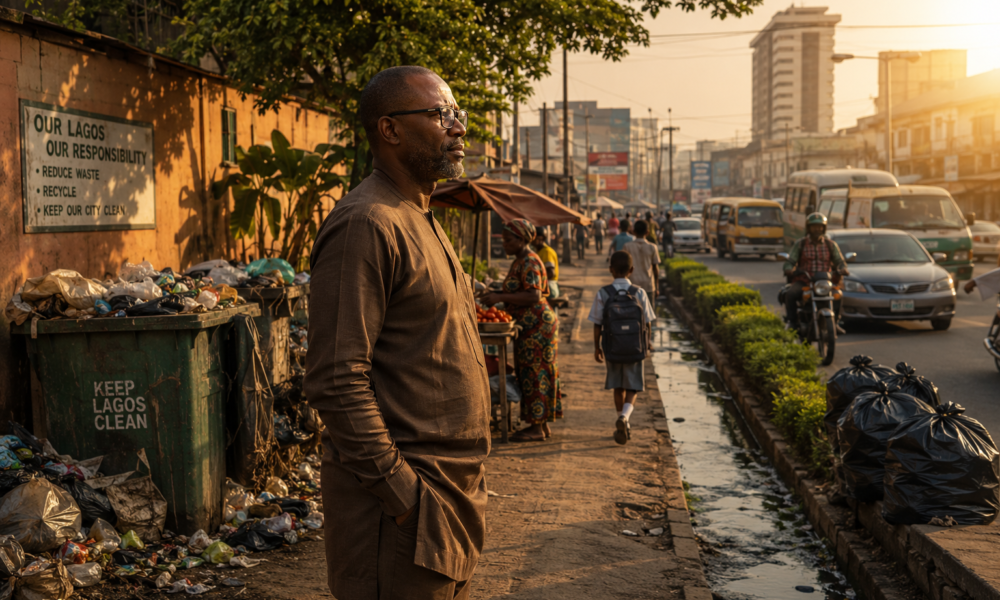
I want to talk about something that does not often make it into academic journals or international climate discussions, but that shapes the daily lived experience of millions of people in one of Africa’s most extraordinary cities.
Table Of Content
Waste.
Specifically, the challenge of managing it in Lagos — a megacity of over twenty million people, growing faster than almost any city on the continent, and carrying the weight of that growth in ways that are increasingly visible on its streets, in its drains, and in the health of its communities.
This is not a piece written in anger or frustration, though both would be understandable responses to what anyone walking through a Lagos neighbourhood might observe on any given day. It is written in the belief that honest, constructive conversation is the beginning of change. And that Lagos — its government, its residents, and its institutions — is more than capable of rising to this challenge if we understand it clearly enough to address it together.
What We Are Seeing on Our Streets
It would be difficult to walk through most parts of Lagos today without noticing that waste management is under significant strain.
Waste accumulates at street corners and collection points. PSPs — the Private Sector Participants contracted by Lagos State to collect waste from residential and commercial areas — are not always able to service their routes as regularly as the system requires. Drainage channels that should carry only rainwater sometimes carry waste instead. And in a city that generates an estimated thirteen thousand tonnes of solid waste every single day, the gap between what is produced and what is collected and properly disposed of is wide enough to have real consequences for public health and environmental quality.
None of this reflects a lack of effort or intention at any level. Lagos State has invested significantly in waste management infrastructure over the years, and many PSP operators work hard under genuinely difficult conditions. The challenges are real, but so is the commitment of many individuals and institutions working within the system. What the situation calls for is not blame, but understanding — of why the system is under pressure, and what might help relieve that pressure in practical, sustainable ways.
Two Structural Challenges Worth Understanding
Conversations about waste in Lagos often focus on what is not happening — trucks not arriving, waste not being collected — without fully exploring the structural reasons behind those gaps. Two issues are worth examining honestly.
The first is the availability of functional waste disposal infrastructure. Lagos currently has a limited number of transfer loading stations and landfill facilities relative to the volume of waste the city produces. When PSP operators collect waste from residential streets, they need accessible, functional endpoints to deposit it. When those facilities are stretched, inaccessible, or too distant to make collection economically viable for smaller operators, the entire chain from street to disposal is affected. This is not a problem that any single actor can solve alone. It is an infrastructure challenge that requires sustained, strategic investment at the state level — the kind of long-term planning that a city of Lagos’s scale genuinely needs.
The second challenge is one of financial sustainability within the collection system. PSP companies depend on the fees paid by residents and businesses to fund their operations — their vehicles, their fuel, their workers, and the cost of transporting waste to disposal sites. Where fee payment is inconsistent or incomplete, the financial viability of regular collection is undermined. This is a delicate issue to raise, because it sits against a backdrop of very real economic pressures that many Lagos residents face. But it is worth understanding as part of the system, because the connection between consistent participation and consistent service runs in both directions.
The Role of Behaviour in the Bigger Picture
Alongside the structural challenges, there is a behavioural dimension to Lagos’s waste situation that is worth reflecting on — gently, and without pointing fingers.
Waste deposited in drainage channels, on roadsides, or in waterways does not stay where it is placed. It moves. It accumulates. It blocks the infrastructure that the city depends on to manage rainfall. And the connection between improperly disposed waste and the flooding that Lagos experiences with increasing frequency and severity is one that is well documented in environmental research.
This connection matters because it means that waste management is not a separate issue from climate resilience, urban flooding, or public health. It is woven into all of them. The choices made at the level of the individual household — about where waste is placed, whether fees are paid, how drainage channels are treated — have consequences that extend well beyond any single street or neighbourhood.
Raising this is not about assigning blame to residents who are navigating genuine difficulties. It is about inviting a shared understanding of how individual actions connect to collective outcomes. Because that understanding, once genuinely held, tends to be more powerful than any enforcement mechanism or public campaign.
What Good Waste Management Could Look Like for Lagos
It is worth spending a moment on possibility, rather than only on problems.
A Lagos with expanded, well-distributed waste disposal infrastructure — more transfer loading stations, greater landfill capacity, and growing investment in recycling and composting alternatives — would be a city where PSP operators could function more efficiently and more sustainably. The economics of collection would improve. The pressure on individual routes would ease.
A Lagos with a sustained, culturally intelligent public communication strategy around waste — one that helps residents understand the direct link between their participation and the environmental quality of their community — would be a city where fee payment and proper disposal were understood not as obligations imposed from above, but as genuine contributions to a shared environment.
And a Lagos where PSP contracts carried stronger accountability mechanisms, where residents had accessible channels to report non-collection, and where the state’s oversight role was consistently exercised, would be a city where the public-private partnership at the heart of the waste management system could deliver closer to its potential.
None of this is beyond reach. Lagos has demonstrated, in many domains, a remarkable capacity to organise, innovate, and improve. The ingredients for better waste management — infrastructure investment, community engagement, policy coherence, and shared responsibility — are all within the city’s grasp.
A Shared Responsibility, A Shared Environment
What I find most compelling about the waste management challenge in Lagos is that it resists simple narratives.
It is not purely a government failure. It is not purely a resident behaviour problem. It is not purely an infrastructure deficit or a funding crisis or a regulatory gap. It is all of these things, interacting with each other in ways that require all of these things to be addressed — simultaneously, collaboratively, and with genuine commitment from every part of the system.
The environment we share does not distinguish between its contributors. The health consequences of poor waste management fall on everyone within reach. The flooding that blocked drains produce visits streets regardless of whether their residents paid their PSP fees or not. The air quality affected by improperly disposed waste is breathed by children across every income bracket.
This shared vulnerability is, in its own way, an invitation. An invitation to approach the waste challenge not as a problem that someone else needs to fix, but as a collective responsibility that every Lagos resident and institution has both a stake in and a role to play in.
Lagos is a city of remarkable people. It deserves urban systems and environmental conditions that reflect the energy, creativity, and resilience of the people who build their lives within it every day.
That conversation — about how we get there together — feels worth having.


No Comment! Be the first one.