



Turning Environmental Research into Viral Stories
Somewhere in the world right now, a brilliant climate study is sitting quietly behind a journal paywall. It is rigorous, peer-reviewed, and packed with insights that could save lives, protect...

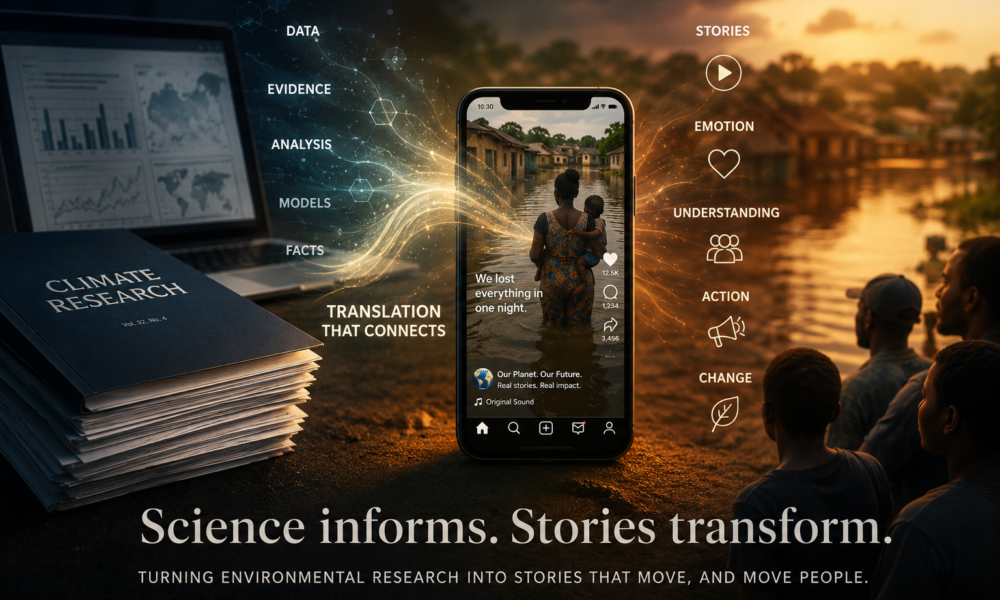
Somewhere in the world right now, a brilliant climate study is sitting quietly behind a journal paywall. It is rigorous, peer-reviewed, and packed with insights that could save lives, protect ecosystems, or influence policy. Yet, outside a small circle of academics, almost no one will ever read it.
That should trouble us deeply.
Environmental research has never been more urgent. Climate change, flooding, heatwaves, food insecurity, and biodiversity loss are no longer distant projections; they are lived realities, particularly across the Global South. And yet, at the very moment when research is most needed, it often fails to reach the people whose lives it seeks to improve.
The problem is not the quality of the research. The problem is how it travels.
Research holds answers. Stories carry them.
A thirty-page technical report on urban flooding may be methodologically sound, statistically robust, and intellectually impressive. But to most people, it remains a dense PDF—downloaded once, skimmed briefly, and quickly forgotten. By contrast, a sixty-second story about a family wading through floodwater after losing their home speaks directly to the human experience. It travels across timelines, crosses borders, and sparks conversations. It gets shared. It lingers. It changes minds.
This is not a failure of science. It is a failure of translation.
Too often, storytelling is dismissed in academic and policy spaces as a form of simplification, even dilution. Turning data into story is sometimes framed as “dumbing it down”. In reality, it is the opposite. Storytelling is an act of interpretation. It is the careful process of taking complex truths and rendering them legible, meaningful, and emotionally resonant without stripping them of their integrity.
Stories do what tables and charts cannot: they give truth a heartbeat.
As scholars and researchers, particularly those working on environmental and climate issues, we must confront an uncomfortable question: if our findings do not reach people, do they truly matter? Knowledge that remains locked within academic silos may advance careers and citations, but it rarely advances change. Impact does not begin at publication; it begins at connection.
In places like Nigeria—and indeed across much of Africa—the gap between research and public understanding is especially consequential. Communities experience flooding, erosion, pollution, and heat stress long before they encounter the language used to describe these phenomena in academic journals. When research fails to speak in ways people recognise, misinformation fills the void. Emotion is then mobilised without evidence, fear without context, outrage without solutions.
Storytelling offers a different path.
When environmental research is translated into narrative—through short videos, radio segments, essays, podcasts, or visual storytelling—it becomes accessible without becoming inaccurate. It invites people into the conversation rather than positioning them as passive recipients of expert knowledge. It allows communities to see themselves within the data, to recognise their experiences in the findings, and to understand not just what is happening, but why it matters.
This is where research meets responsibility.
The future of environmental communication will not be decided solely in journals or conference halls. It will be shaped on social media feeds, community platforms, digital radio, and storytelling spaces where attention is scarce but influence is real. Scholars must learn not only how to conduct excellent research, but how to collaborate with communicators, creatives, and technologists who can help research travel further and faster.
The task before us is not to abandon rigour, but to expand reach. Not to replace evidence with emotion, but to let evidence speak through human experience. When science is translated into story, it does not lose its power; it gains an audience.
Because if environmental research is to change the world, it must first be felt within it.
And that is the work we commit to: turning research into stories that move—and move people.

No Comment! Be the first one.