



Clearing Drainage Channels Before the Rains:
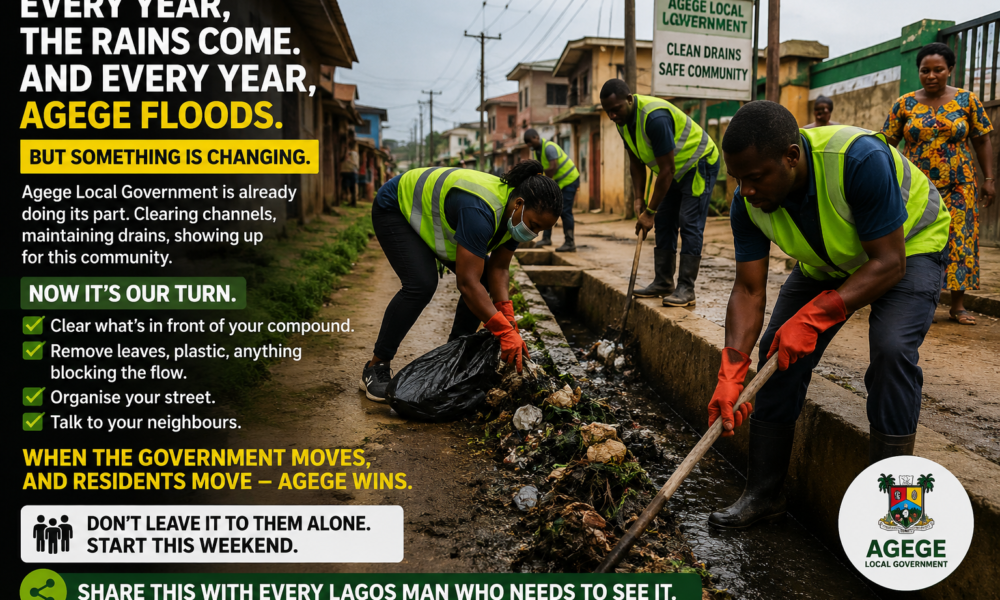
Why Flooding in Agege Is No Longer Just the Government’s Problem Every year, the rains come.And every year, Agege floods. This cycle has become so familiar that many residents now speak of flooding...

Why Flooding in Agege Is No Longer Just the Government’s Problem
Every year, the rains come.
And every year, Agege floods.
Table Of Content
This cycle has become so familiar that many residents now speak of flooding as though it were a seasonal ritual—unfortunate, unavoidable, and beyond control. When the water rises, we sigh, we complain, we post pictures online, and we wait for it to recede. Then we move on, until the next rainy season returns to remind us that nothing has truly changed.
But something is changing.
For once, the local government is not waiting for disaster to strike before acting. Drainage channels are being cleared. Blocked waterways are being reopened. Maintenance work is happening before the clouds fully gather. In a city where governance is often reactive, this shift—however modest—matters.
Yet flood prevention does not succeed on government effort alone. And this is where the conversation must become uncomfortable, honest, and collective.
Flooding Is a Shared Responsibility
In many parts of Lagos, drainage channels do not fail because they were poorly designed. They fail because they have been turned into unofficial dumping grounds. Plastic bottles, nylon bags, food waste, fallen leaves, abandoned household refuse—these are not carried into drains by nature. They are placed there, gradually and repeatedly, by human hands.
When water has no path to flow, it does what water always does: it finds the nearest available space. Roads become rivers. Homes become ponds. Markets shut down. Livelihoods are disrupted. And we call it “flooding,” as though it were an external enemy rather than a consequence of everyday choices.
Agege’s flooding problem, like that of many urban communities in Nigeria, sits at the intersection of infrastructure and behaviour. Clearing drains without changing habits is like mopping the floor while the tap remains open.
When Government Moves, Citizens Must Move Too
The ongoing drainage clearing efforts in Agege represent an invitation, not a conclusion. They invite residents to participate in something larger than compliance: community responsibility.
Clearing the drain in front of one’s compound may feel insignificant in isolation, but when multiplied across streets, neighbourhoods, and wards, it becomes powerful. Removing leaves and plastic from gutters. Ensuring refuse is properly disposed of. Speaking to neighbours. Organising small, informal clean-ups. These are not grand gestures, but they are effective ones.
Urban resilience is not built solely through bulldozers and budgets. It is built through everyday cooperation between state action and civic behaviour.
Flood Prevention Begins at the Doorstep
There is a tendency in public discourse to frame environmental responsibility as something abstract—something discussed in conferences, policy documents, or international climate agreements. But in places like Agege, environmental responsibility begins at the doorstep.
It begins with what we throw away, where we throw it, and whether we are willing to see our immediate surroundings as part of a shared ecosystem rather than a private space detached from communal consequences.
When one compound blocks a drain, an entire street can flood. When one street ignores waste management, an entire community suffers. Floodwater does not respect property lines.
A Culture Shift, Not Just a Clean-Up
What Agege needs—what Lagos needs—is not a once-off sanitation exercise but a gradual cultural shift. A shift from seeing environmental care as “government work” to understanding it as shared work. A shift from reaction to prevention. From blame to participation.
The rainy season will come, as it always does. The question is whether it will meet clogged drains and indifference, or prepared channels and collective action.
This is not about perfection. It is about effort.
So start small. Clear what is in front of your home. Encourage your neighbours. Support local clean-up initiatives. Share information. Reinforce the idea that when government shows up, citizens must show up too.
Because when both move together, communities do not just survive the rains—they withstand them.
And when Agege withstands the rains, Agege wins.






No Comment! Be the first one.