



Environmental Communication for the TikTok Generation
The generation that will inherit this planet is receiving much of its information in fifteen seconds. Not from academic journals. Not from textbooks. Not necessarily from television news. From a...

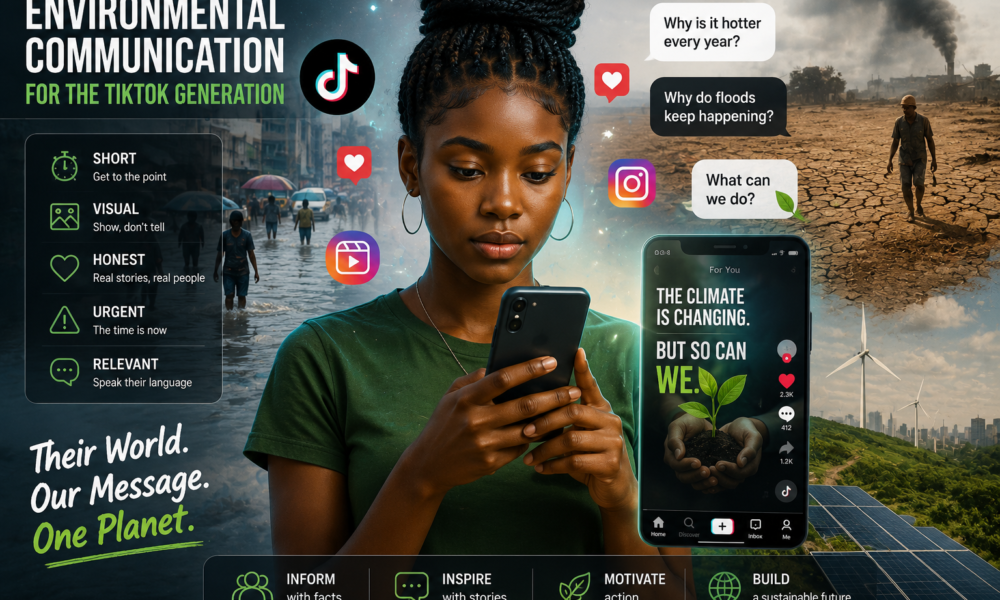
The generation that will inherit this planet is receiving much of its information in fifteen seconds.
Table Of Content
- The Generation Living Through the Crisis
- The TikTok Generation Is Not Uninterested
- The Age of the Scroll
- Young People Need Stories, Not Just Data
- Short Does Not Mean Shallow
- Respect the Audience’s Intelligence
- Environmental Communication Must Go Where People Are
- The Future of Climate Communication Is Human
- Conclusion: The Environment Needs a Voice Everywhere
Not from academic journals. Not from textbooks. Not necessarily from television news.
From a screen.
Often while scrolling.
That reality should concern anyone involved in environmental and climate change communication.
Because if we are still communicating environmental issues as though the public is sitting quietly in a lecture hall, we may already be losing the audience we most urgently need to reach.
This is not a complaint about young people. It is not an argument that social media has destroyed attention spans or that the younger generation is unwilling to learn. In fact, I believe the opposite may be closer to the truth.
The challenge is not that young people are disengaged.
The challenge is that many of our communication approaches are failing to meet them where they are.
The Generation Living Through the Crisis
Across Africa, young people are not learning about climate change as an abstract issue that may affect them sometime in the future.
They are already living through its consequences.
They feel the heat.
They see the floods.
They experience water shortages.
They watch food prices rise.
They see their communities struggle with waste, pollution, erosion and increasingly unpredictable weather.
For many young Africans, climate change is not a chapter in a textbook. It is a reality outside their front doors.
A young person in Lagos may not use the language of climate science to describe an extreme rainfall event, but they know what it means when their street becomes impassable. A farmer’s child may not speak about changing precipitation patterns, but they understand when the rainy season no longer behaves as it once did. A student in a rapidly growing African city may not describe the urban heat island effect, but they know that some neighbourhoods feel unbearably hotter than others.
Young people are observing. They are questioning. They are discussing.
The real question is whether the institutions, experts and communicators responsible for environmental information are listening carefully enough.
The TikTok Generation Is Not Uninterested
There is a tendency to describe young people as distracted or incapable of sustained attention. This is an overly simplistic interpretation.
The so-called TikTok generation is not necessarily uninterested in serious issues. It is simply accustomed to a different communication environment.
Information competes for attention at an extraordinary speed. A person can move from a comedy video to a climate explanation, from a political argument to a music performance, all within a few minutes.
In such an environment, communication must earn attention.
This does not mean that every environmental issue must be reduced to fifteen seconds. Nor does it mean that complex subjects should be stripped of all nuance. The challenge is to communicate complexity in ways that are accessible, visually engaging and relevant.
The problem is not brevity.
The problem is boring communication.
The Age of the Scroll
For decades, environmental communication relied heavily on formal channels: newspapers, television, radio, academic publications, public lectures and government campaigns.
These platforms remain important. In Africa, radio in particular continues to play a significant role in reaching communities.
But the communication environment has changed dramatically.
Today, a young person may encounter information about climate change through a TikTok video, an Instagram Reel, a YouTube Short, a meme, a podcast clip or a creator’s personal story.
The message may come from a scientist. It may come from a journalist. It may come from an activist. Or it may come from an ordinary person standing in floodwater and asking a simple question:
Why does this keep happening?
That question may generate more public engagement than a lengthy technical report.
This is not because the report is unimportant. It is because communication is not simply about producing knowledge. It is about ensuring that knowledge reaches people in ways they can understand, remember and use.
Young People Need Stories, Not Just Data
Data is essential.
We need scientific evidence. We need research. We need accurate information. We need credible experts.
But data alone does not necessarily produce action.
People do not experience climate change as a graph.
They experience it as a flooded home.
A failed harvest.
A sleepless night because of extreme heat.
A child unable to attend school because a road has disappeared under water.
A family paying more for food because environmental changes have disrupted agricultural production.
These experiences require stories.
A good story does not replace science. It helps people understand why the science matters.
This is particularly important in Africa, where environmental experiences are deeply connected to questions of livelihood, poverty, inequality, culture and survival.
When we communicate climate change only through scientific terminology, we risk making it sound distant. When we connect it to people’s lives, it becomes real.
Short Does Not Mean Shallow
One of the most important lessons from social media is that short communication can still be meaningful.
A fifteen-second video can raise a powerful question.
A thirty-second clip can challenge a misconception.
A one-minute story can make someone reconsider a familiar behaviour.
The real challenge is not simply to make environmental content shorter. It is to make it sharper.
What is the central idea?
What does the audience need to understand?
Why should they care?
What question will make them stop scrolling?
These questions are increasingly important for environmental communicators.
The first few seconds matter. If the opening does not create curiosity, emotion or recognition, the audience may never reach the most important part of the message.
This does not mean using sensationalism or spreading fear. It means understanding how contemporary audiences consume information.
A message can be scientifically accurate and still fail as communication.
Respect the Audience’s Intelligence
There is another important issue we need to address.
Communicating with young people does not mean talking down to them.
Too many campaigns assume that because a message is simple, the audience must also be intellectually simple. That is a mistake.
Young people can understand complex issues. What they often reject is unnecessary complexity.
There is a difference between simplifying a message and oversimplifying an issue.
The task of the communicator is to make important information accessible without making it intellectually empty.
We should not assume that young Africans need climate change to be made childish. They need it to be made relevant.
They want to know:
Why is my city flooding?
Why is food becoming more expensive?
Why is the heat becoming unbearable?
Why are governments still building in vulnerable areas?
Why are some communities suffering more than others?
These are not shallow questions.
They are questions about science, governance, inequality and the future.
Environmental Communication Must Go Where People Are
If the next generation is on TikTok, Instagram, YouTube and other digital platforms, environmental communication must be present there.
Not as an afterthought.
Not only when there is a global climate conference.
Not only when a disaster has already occurred.
The environment needs a voice in the spaces where people are already having conversations.
That voice must be credible, but it must also be human.
It must be able to explain a scientific concept without making people feel as though they are sitting for an examination. It must be able to tell a story without abandoning evidence. It must be able to use humour without trivialising suffering. It must be able to speak about urgency without creating hopelessness.
This is where digital creators, journalists, scientists, academics and environmental organisations have an important opportunity.
We need more communication that is short but thoughtful.
Visual but accurate.
Emotional but evidence-based.
Local but globally relevant.
The Future of Climate Communication Is Human
Technology will continue to change.
The platforms young people use today may not be the platforms they use tomorrow. New forms of artificial intelligence, virtual reality and digital storytelling will transform how information is produced and consumed.
But one thing is unlikely to change: people will continue to respond to communication that makes them feel seen.
The future of environmental communication is therefore not simply about chasing every new platform.
It is about understanding people.
What do they fear?
What do they value?
What language do they use?
What stories do they trust?
What experiences shape their understanding of the environment?
These questions are particularly important for Africa, where climate communication must reflect diverse languages, cultures, histories and lived realities.
The most effective message may not always be the most technically sophisticated one.
Sometimes, it may be the one that makes someone stop scrolling and say:
“This is exactly what is happening in my community.”
Conclusion: The Environment Needs a Voice Everywhere
The TikTok generation is not waiting for permission to participate in the climate conversation.
Young Africans are already creating content, asking questions, challenging institutions and sharing their experiences online.
The responsibility of environmental communicators is to meet them there.
We must tell stories that are short enough to capture attention, strong enough to create reflection and honest enough to build trust.
We must communicate in a way that respects young people’s intelligence while recognising the realities of the digital world in which they live.
Because the generation that will inherit this planet is already listening.
The question is whether we are speaking in a language they can hear.
The environment needs a voice—not only in journals, conference halls and policy documents, but on every platform where the next generation is learning, questioning and imagining its future.

No Comment! Be the first one.