



The Niger Delta Oil Spills: Counting the Cost Beyond the Barrel
Imagine waking up one morning and discovering that the water your family drinks has turned black. Not dark. Not murky. Black.The land your family has farmed for generations, ruined. The river your...

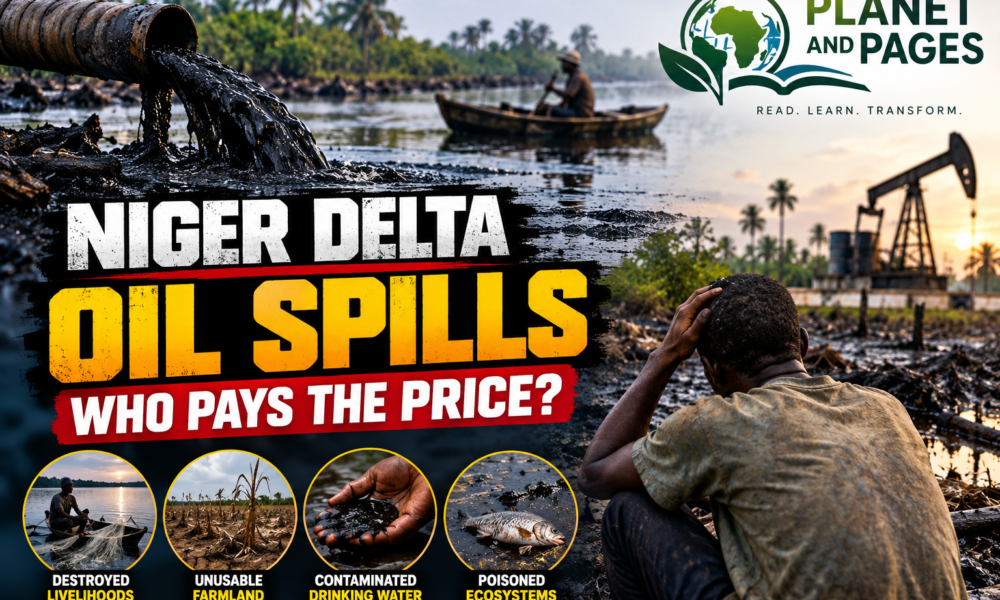
Imagine waking up one morning and discovering that the water your family drinks has turned black.
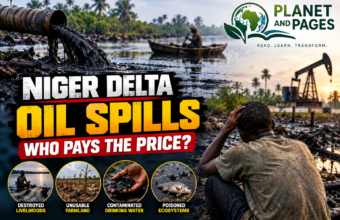
Not dark. Not murky. Black.The land your family has farmed for generations, ruined. The river your children grew up fishing, dead. The smell of crude oil so heavy in the air that it sits in the lungs long after you have moved indoors.For most people reading this, that scenario belongs to the realm of environmental catastrophe — something that happens elsewhere, to other people, in other countries. For hundreds of thousands of Nigerians living in the Niger Delta, it is not imagination. It is not metaphor. It is the condition of ordinary life. And it has been, with varying degrees of intensity and frequency, for the better part of six decades.This article is not primarily about the history of oil production in the Niger Delta, though that history is essential context. It is about a more specific and more urgent question: what does it mean to count the true cost of oil — not in barrels exported and revenue earned, but in the environmental and human price paid by the communities where that oil is pulled from the ground? And who, in any morally coherent accounting, bears responsibility for that cost?
Table Of Content
The Numbers That Should Have Stopped Us
On the 12th of October 2026, Premium Times, citing official oil spill records, reported something that deserved far more attention than it received.Between August and September 2026 alone — two months — nine separate oil spill incidents released an estimated 129,855 litres of crude oil across Delta, Bayelsa, and Rivers States. Delta State accounted for nearly ninety percent of that volume.The causes, as officially recorded, included equipment failure, corrosion, operational errors, sabotage, and oil theft.Read that list again slowly. Equipment failure. Corrosion. Operational errors. These are not acts of God. They are not natural disasters. They are the predictable consequences of ageing infrastructure, inadequate maintenance, and a regulatory environment that has historically prioritised production volume over environmental protection. Sabotage and oil theft are real and serious problems, and they deserve their own serious analysis. But they do not absolve the industry or the state of responsibility for creating and perpetuating the conditions in which they occur.129,855 litres. In two months. From nine incidents.And this is what was officially recorded. Environmental researchers and community advocates have long argued that official spill figures in Nigeria significantly underestimate the actual volume of oil released, for reasons ranging from measurement limitations to incentive structures that favour underreporting. The National Oil Spill Detection and Response Agency (NOSDRA) has itself acknowledged data gaps in the national spill database. What the official numbers tell us is the floor, not the ceiling, of the damage.
Beyond the Litres: The Human Accounting
The challenge with oil spill reporting in Nigeria — and this is a communication challenge as much as it is a governance one — is that the numbers become the story. Litres spilled. Incidents recorded. Barrels lost. And when numbers become the story, the people behind the numbers disappear.Let me try to put those people back.The fishing communities of the Niger Delta are not an abstraction. They are men and women whose livelihoods, cultural identities, and nutritional security are built on the productivity of the rivers, creeks, and coastal waters that make up one of the most ecologically significant wetland systems on the African continent. The Niger Delta covers approximately 70,000 square kilometres, and for the communities who have inhabited it across generations, it is not a resource to be extracted. It is home, livelihood, and identity, woven together in ways that no compensation formula has ever adequately captured.When crude oil enters that ecosystem — whether in a dramatic visible slick or in the slower, less photogenic seepage that characterises many pipeline leaks — the damage it does is not temporary. It is not the kind of environmental insult that the ecosystem absorbs and recovers from in a season or two. Studies of oil-impacted communities in Ogoniland and other parts of the Niger Delta have documented contamination of soil and groundwater that persists for decades after a spill. The United Nations Environment Programme’s (UNEP) 2011 Environmental Assessment of Ogoniland — still the most comprehensive independent assessment of oil pollution in the region — estimated that full remediation of that single area alone could take thirty years and cost over one billion United States dollars.Thirty years. One billion dollars. One area.When we speak of the environmental cost of Nigerian oil production, we are speaking of numbers that dwarf the compensation figures that have historically been offered to affected communities — when compensation has been offered at all.
The Governance Gap
The regulatory framework for oil spill response and environmental liability in Nigeria is neither absent nor, on paper, inadequate. The Petroleum Industry Act of 2021 includes provisions for environmental remediation and host community development. The National Oil Spill Contingency Plan establishes response protocols. NOSDRA exists specifically to detect, monitor, and coordinate responses to oil spills. The Environmental Guidelines and Standards for the Petroleum Industry in Nigeria (EGASPIN) set out technical requirements for spill management.And yet the gap between what these frameworks promise and what communities experience remains cavernous.Clean-up operations, when they occur, are frequently inadequate — removing visible surface oil while leaving contamination in the soil and groundwater largely unaddressed. Compensation processes are protracted, technically complex, and structurally weighted against communities with limited legal and financial resources. The joint investigation visits (JIVs) that determine spill volumes and assign liability are conducted by teams that include representatives of the oil companies whose financial exposure depends on the outcome — an arrangement whose structural conflicts of interest have been documented and critiqued by researchers, civil society organisations, and international bodies for years.The consequence of this governance gap is not simply that communities go uncompensated. It is that a system has been constructed — through policy, regulation, and practice — in which the environmental cost of oil production is systematically externalised onto the communities least able to absorb it. The people who receive the least benefit from Nigeria’s oil wealth bear the greatest share of its environmental burden. That is not an accident of geography. It is the predictable outcome of decades of decisions about where to invest in infrastructure maintenance, how to structure liability and compensation, and whose voices to privilege in environmental governance.
The Communication Silence
There is a dimension of this crisis that falls specifically within my field of environmental communication, and it is one that I think deserves explicit attention.The Niger Delta oil spills are, in an important sense, a communication failure as much as they are a regulatory and governance failure.Not because the information does not exist. Premium Times and other investigative outlets do important work in reporting spill incidents, often against considerable institutional resistance. Environmental organisations like Environmental Rights Action / Friends of the Earth Nigeria have documented the human and ecological costs of oil pollution with remarkable rigour over many years. Academic researchers across Nigerian universities have produced a body of scholarship on Delta pollution that is internationally recognised and cited.But that information exists in fragments. It appears in news cycles that move quickly. It lands in academic journals that most affected community members will never read. It is reported in English to audiences that may not include the Ijaw, Urhobo, Itsekiri, or Ogoni-speaking communities most directly affected by what is being described.The result is a communication landscape in which the people with the most knowledge of oil spill impacts — the communities living with those impacts every day — are paradoxically among the least represented in the public and policy conversations about how to address them. Their experiential knowledge, accumulated across generations of living in relationship with a landscape that has been progressively degraded, is rarely treated as evidence in the formal processes that determine liability, compensation, and remediation.This is not simply a matter of media reach or literacy. It is a question of whose knowledge counts, and in whose language the authoritative version of events is told. When a spill occurs, the story that reaches national and international audiences is predominantly the one told by official statements, company press releases, and government agency reports. The story told by the fisherman whose nets come up coated in oil, or the woman whose children have developed skin conditions after bathing in contaminated water, reaches a smaller and less powerful audience, if it reaches any at all.Changing this is not only a matter of media training or digital platform access, though both matter. It requires a fundamental rethinking of how environmental knowledge is produced, validated, and communicated in a context where the communities most affected by environmental harm are also the communities with the least institutional power to have their experiences recognised as credible evidence.
Who Bears the Cost?
Let me return to the question that sits at the heart of this piece, because I think it is worth stating with some precision.Nigeria’s oil sector generates substantial revenue for the federal government, significant profits for the multinational and domestic oil companies operating in the country, and a range of economic benefits — employment, infrastructure, multiplier effects — that, while unevenly distributed, are real.The environmental cost of generating that revenue is also real. Contaminated water. Degraded farmland. Depleted fish stocks. Health impacts ranging from skin conditions and respiratory illness to the longer-term consequences of chronic exposure to hydrocarbon pollutants. Displacement of communities whose traditional livelihoods have been rendered unviable. Loss of biodiversity in an ecosystem whose ecological significance extends far beyond Nigeria’s borders.The question of who bears that cost is not merely rhetorical. It has specific, practical implications for how we design and implement environmental policy, how we structure liability and compensation frameworks, and how we understand the relationship between the extractive economy and the communities within whose territories extraction occurs.A rigorous moral and legal accounting would suggest that the cost should be borne primarily by those who generate it — the companies whose operations produce the spills, and the regulatory state whose inadequacies allow them to persist. That principle is not, in itself, controversial. It is embedded in Nigerian law, in international environmental standards, and in the basic logic of environmental justice.What is controversial — what remains deeply, stubbornly contested in practice — is the enforcement of that principle. The translation of a legal norm into actual remediation, actual compensation, and actual accountability for the individuals and institutions responsible.Until that translation happens — consistently, transparently, and in a manner that genuinely centres the experiences and rights of affected communities — the true cost of Nigerian oil will continue to be paid by the people who can least afford it.
A Closing Word on Urgency
I want to be clear about something before I conclude.This article is not an argument against Nigeria’s oil sector per se. The economic realities of a nation in which petroleum revenues account for a substantial share of government income are complex, and the transition to a post-fossil-fuel economy, however necessary in the long term, is not something that can be wished into being by a single policy announcement or a well-intentioned op-ed.What I am arguing is something more specific, and I believe it is something that most reasonable people — regardless of their position on the broader question of oil and development — can accept.Communities that live with the environmental consequences of oil production deserve clean water. Productive land. Healthy rivers. Adequate compensation when spills occur. Genuine remediation that addresses contamination at depth, not merely surface clean-up operations designed to satisfy regulatory checkboxes. And they deserve to have their voices heard — in the language they speak, through the channels they trust, in the processes that determine their futures.129,855 litres. Two months. Nine incidents. Delta, Bayelsa, Rivers.These are not just numbers.They are someone’s water. Someone’s land. Someone’s river. Someone’s life.And they deserve to be counted — fully, honestly, and with the moral seriousness that the human beings behind them have always deserved, and have far too rarely received.Dr Moshood Olawale Ajibola is an environmental communicator and scholar specialising in climate narratives, power, and Africa-centred environmental discourse. He is the founder of Planet and Pages and BrandLift Communication Consult, both based in Lagos, Nigeria. Follow his work on Planet and Pages across YouTube, Instagram, TikTok, Facebook, and X.



No Comment! Be the first one.