



Media Ownership and Environmental Silence
Have you ever noticed how environmental stories in Nigeria often follow a familiar pattern? A devastating flood sweeps through a community. Homes are submerged. Families are displaced. Television...

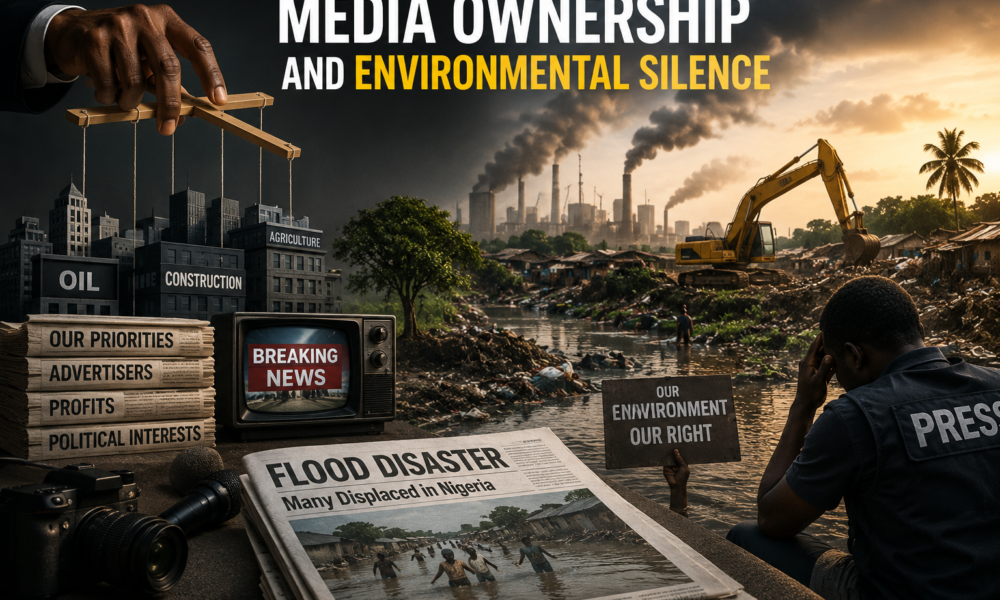
Have you ever noticed how environmental stories in Nigeria often follow a familiar pattern?
Table Of Content
A devastating flood sweeps through a community. Homes are submerged. Families are displaced. Television stations broadcast dramatic images. Newspapers carry bold headlines. Social media erupts with outrage.
Then, almost as quickly as the story appears, it disappears.
The floodwaters may take weeks to recede, but public attention often fades within days. The cameras move elsewhere. The headlines change. The environmental crisis becomes yesterday’s news.
This raises an important question: why do environmental issues struggle to remain in the public conversation, despite their growing impact on people’s lives?
The answer is more complex than many people realise.
The Stories Exist
Africa is not short of environmental stories.
Across the continent, communities grapple daily with flooding, coastal erosion, desertification, deforestation, pollution, biodiversity loss and the growing impacts of climate change. In Nigeria alone, annual floods displace thousands of people, damage infrastructure, destroy farmlands and disrupt livelihoods.
Yet many of these stories receive only brief media attention before being overtaken by politics, elections, security concerns or entertainment.
This does not necessarily reflect a lack of journalistic interest. Many reporters recognise the importance of environmental issues and work diligently to bring them to public attention.
The challenge often lies elsewhere.
It lies in the structures within which journalism operates.
Who Owns the Microphone?
One of the most overlooked questions in environmental communication is who owns the media.
Media organisations do not operate in isolation. Like other institutions, they exist within political and economic systems that influence editorial priorities, financial sustainability and news selection.
Across Africa, media ownership takes many forms. Some outlets are publicly owned, others belong to private corporations, influential business figures or political actors. These ownership structures do not automatically determine editorial decisions, but they can shape organisational priorities and influence which stories receive sustained attention.
Environmental reporting frequently sits at the intersection of powerful economic interests.
Extractive industries, large-scale construction projects, manufacturing, mining and commercial agriculture are major contributors to national economies. They also provide substantial advertising revenue and, in some cases, maintain close relationships with political and media institutions.
In such contexts, environmental reporting can become particularly sensitive.
Journalists may uncover evidence of pollution, illegal waste disposal or environmental degradation. Yet whether those investigations receive prominence can depend on factors extending beyond the newsroom.
This is not unique to Africa.
Scholars of media and communication have long argued that ownership structures, commercial pressures and political interests influence news agendas around the world. The question is rarely whether environmental stories exist. More often, it is which stories are amplified, which are marginalised and which gradually disappear from public view.
Silence Can Be Structural
Environmental silence is not always the result of censorship.
Sometimes it emerges through quieter, less visible processes.
A newsroom with limited financial resources may struggle to support investigative environmental reporting, which often requires weeks or months of fieldwork.
Editors working under intense commercial pressure may prioritise stories that generate immediate audience engagement.
Media organisations dependent on advertising revenue may be cautious when reporting on industries that contribute significantly to their financial survival.
None of these realities necessarily imply deliberate suppression of environmental journalism. However, together they can create conditions in which environmental issues receive less sustained coverage than their social importance deserves.
The result is a form of structural silence.
Not because no one cares.
But because the systems through which news is produced often favour stories that appear more immediate, more profitable or more politically advantageous.
The Cost of Looking Away
When environmental stories disappear from public discussion, communities continue to live with their consequences.
A polluted river does not become cleaner because the television cameras have left.
Flood victims do not recover simply because the headlines have changed.
Communities exposed to toxic waste, erosion or poor waste management continue to face those realities long after national attention has moved elsewhere.
The consequences extend beyond environmental degradation.
Limited media attention weakens public accountability, reduces pressure for policy implementation and makes it more difficult for citizens to demand environmental justice.
In many respects, silence can be as damaging as misinformation.
A problem that is rarely discussed is often perceived as less urgent than one that dominates public debate.
Environmental Journalism Is a Public Service
Environmental journalism should not be viewed as a specialised niche reserved for scientists or conservationists.
It is public-interest journalism.
Reporting on climate change, pollution, biodiversity, waste management and environmental health is ultimately reporting on people’s lives, livelihoods and futures.
Strong environmental journalism helps citizens understand risks before disasters occur. It explains the connections between public policy and everyday experience. It gives voice to communities that are often overlooked in national conversations.
Most importantly, it creates accountability.
Governments, businesses and institutions are more likely to respond when environmental issues remain visible within the public sphere.
Beyond Ownership
Media ownership is only one part of a much larger conversation.
Strengthening environmental reporting also requires investment in specialised journalism, greater editorial commitment, improved access to environmental data, stronger legal protections for investigative reporters and increased public demand for evidence-based reporting.
Universities, civil society organisations and independent media platforms equally have important roles to play in expanding environmental literacy across society.
The future of environmental communication in Africa cannot depend solely on traditional news organisations.
Digital platforms, community radio, independent publications and citizen journalism are increasingly helping to fill important gaps by bringing neglected environmental stories into public view.
Towards a More Visible Environment
Climate change is reshaping African societies in profound ways.
Floods are becoming more frequent. Heatwaves are intensifying. Urban waste challenges continue to grow. Coastal communities face rising sea levels, while farmers struggle with increasingly unpredictable rainfall.
These are not occasional stories.
They are defining stories of our generation.
If the media are to fulfil their democratic responsibility, environmental reporting must move beyond episodic disaster coverage towards sustained, investigative and solutions-oriented journalism.
Communities deserve more than temporary attention when tragedy strikes.
They deserve continuous reporting that examines why environmental problems occur, who is affected, who benefits, who bears the costs and what can be done differently.
Conclusion
Environmental silence is rarely created by a single decision.
It often emerges from the interaction of ownership structures, commercial realities, editorial priorities and political influence.
Recognising these dynamics is not an attack on journalism. Rather, it is an invitation to strengthen it.
As Africa confronts an increasingly uncertain climate future, independent and courageous environmental reporting will become more important than ever.
Because protecting the environment begins with protecting the public’s right to know.
And sometimes, the most important environmental story is not the one making the headlines.
It is the one that never reached them in the first place.

No Comment! Be the first one.