



Climate Justice as a Human Rights Issue: A Communication Perspective
There is something climate communicators rarely say out loud: climate change is not just a science story. It is a rights story. And the way we choose to tell it determines who gets protected — and...

There is something climate communicators rarely say out loud: climate change is not just a science story. It is a rights story. And the way we choose to tell it determines who gets protected — and who gets left behind.
For decades, climate change has been communicated primarily as an environmental and scientific challenge. Emissions data. Temperature projections. Ecosystem collapse. These framings are not wrong, but they are incomplete. They locate the crisis in laboratories and policy corridors, far from the lived experience of the people bearing its heaviest consequences. When the story stays technical, the response stays technical too — and the communities most affected remain voiceless in the very conversations that will decide their futures.
From Environment to Rights: Why the Frame Matters
Framing is not merely a communication technique. It is a political act. The language we choose to describe a crisis shapes who is held responsible, who is invited to respond, and whose suffering is recognised as legitimate.
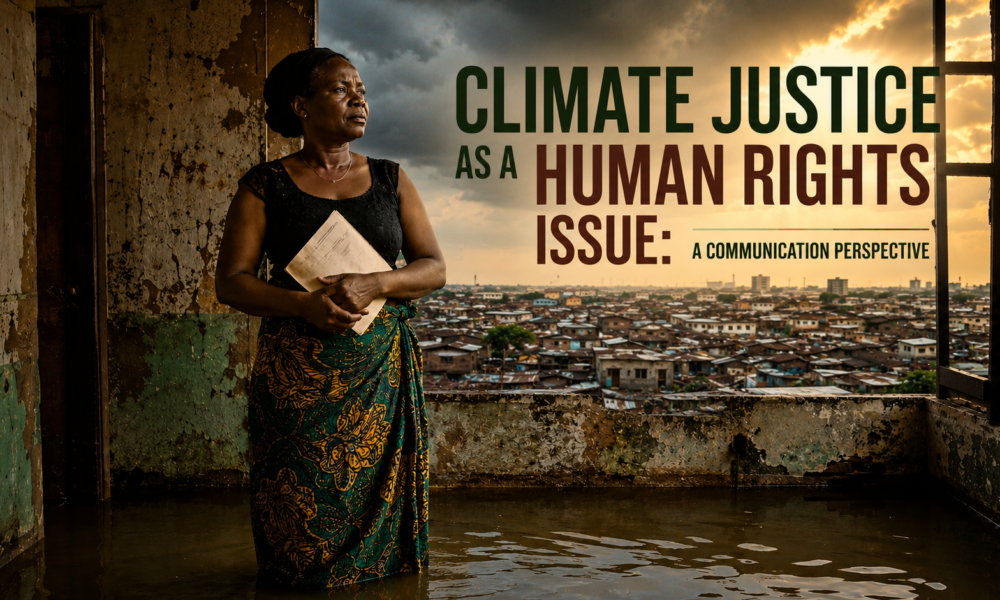
Consider the difference between calling repeated flooding a natural disaster and calling it a rights violation. The first framing positions governments and corporations as bystanders to an unfortunate event. The second positions them as actors with obligations — legal, moral, and constitutional. One invites sympathy. The other demands accountability.
This distinction is not semantic. It has material consequences. When climate harm is understood as a human rights issue, it enters a different institutional architecture. It moves from environmental agencies into courts. From scientific reports into constitutions. From voluntary pledges into enforceable duties. Human rights frameworks carry mechanisms for redress, for legal standing, for the recognition of victims as rights-holders rather than aid recipients.
The African Context
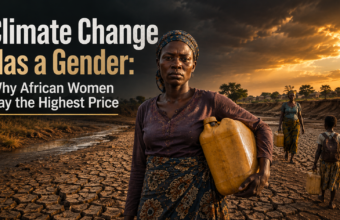
Nowhere is this reframing more urgent than across the African continent. Africa contributes less than four percent of global greenhouse gas emissions, yet its communities are among the most severely affected by climate impacts — from the flooding of Lagos informal settlements to the desertification of the Sahel, from cyclones battering Mozambique to droughts threatening food systems across the Horn of Africa.
When these crises are narrated purely as environmental events, they remain humanitarian footnotes — objects of international charity rather than subjects of international justice. But when they are named as what they are — violations of the right to life, the right to food, the right to a healthy environment, the right to adequate housing — they acquire a moral and legal weight that charity cannot carry.
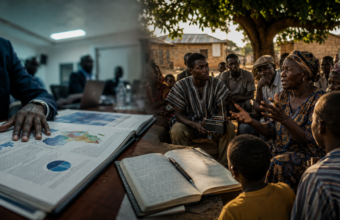
African climate communicators occupy a distinctive position in this shift. They hold proximity to the communities most affected. They carry cultural knowledge that shapes how climate information lands and moves. And they have the capacity to translate the abstract language of rights into the concrete grammar of daily experience — to make visible the connection between a flooded home and a broken policy, between a failed harvest and a systemic injustice.
Language as Instrument
The stakes of language in climate communication extend beyond framing individual events. They shape collective imagination — what people believe is possible, who they believe is responsible, and whether they see themselves as passive sufferers or active claimants.
Framing climate change as a distant threat keeps people passive. It places the crisis in a future that has not yet arrived, or in geographies that feel removed. Framing it as a present injustice — one already unfolding in communities, already registered in bodies and livelihoods — activates a different response. It creates urgency without despair. It names victims without stripping them of agency. It opens space for solidarity rather than pity.
This is not a call to abandon scientific communication. Rigorous data remains indispensable. But data without justice framing is politically inert. It informs without mobilising. It describes without demanding. The integration of rights language into climate narratives does not weaken the science — it gives the science somewhere to go.
A Different Kind of Story
The climate story the world most often hears is told from the outside looking in — from the perspective of emitters, of policymakers, of researchers studying systems from a distance. African climate communicators offer something different: an account told from within the experience of injustice, grounded in the specific places and peoples where the crisis is not a projection but a present reality.
That account is not merely additive. It is transformative. It changes what the crisis is understood to be, who it is understood to affect, and what kind of response it demands.
Climate justice as a human rights issue is not a rhetorical flourish. It is an accurate description of what is happening — and a call for a communication practice worthy of the moment.
How we tell the climate story decides who the world decides to save.

No Comment! Be the first one.