



How African Storytelling Traditions Can Save Climate Communication
Climate change is often described through numbers. We hear about rising global temperatures, carbon emissions, sea-level rise and greenhouse gases. Scientists present graphs. Governments publish...

Climate change is often described through numbers. We hear about rising global temperatures, carbon emissions, sea-level rise and greenhouse gases. Scientists present graphs. Governments publish policies. International organisations produce lengthy reports filled with evidence and recommendations. Yet despite the abundance of information, one challenge remains: millions of people still struggle to connect these scientific realities with their everyday lives.
Table Of Content
- Africa’s First Climate Communicators
- Storytelling Was Never Just Entertainment
- Why Modern Climate Communication Struggles
- Why Stories Still Matter
- Africa’s Cultural Strength Is Also Its Communication Strength
- Bridging Indigenous Knowledge and Modern Science
- A Call to Reclaim Africa’s Communication Heritage
- Conclusion
This raises an important question: What if the future of climate communication does not lie in producing more reports, but in rediscovering one of Africa’s oldest forms of knowledge sharing?
Long before universities emerged, Africa had its own communication systems. Long before policy briefs, scientific journals and international climate conferences, African communities understood the value of storytelling. They relied on stories not merely for entertainment but for education, preservation of knowledge and collective survival.
Perhaps the greatest innovation climate communication needs today is not something entirely new. Perhaps it is something Africa has possessed all along.
Africa’s First Climate Communicators
Before the textbook, there was the griot.
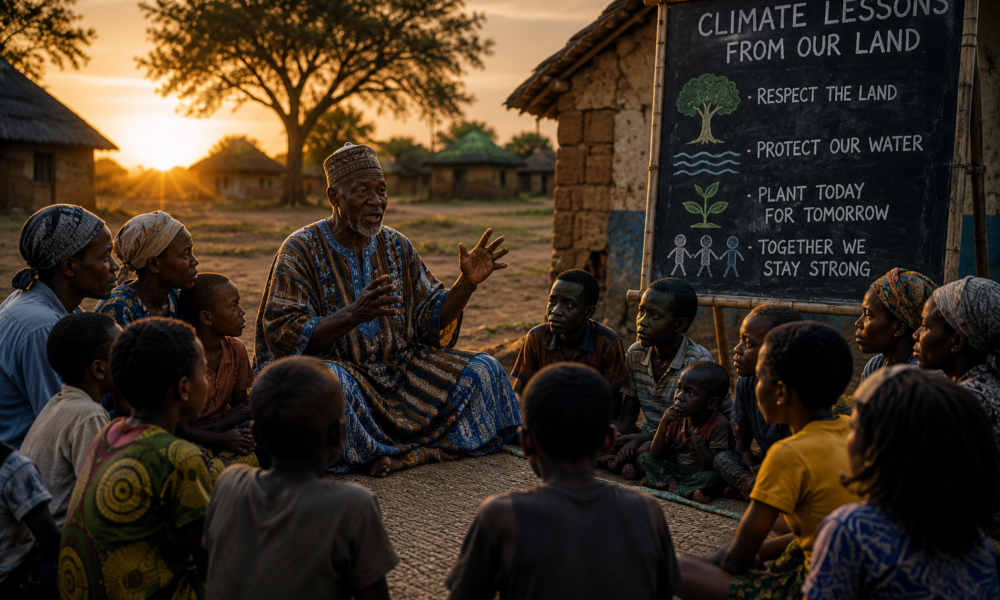
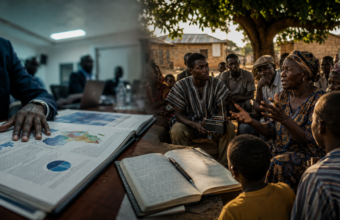
Before environmental campaigns, there were elders sitting beneath trees, sharing stories with younger generations.
Before meteorological forecasts, communities carefully observed the skies, the behaviour of birds, the flowering of certain trees and the movement of rivers to anticipate changing seasons.
These were not random traditions or superstitions. They were systems of environmental observation developed over generations through experience, reflection and careful attention to nature.
Knowledge about rainfall, drought, farming seasons and environmental stewardship was woven into folktales, songs, proverbs and communal rituals. Every story carried a lesson. Every proverb preserved wisdom. Every generation inherited not only language but also practical knowledge about living in harmony with the environment.
Far from being primitive, these traditions represented sophisticated forms of environmental communication.
Storytelling Was Never Just Entertainment
One of the greatest misconceptions about African oral traditions is that they existed simply to entertain.
In reality, storytelling performed multiple social functions.
It warned communities about danger.
It taught moral responsibility.
It strengthened social cohesion.
It encouraged respect for nature.
It shaped behaviour.
A child who grew up listening to stories about rivers, forests and animals was not simply hearing tales. They were learning values—respect for shared resources, responsibility towards future generations and the consequences of human actions.
Modern communication scholars refer to these processes as behaviour change communication, social learning and audience engagement. African communities had been practising these principles centuries before they acquired academic names.
Why Modern Climate Communication Struggles
Today’s climate communication often assumes that providing scientific facts is enough to change behaviour.
Unfortunately, evidence suggests otherwise.
People rarely change because they receive more information alone. They change when information connects with their beliefs, emotions, culture and identity.
This is where many climate campaigns encounter difficulties.
Technical terms such as adaptation, mitigation, carbon neutrality and greenhouse gas emissions may be scientifically accurate, but they often fail to resonate with ordinary citizens who are more concerned with rising food prices, disappearing harvests, water shortages or increasingly unpredictable rainfall.
For many Africans, climate change is experienced long before it is understood scientifically.
Communication that ignores this reality risks becoming informative without being influential.
Why Stories Still Matter
Stories achieve something that statistics often cannot.
They create emotional connection.
They help people remember.
They simplify complex ideas without oversimplifying the truth.
They make distant problems feel personal.
This explains why a grandmother’s story about how rivers once flowed differently may influence attitudes towards environmental protection more effectively than pages of technical analysis.
Stories speak both to the mind and to the heart.
They allow people to see themselves within the issue rather than merely observing it from a distance.
This is precisely what climate communication needs.
Africa’s Cultural Strength Is Also Its Communication Strength
Across the continent, storytelling remains deeply woven into daily life.
Religious leaders communicate through parables.
Parents teach through anecdotes.
Musicians use lyrics to address social issues.
Comedians highlight environmental realities through humour.
Filmmakers increasingly explore climate-related themes.
Social media creators tell stories through short videos, spoken-word poetry and animation.
These platforms demonstrate that storytelling has never disappeared. It has simply evolved.
The challenge is not whether Africans still tell stories.
The challenge is whether climate communicators are willing to embrace storytelling as a serious communication strategy rather than treating it as an optional cultural activity.
Bridging Indigenous Knowledge and Modern Science
Rediscovering storytelling does not mean abandoning scientific evidence.
Rather, it means presenting scientific knowledge in ways that communities recognise, trust and remember.
Climate science explains what is happening.
African storytelling helps explain why it matters.
Together, they can create communication that is both credible and compelling.
Imagine flood preparedness explained through familiar proverbs.
Imagine radio dramas helping farming communities understand changing rainfall patterns.
Imagine climate education embedded in folktales taught in schools.
Imagine digital creators using local languages, humour and traditional narratives to communicate scientific findings.
This is not a rejection of modern communication.
It is an expansion of it.
A Call to Reclaim Africa’s Communication Heritage
Africa faces some of the world’s most significant climate challenges, despite contributing relatively little to global greenhouse gas emissions. Building resilience will require investment, innovation and sound public policy. But it will also require communication that reflects African realities and African ways of knowing.
The continent should not depend solely on imported communication models when it already possesses rich traditions capable of inspiring learning, participation and collective action.
Perhaps the future of climate communication in Africa does not begin with inventing a new language.
Perhaps it begins with remembering one we have always spoken.
Conclusion
The question is no longer whether storytelling can contribute to climate communication.
History has already answered that.
For centuries, African storytelling warned communities, preserved environmental knowledge, encouraged responsible behaviour and strengthened social resilience. These are precisely the outcomes modern climate communication seeks to achieve.
The real question is this:
Why did we stop trusting one of Africa’s greatest communication traditions?
As the continent confronts an increasingly uncertain climate future, reclaiming its storytelling heritage may prove to be one of its most powerful and most authentic communication strategies.
Because sometimes, the oldest wisdom offers the clearest path forward.
And perhaps the story that will help Africa confront climate change has been waiting to be told all along.

No Comment! Be the first one.