



The Language of the Street: Why Slang Expressions and Slogans May Hold the Key to Climate Change Communication in Africa
Climate change is one of the most researched issues of the twenty-first century. Every year, governments, scientists, international organisations and development agencies produce thousands of...

Climate change is one of the most researched issues of the twenty-first century. Every year, governments, scientists, international organisations and development agencies produce thousands of reports, policy briefs and academic papers explaining its causes, consequences and possible solutions. Yet despite this wealth of knowledge, public understanding and behavioural change remain frustratingly slow, particularly across many parts of Africa.
Table Of Content
This raises an important question: What if the problem is not a lack of information, but the language in which that information is communicated?
What if the phrase that finally inspires people to take climate change seriously is not buried in a scientific journal or delivered at an international climate conference? What if it emerges instead from the streets of Lagos, Nairobi or Accra? What if it is a slang expression repeated in everyday conversation, or a slogan painted on a wall that captures the frustration and resilience of ordinary people?
As someone who researches environmental communication, I believe these are questions that deserve far more attention than they currently receive.
Climate Change Is Also a Communication Challenge
Much of the global climate conversation has been dominated by technical terms and scientific language. We speak of carbon emissions, greenhouse gases, adaptation strategies, mitigation pathways and net-zero targets. These concepts are undoubtedly important, but for many ordinary citizens, they remain distant, abstract and disconnected from everyday life.
The average trader in Lagos is more concerned about rising food prices than atmospheric carbon concentrations. A commercial bus driver is likely to notice worsening heat and more frequent flooding long before encountering a scientific report explaining why they occur. Farmers recognise changing rainfall patterns through experience, not through academic terminology.
This does not mean people are uninformed. Rather, it suggests that the language of climate communication often fails to connect with the language of everyday living.
Communication is effective only when people understand, relate to and remember the message.
The Hidden Power of Slang
Across Africa, slang expressions are more than fashionable words. They are cultural markers. They express identity, emotion and collective experience. They are often created in response to social realities and spread rapidly across communities through conversation, music and social media.
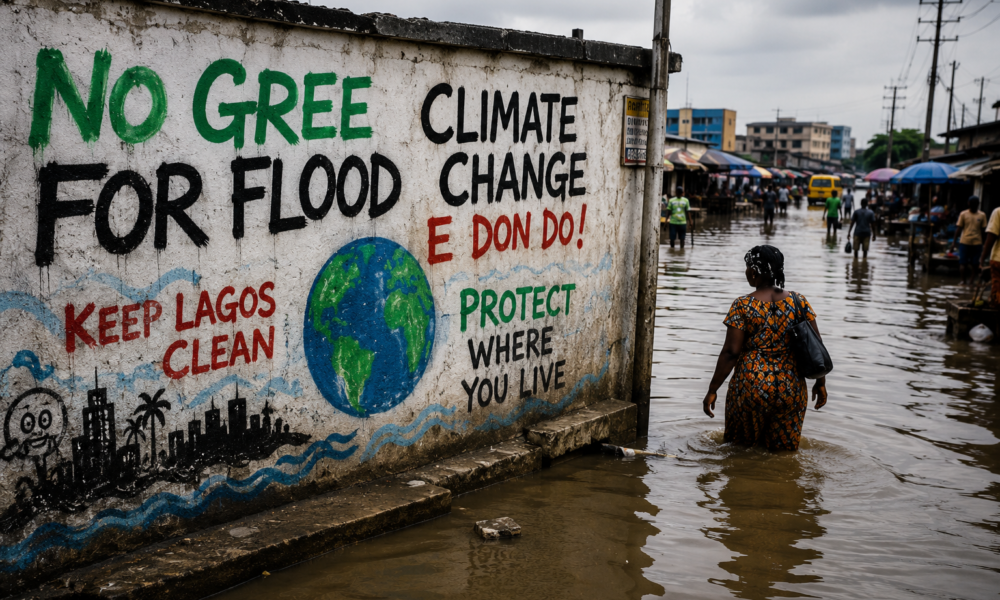
When young Nigerians describe a flooded neighbourhood by saying “E don do”—meaning “This has gone too far”—they are doing more than expressing frustration. They are communicating an environmental reality in language that is immediate, authentic and emotionally powerful.
Similarly, expressions such as “No gree for flood” or “Protect where you live” may resonate more strongly with many audiences than carefully constructed policy statements. These phrases require no technical explanation. They are memorable because they speak the language of the people.
From a communication perspective, this matters enormously.
Research in communication consistently shows that people respond more positively to messages that reflect their cultural identity and lived experiences. Messages become persuasive not simply because they contain facts, but because they feel familiar and personally relevant.
Why Slogans Work
History offers countless examples of slogans transforming public behaviour.
Public health campaigns have used memorable slogans to encourage handwashing, immunisation and road safety. Political movements have mobilised millions through simple, emotionally compelling phrases. Commercial brands spend enormous resources developing slogans because they understand one fundamental truth: people remember simplicity.
Climate communication should learn from this lesson.
A powerful slogan can communicate urgency in just a few words. It can cross educational boundaries, bridge multiple languages and remain in people’s minds long after statistics have been forgotten.
In multilingual societies such as Nigeria, where hundreds of languages coexist alongside English and Nigerian Pidgin, slogans also provide a practical communication advantage. A well-crafted phrase can travel effortlessly through radio programmes, community meetings, music, religious gatherings and social media platforms.
In many cases, slogans succeed because they are repeated naturally in everyday conversations rather than being imposed through formal campaigns.
Africa’s Streets Are Already Communicating Climate Change
One of the greatest misconceptions in climate communication is the assumption that meaningful climate messages must originate from experts.
In reality, Africa’s streets already communicate climate change every day.
Musicians sing about disappearing seasons and economic hardship linked to environmental changes. Market women discuss rising food prices caused by poor harvests. Fishermen talk about changing coastlines. Farmers exchange observations about unpredictable rainfall. Young people create memes that reflect extreme heat, flooding and waste management failures.
These conversations may not use scientific vocabulary, but they communicate climate realities with remarkable clarity.
Rather than dismissing these informal expressions, policymakers, researchers and communicators should recognise them as valuable entry points for public engagement.
The future of climate communication may depend as much on listening as on speaking.
Identity Drives Action
Communication scholars have long argued that identity shapes behaviour. People are more likely to embrace ideas when those ideas reflect who they are and how they see the world.
This is why slang matters.
Slang is not merely casual speech; it is an expression of belonging. It signals shared experiences, common frustrations and collective aspirations.
When climate messages are expressed through familiar language, they stop sounding like instructions from distant institutions and begin to feel like conversations within the community.
That shift can make all the difference.
If people begin to see environmental responsibility as part of who they are—not simply as something experts recommend—behavioural change becomes far more achievable.
Rethinking Climate Communication for Africa
Africa does not lack climate stories. It lacks climate conversations that truly resonate with ordinary people.
The challenge before communicators is therefore not simply to produce more information, but to translate scientific knowledge into language that communities recognise as their own.
This requires collaboration between scientists, communication scholars, linguists, educators, musicians, content creators and local communities. It means embracing storytelling alongside statistics, conversation alongside conferences, and cultural expression alongside scientific evidence.
Climate communication must become more human, more local and more culturally grounded.
Only then will it move beyond awareness to action.
Conclusion
The next breakthrough in climate communication may not come from another international report or technical presentation. It may come from a phrase spoken in a marketplace, a lyric in a popular song, or a slogan painted on a neighbourhood wall.
Sometimes, the most powerful environmental messages are not those written by experts. They are the ones created by ordinary people trying to make sense of extraordinary changes around them.
If Africa is serious about building climate resilience, it must also become serious about the language it uses to communicate climate change.
Because sometimes, the words that change society are not found in reports.
They are found in the streets.

No Comment! Be the first one.