



Waste Collection Gaps and Informal Dumping in Lagos: Why the Problem Is Bigger Than Behaviour
Walk through many neighbourhoods in Lagos early in the morning, and the signs are hard to miss. Piles of refuse at street corners. Plastic bottles floating in open drains. Black nylon bags quietly...

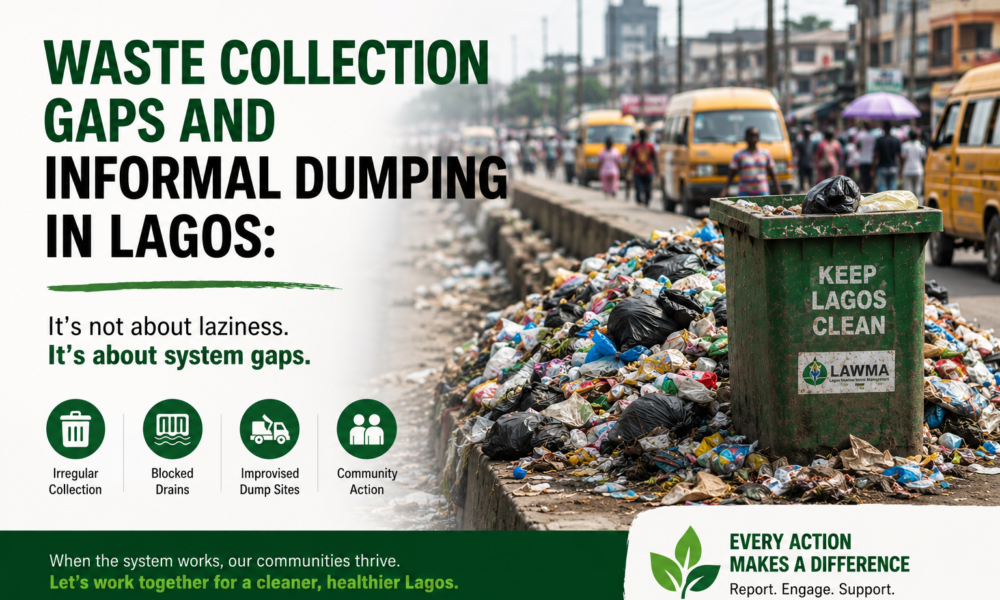
Walk through many neighbourhoods in Lagos early in the morning, and the signs are hard to miss. Piles of refuse at street corners. Plastic bottles floating in open drains. Black nylon bags quietly multiplying where there were none a week ago. The easy explanation is often the same: “Lagosians don’t care about the environment.”
Table Of Content
But that explanation is not only lazy—it is inaccurate.
Waste is piling up across our communities not because people are indifferent, but because the waste management system itself has gaps. And when systems fail, people improvise.
When the System Stutters, the Streets Respond
In an ideal city, waste follows a predictable journey: from household bins to collection trucks, to transfer stations, and finally to regulated disposal or recycling sites. In reality, across parts of Lagos—particularly in densely populated areas like Agege—this chain often breaks.
Collection schedules are irregular. Trucks fail to show up for weeks. Communal bins overflow without replacement. Payment systems for private waste operators are inconsistent, especially for low-income households already under economic strain.
When waste is not collected, residents do what humans have always done in the absence of structure: they adapt. Roadside corners become temporary dumpsites. Open drains turn into accidental storage spaces. Vacant plots quietly absorb what the system cannot carry.
This is not laziness. It is infrastructural breakdown made visible.
Informal Dumping Is a Symptom, Not the Disease
It is important to be clear: informal dumping is environmentally dangerous and socially costly. Blocked drains worsen flooding during the rainy season. Accumulated waste breeds disease vectors. Burning refuse releases toxic fumes into already polluted air.
But blaming residents alone misses the point. Informal dumping is not the root problem—it is a symptom of a system that is overstretched, uneven, and sometimes absent.
In cities like Lagos, where population growth has outpaced infrastructure expansion, waste management requires more than enforcement. It requires communication, coordination, and community trust.
What Can Be Done—Starting From Where We Are
The good news is that not all solutions require massive funding or long-term construction projects. Some interventions are already within reach:
- Temporary storage points in areas where trucks cannot easily access can prevent indiscriminate dumping.
- Organised community pick-up schedules, coordinated through residents’ associations, can bridge gaps in formal collection.
- Clear reporting channels for illegal dumping spots allow quicker response before small piles become permanent fixtures.
- Environmental communication—clear, respectful, localised messaging—helps residents understand not just whatto do, but why it matters.
When people feel seen and supported by the system, compliance increases. Environmental responsibility grows best in environments where structure exists.
Government Efforts—and Why Public Support Matters
It is important to acknowledge that Agege Local Government and the Lagos State Government are not standing still. Waste management reforms, private sector partnerships, and enforcement mechanisms are ongoing efforts to close long-standing gaps.
However, governance does not function in silence. Policies succeed when citizens engage, report, question, and participate. Public support does not mean uncritical praise; it means constructive involvement.
Silence allows broken systems to persist. Engagement pushes them to improve.
Beyond Blame: Rethinking Environmental Responsibility in Lagos
If Lagos is to become the resilient megacity it aspires to be, we must move beyond narratives that blame individuals without examining structures. Environmental behaviour does not exist in a vacuum—it responds to availability, access, and reliability.
Waste on the streets is not just an environmental issue. It is a communication issue, a governance issue, and a social equity issue.
And until we address it as such, the piles will keep growing—quietly reminding us where the system stopped working.
If this conversation matters to you, share it. Environmental change begins when someone hears what they had been ignoring.




No Comment! Be the first one.