



What Ghanaians Actually Want From Climate Communication: A Critical Reading of Odoom and Fosu
A Paper Trail Review | Environmental Communication and Climate Justice Introduction: Why We Need to Read Climate Research More Carefully There is a particular kind of academic paper that deserves far...

A Paper Trail Review | Environmental Communication and Climate Justice
Introduction: Why We Need to Read Climate Research More Carefully
There is a particular kind of academic paper that deserves far more attention than it receives. Not the landmark study that reshapes an entire field overnight, nor the provocative theoretical intervention that sets conference rooms buzzing — but the quiet, methodical, community-facing study that asks ordinary people what they actually think, feel, and need. Daniel Odoom and Modestus Fosu have written one of those papers. And almost nobody is talking about it.
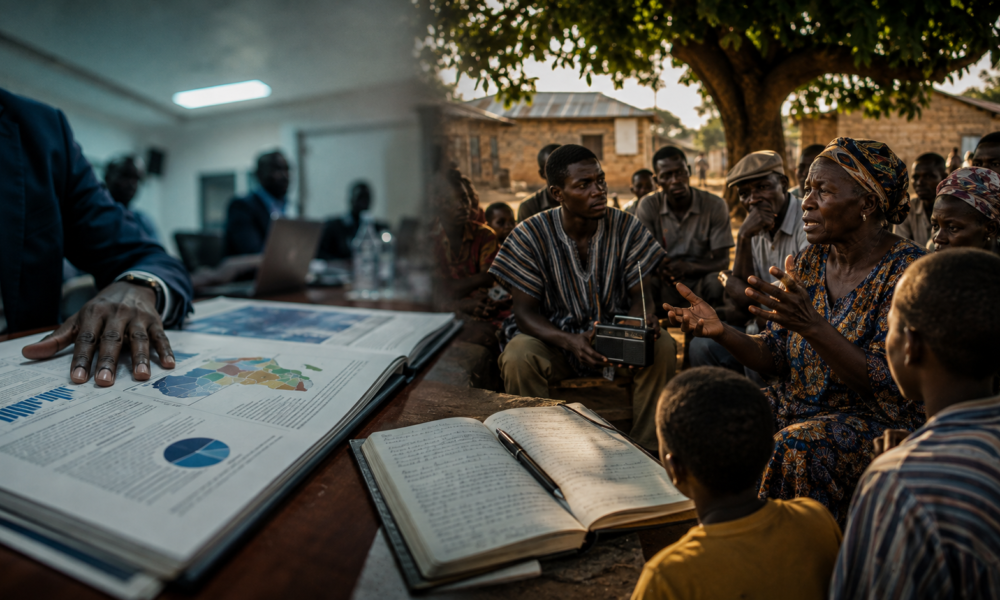
Published in the Journal of Policy and Development Studies, their study does something deceptively simple: it asks 327 Ghanaians how they feel about the way climate change is communicated to them. Not what scientists think communities need to hear. Not what government ministries have decided is the appropriate message. What people themselves — living in a country on the front lines of West African climate vulnerability — actually want from the institutions and communicators tasked with informing them about a crisis that is already reshaping their lives.
The findings are illuminating. The methodological questions they raise are equally so. And taken together, they point towards a set of challenges in African climate communication that researchers, practitioners, and policymakers would do well to sit with rather than move past.
This review does not set out to diminish Odoom and Fosu’s contribution. Quite the opposite. It engages their work seriously — because serious engagement is, in the end, the most meaningful form of scholarly respect.
What the Study Found: The Gap Between What Is Communicated and What Is Wanted
The central finding of Odoom and Fosu’s study is both straightforward and damning: there is a significant disconnect between the way climate change is currently communicated in Ghana and the way the people most affected by it want to receive that information.
Respondents were clear about what they do not want. They do not want government press releases, drafted in formal institutional language and distributed through official channels that most people neither access nor trust. They do not want technical briefings that assume a level of scientific literacy that general populations — particularly in communities where formal education has been inconsistent or disrupted — simply do not possess. And they do not want to be spoken at by officials who appear, from the community’s perspective, to be narrating a crisis from a comfortable distance rather than inhabiting the same reality as the people they are addressing.
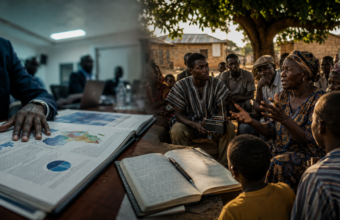
What respondents said they actually want is worth quoting in spirit, if not verbatim: folklore. Music. Their own languages. Communication that arrives through the cultural channels that communities already inhabit, rather than demanding that communities travel to where the institutions happen to be. They want local voices leading the conversation — not as props to legitimise messages that were designed elsewhere, but as genuine authors of the climate narrative in their own communities. And they want climate change to be treated with the urgency it deserves — as the national emergency it demonstrably is — rather than as a technical sidebar that appears briefly on the agenda before more pressing matters of political economy crowd it out.
These are not new demands in the abstract literature of risk communication and environmental communication scholarship. Researchers have argued for culturally resonant, community-led, vernacular climate communication for at least two decades. What Odoom and Fosu contribute is empirical grounding for these arguments in a specific West African context — evidence that the gap between what communication scholars recommend and what communication practitioners deliver is not merely theoretical. It is experienced, felt, and articulated by the people on whose behalf the communication is ostensibly being designed.
That is a significant contribution. It deserves to be recognised as such.
The Role of Indigenous Knowledge and Cultural Communication
One of the most important threads running through the study’s findings — and one that merits more analytical attention than the paper itself perhaps gives it — is the role of indigenous knowledge systems and cultural communication practices in shaping how climate information lands and moves within communities.
When respondents expressed a preference for folklore and music over press releases and official briefings, they were not simply expressing an aesthetic preference for the familiar over the formal. They were pointing towards something deeper: the understanding that knowledge which travels through culturally embedded channels carries a different kind of authority than knowledge delivered through institutional ones. A proverb about rain and harvest, passed through generations and activated in the context of a community gathering, does not merely convey information. It connects that information to a web of meaning, memory, and social relationship that gives it traction in ways that a government advisory simply cannot replicate.
This insight has profound implications for how climate communication is designed and delivered across West Africa — and across the African continent more broadly. It suggests that the challenge is not primarily technical: it is not about finding the right platform, the right framing, or the right set of talking points. It is about recognising that communities already possess sophisticated communicative traditions and knowledge systems, and that effective climate communication must enter into relationship with those traditions rather than bypassing them in the name of scientific clarity or institutional efficiency.
Odoom and Fosu gesture towards this insight. The field needs to do more than gesture. It needs to build research programmes that take indigenous communicative practice seriously as a subject of rigorous scholarly inquiry — not merely as a policy-friendly talking point about the value of local knowledge.
The Statistical Inconsistency: A Small Problem With Large Implications
Good scholarship is not merely about the quality of the questions asked or the insights generated. It is also about the precision and consistency with which findings are reported. And here, Odoom and Fosu’s paper gives pause.
One of the study’s key statistics — a figure central enough to the argument that its accuracy matters — appears reported in two different ways within the same paper. The discrepancy is not dramatic. It does not suggest data fabrication or deliberate misrepresentation. In all probability, it is what it appears to be: an editing slip, the kind of minor inconsistency that can survive multiple rounds of review when authors and reviewers are focused, quite reasonably, on the larger intellectual questions the paper is wrestling with.
But minor inconsistencies in reported statistics are not trivial matters, even when they are innocent in origin. In a field where numbers are mobilised to make arguments, to justify policies, and to allocate resources, the precision of those numbers matters. A statistic reported inconsistently invites the reader to ask which version is correct — and once that question is raised, it necessarily casts a shadow, however slight, over the confidence with which the broader findings can be cited and built upon.
The lesson here is not that Odoom and Fosu have produced unreliable work. They have not. The lesson is one that applies equally to every researcher in this field, including those writing this review: even strong research benefits from one additional careful read before it goes to print. The pressure to publish, the fatigue of long writing processes, the limitations of peer review as an error-detection mechanism — all of these are real and understandable. But they do not diminish the responsibility to ensure that the numbers readers will carry away from a paper are the right ones, reported consistently and without ambiguity.
Scholarly rigour is not a finishing touch. It is structural. And it deserves to be practised as such, even — especially — in research that is doing genuinely important work.
The Sampling Question: Who Gets to Speak for a Community?
The most substantive methodological question raised by Odoom and Fosu’s study is one that the paper itself does not adequately foreground, though it is touched upon in the methodology section: the question of who, exactly, was included in the sample of 327 respondents — and what that means for the generalisability of the findings.
The respondents in this study were drawn largely through social media channels. The practical consequence of this recruitment strategy is significant: it skews the sample towards individuals who are digitally connected, and therefore disproportionately towards those who are younger, urban, and university-educated. This is not an unusual limitation in social science research, particularly research conducted under the resource and time constraints that characterise much academic work in the Global South. It is a limitation that deserves to be stated clearly and engaged with honestly.
The concern is not that university-educated, digitally connected Ghanaians do not have valuable perspectives on climate communication. They clearly do, and those perspectives are worth capturing. The concern is that they are not representative of the full range of people who need to be reached by climate communication in Ghana — or anywhere else in West Africa. The smallholder farmer in a rural community in the Volta Region, who has no social media presence and whose primary sources of information are community radio, religious gatherings, and the accumulated wisdom of neighbours and elders, may have very different views about what effective climate communication looks and feels like. His wife, managing a household with limited access to formal education and institutional channels, may have different views still. Their children, navigating the intersection of digital connectivity and rural livelihood, occupy yet another communicative world.
When a study asks who wants folklore and music and local voices — and finds that even the relatively privileged respondents in its sample are calling for these things — the implication is not that the findings are wrong. The implication is that the demand is probably even stronger, and the communicative gap probably even wider, among the communities that the study did not reach. In other words, Odoom and Fosu’s findings, if anything, may understate the scale of the problem they are identifying.
This is not a knock on the researchers. It is an argument for the next study. African climate communication scholarship needs research designs that deliberately and systematically include the voices of marginalised, rural, and non-digitally-connected communities — not as afterthoughts or supplementary case studies, but as primary subjects of inquiry. The loudest voices in a survey are not always the full picture. And in a field concerned with equity and justice, the omission of the quietest voices is a methodological and ethical issue simultaneously.
What This Means for African Climate Communication Practice
Stepping back from the specific findings and methodological considerations, Odoom and Fosu’s study points towards a set of broader implications for climate communication practice across Africa that are worth stating directly.
The first is that the institutional default of top-down, expert-led, formally mediated climate communication is not working — and communities know it. The respondents in this study were not passively unaware of a communication problem. They were actively articulating it, with clarity and specificity. That articulation should be understood not merely as feedback for researchers to process but as a form of democratic demand: a signal from communities that they expect to be communicated with differently, and that the current arrangements do not meet their needs.
The second implication is that language is not a peripheral concern in climate communication. It is central. The preference for local languages over formal English or French — the linguistic inheritance of colonial administration that continues to govern official communication across much of West Africa — is not merely about comprehension, though comprehension matters enormously. It is about ownership. When climate change is communicated in a language that communities speak not just with their tongues but with their identities, it becomes possible for communities to claim that information as their own — to metabolise it, argue with it, build on it, and act on it. When it arrives in a language that marks it as belonging to the educated, the official, and the distant, it remains external — received rather than inhabited.
The third implication concerns the relationship between urgency and trust. Respondents in Odoom and Fosu’s study wanted climate change to be treated as a national emergency — and were frustrated by what they experienced as a failure of official communication to match the scale and urgency of the crisis. This frustration is not irrational. In countries where climate impacts are already registering in agriculture, water availability, coastal erosion, and public health, the gap between the severity of what is happening and the measured, bureaucratic tone of official climate communication is not merely a stylistic failure. It is a credibility failure. Communities that have experienced flooding, drought, or erratic seasons do not need to be convinced that climate change is serious. They need to be met with communication that acknowledges what they already know — and that offers something useful in response.
Conclusion: The Value of Looking Carefully
Daniel Odoom and Modestus Fosu have produced a paper that matters. It asks the right people the right questions, arrives at findings that are both empirically grounded and practically significant, and contributes meaningfully to a body of scholarship that African climate communication urgently needs to expand.
It is also a paper with limitations — a sampling frame that skews towards the digitally connected and formally educated, and a statistical inconsistency that, whilst almost certainly innocent, serves as a reminder that precision in reporting is inseparable from scholarly credibility.
Neither of these observations diminishes the paper’s value. They contextualise it — and in contextualising it, they point towards the work that remains to be done. Research that reaches further into the margins. Studies that centre the voices of those most affected by climate change and least represented in the conversations about it. Scholarship that takes indigenous communicative traditions not as romantic alternatives to science but as serious knowledge systems deserving rigorous engagement.
The climate communication field in Africa needs more studies like this one. It also needs the critical reading culture that ensures those studies are held to the standards they deserve — not to diminish them, but to strengthen what they make possible.
Because research this important deserves exactly this kind of scrutiny.
Every single week.
The author writes on climate communication, environmental history, and African knowledge systems. This review is part of Paper Trail, a weekly series examining published research in climate and environmental communication.

No Comment! Be the first one.