



August Break: Why the Rains Suddenly Stopped
You have probably noticed it already. Something shifted this week. The rain that has been a near-daily presence since April has gone quiet. The air feels different — cooler, stiller, carrying a...

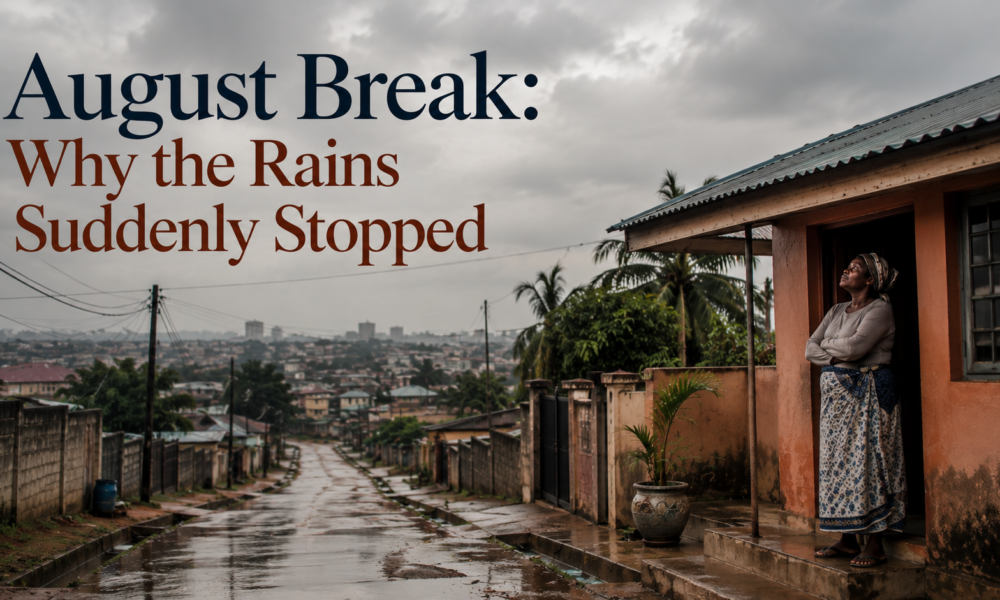
You have probably noticed it already. Something shifted this week. The rain that has been a near-daily presence since April has gone quiet. The air feels different — cooler, stiller, carrying a quality that is difficult to name but impossible to miss. If you are in Lagos right now, you may have reached for a cardigan you had not touched since January. You may have looked up at the sky and felt, for the first time in months, that it was not about to fall on you.
You are not imagining it. And you are certainly not alone in noticing it.
What you are experiencing has a name. It is called August Break — and far from being a malfunction of the weather, it is the weather doing precisely what it has done for centuries. The question is whether we still understand it well enough to respond to it wisely.
What August Break Actually Is
To understand August Break, you need to know a little about the atmospheric system that governs rainfall across West Africa. The Inter-Tropical Convergence Zone — the ITCZ, as meteorologists call it — is a belt of low pressure that forms near the equator, where the trade winds of the northern and southern hemispheres meet. It is this system that drives the West African monsoon, pulling moisture-laden air inland from the Atlantic Ocean and releasing it as the heavy rains that characterise our rainy seasons.
The ITCZ does not stay still. It migrates north and south with the seasons, following the sun. In the early part of the year, it sits south of the equator. By April, it has moved northward enough to bring the first rains to southern Nigeria. By June and July, rainfall is at its most intense across much of the south. And then, in late July and into August, the ITCZ shifts further northward still — temporarily withdrawing the moisture system that feeds our skies.
The result is August Break: typically two to three weeks of dramatically reduced rainfall, cooler temperatures, hazier skies, and a striking atmospheric pause that cuts across the middle of what should otherwise be an uninterrupted wet season. In Lagos, average temperatures during this period drop to around 25 degrees Celsius — making August, improbably, the coldest month of the entire year in the city. Colder, on average, than December. Colder than any harmattan morning most Lagosians have experienced. This is not a local curiosity. It is a meteorological fact that has been observed and recorded across southern Nigeria for decades.
Southern Nigeria, it is worth noting, experiences what climatologists call a bimodal rainfall pattern — two distinct rainy seasons, separated by this brief August dry spell. The first rainy season runs roughly from March through July, peaking in June. August Break follows. Then the second, shorter rainy season arrives in September and October before the long dry season settles in. This rhythm has shaped agriculture, culture, and daily life across the region for generations. The farmers who plant by it, the traders who plan around it, the children who have always known that August means something different — all of them are reading a calendar written not in ink but in the movement of the atmosphere.
What It Feels Like — and Why That Matters
There is something disorienting about August Break if you are not expecting it. You have spent months dressing for rain, navigating flooded streets, planning around afternoon downpours. And then, suddenly, the rain stops. The sky turns a particular shade of flat, grey-white — not the brooding darkness of a storm about to break, but something quieter and more ambiguous, a kind of atmospheric suspension. The air feels cool even when the sun is technically overhead. The trees are still in the absence of the wet-season wind. Puddles from earlier rains sit on the ground without being replenished, slowly shrinking in the diffuse light.
For many Nigerians, this is a familiar and welcome pause — a moment to catch breath, to dry out, to move around the city without watching the sky for signs of imminent flooding. For others, particularly those not raised with this seasonal literacy, it can feel inexplicable. Social media fills with speculation about the cold weather every year. People wonder whether something unusual is happening, whether the weather is broken, whether they should be worried.
The answer is nuanced. In its traditional form, August Break is not something to worry about. It is something to understand. But understanding it has become more complicated in recent years — and that complication is where the conversation needs to go.
When Climate Change Enters the Picture
Research published in the journal Climatic Change has raised a question that should concern anyone paying attention to West African weather patterns: is the August Break breaking?
The concern is not that the phenomenon will disappear entirely, at least not in the near term. It is that it is becoming less predictable, less consistent, and less reliably timed. Climate change — driven by rising global temperatures and shifting atmospheric dynamics — is altering the behaviour of the ITCZ, which in turn alters the timing, duration, and intensity of both the rainy seasons and the break between them. The August Break may arrive later than expected, or end earlier, or in some years produce only a partial pause rather than a clear interruption. In other years, what should be a mild two-week dry spell extends into something more prolonged and more damaging.
This unpredictability is not an abstraction. It has consequences that land on real people in very specific ways — and those consequences are worth naming clearly.
The Health Risks Nobody Warns You About
The first and most immediate health concern during August Break is one that Nigerians know well but rarely associate directly with the weather shift: mosquitoes.
The weeks of heavy rainfall that precede August Break leave behind significant amounts of standing water — in drainage channels, in uncovered containers, in the low-lying corners of compounds and streets. When the rains pause, this water does not disappear. It sits, stagnant and warm, in the relative stillness of the break period. And stagnant, warm water is precisely the breeding environment that Anopheles mosquitoes — the vectors of malaria — require. Research tracking the relationship between rainfall patterns and malaria incidence in Nigerian cities has consistently found elevated transmission risk during and immediately after dry spells that follow periods of heavy rain. The pause in rainfall does not protect you from mosquitoes. In a very real sense, it concentrates them.
The second health risk is respiratory. The human body is remarkably adaptable, but rapid shifts in temperature and humidity place genuine stress on the respiratory system. The sudden drop in temperature that characterises August Break — particularly in coastal cities like Lagos — creates conditions in which upper respiratory tract infections, including coughs, colds, and in vulnerable individuals more serious complications, become more prevalent. Children, elderly people, and those with pre-existing respiratory conditions are particularly susceptible. It is not coincidental that many Nigerians associate the onset of August Break with a surge in what is colloquially called catarrh — the seasonal respiratory complaints that seem to spread through households and offices every year at around the same time.
There is a third, less-discussed health dimension: food. When ambient temperatures drop unexpectedly and the atmospheric conditions shift, food spoilage patterns change in ways that households may not immediately account for. Food that would have kept safely under one set of conditions may behave differently during the break period, particularly in households without refrigeration. Medical experts have noted that this period warrants heightened attention to food storage and preparation — a practical concern that rarely makes it into the health advisories issued around August Break.
What Farmers Are Watching
For agricultural communities across southern Nigeria, August Break has historically been a known variable — a pause to be planned around rather than feared. But as the break becomes less predictable in its timing and duration, the agricultural implications become more serious.
Farmers who plant in expectation of continuous rainfall can find their crops under moisture stress if the break arrives earlier than expected or lasts longer than usual. Conversely, if the break is delayed or truncated, the transition to the second rainy season may be compressed, leaving inadequate time for certain crops to mature before the long dry season arrives. The loss of reliable seasonal rhythm — the ancestral knowledge that told a farmer when to plant, when to wait, and when to harvest — is one of the less-discussed but deeply consequential dimensions of climate change in agricultural West Africa. When the weather stops behaving the way it always has, the knowledge systems built around that behaviour begin to fail.
What You Should Do Right Now
None of this is cause for panic. But it is cause for attention — which is different.
The most immediate practical step for households in affected areas is the removal of standing water. Every container, tyre, gutter, and low-lying surface holding stagnant water around your home is a potential mosquito breeding site. Clearing them during August Break is not just good hygiene. It is a meaningful contribution to reducing malaria transmission risk in your immediate environment.
Dressing appropriately for the temperature shift matters more than it might seem. The instinct to continue dressing for the heat of the rainy season when temperatures have dropped by several degrees is understandable, but the body’s immune response is compromised by thermal stress. A light layer in the evenings — particularly for children and older family members — is a simple precaution with real protective value.
And for those with connections to farming communities, the message is worth passing on: the August Break may not behave this year the way it behaved last year, or the year before. Flexibility, observation, and communication with local agricultural extension services are more valuable than rigid adherence to a planting calendar that the climate may no longer reliably honour.
Reading the Weather Again
There is something worth recovering in all of this, beyond the practical advice and the climate science. It is the habit of paying attention to the sky.
For most of human history in this part of the world, people read the weather the way we now read our phones — constantly, carefully, and with the understanding that the information carried genuine consequences. The farmers who knew which clouds meant serious rain and which meant a passing shower. The fishermen who read the wind. The market traders who planned their weeks around the rhythm of the seasons. August Break was not an anomaly to them. It was a chapter in a story they knew by heart.
That literacy is not lost. But it has been crowded out — by urban life, by built environments that insulate us from weather until it becomes extreme, by a cultural tendency to treat the natural world as background rather than information.
August Break is an invitation to read again. To look up. To notice what the atmosphere is doing and ask what it means. To understand that the pause in the rain is not silence — it is communication.
And in a time when the climate is changing fast enough to alter patterns that have held for centuries, that kind of attention is not optional.
It is the beginning of resilience.


No Comment! Be the first one.