



Left to Drown: Why Africa’s Informal Settlements Are Missing from the Plans Built to Save Them
Let me start with something that should be obvious but is rarely stated in the rooms where climate policy is made: the rain does not check your address before it falls. It does not distinguish...

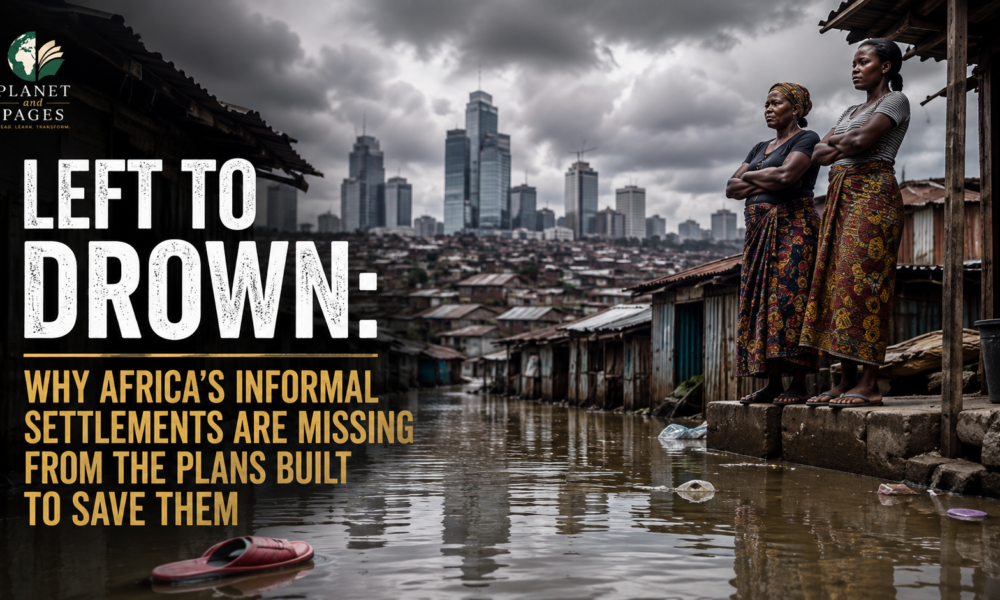
Let me start with something that should be obvious but is rarely stated in the rooms where climate policy is made: the rain does not check your address before it falls.
It does not distinguish between the planned neighbourhood with its concrete drains and manicured roads, and the informal settlement three kilometres away where the drainage channel has been blocked for six months and nobody from the municipal authority has come to fix it. The rain falls. The water rises. And then — and this is the part that rarely makes it into the policy documents — the consequences diverge sharply along lines that have everything to do with politics and very little to do with geography.
Part one of this conversation established the case plainly: Africa’s informal settlements are missing from the climate adaptation plans designed to protect them. The exclusion is documented. The pattern is consistent. The consequences are severe. What I want to do here is go deeper — into the specific mechanisms of that exclusion, into what genuine inclusion would actually require, and into why this is, at its core, a question about power and not merely about planning.
The Bureaucratic Imagination and Its Limits
There is a particular kind of document that circulates in climate and urban planning circles. It is usually produced by a government ministry or an international consultancy. It runs to several dozen pages. It contains maps, projections, risk assessments, and strategic frameworks. It uses words like resilience, adaptive capacity, and multi-hazard approach. It is, in the technical sense, serious work.
And yet, when you look at the maps, something is missing.
The informal settlement — the one that has been there for thirty years, that houses a quarter of the city’s population, that sits directly in the flood plain and absorbs the overflow that the formal drainage system cannot handle — is either absent entirely, or appears only in the footnotes, tagged as a high-risk zone with a note that targeted interventions are required. Which is the bureaucratic way of saying that nobody has figured out what to do about it yet.
This is not coincidence. It reflects a deeper problem with how urban planning systems in many African cities were designed and what kinds of settlements they were built to see. Many of these systems inherited their frameworks from colonial-era planning codes that distinguished sharply between the planned, formal city and everything else. The informal settlement, in this imagination, is not a legitimate part of the city. It is a problem to be solved, a deviation from the plan, a temporary arrangement that will eventually be tidied away.
The trouble is that the tidying has not happened. And in the meantime, the climate has not waited.
Land Tenure and the Infrastructure It Unlocks
One of the quieter but more consequential reasons Africa’s poor are excluded from adaptation planning is land tenure — or rather, the lack of it.
When residents do not hold formal legal title to the land they occupy, a cascade of consequences follows. Governments are reluctant to invest in infrastructure on land whose occupancy is legally ambiguous — partly because it raises questions about permanence, and partly because infrastructure investment can be read as a form of recognition. Recognition, in this context, is politically complicated. It implies that the settlement has a right to exist, which then implies obligations that many municipal authorities are not ready to accept.
The residents, for their part, are caught in a trap of their own. Without secure tenure, they are less likely to invest in improving their own structures, because the risk of eviction — often at short notice, often without adequate compensation — makes long-term investment irrational. So the structures remain more vulnerable than they might otherwise be. And when flooding occurs, the vulnerability that tenure insecurity helped produce is blamed on the residents themselves.
It is a particularly elegant form of institutional cruelty.
None of this is natural. It is manufactured — by policy decisions about who deserves formal recognition and who does not, decisions that carry the weight of class, and in many cases of ethnicity, in ways that the technical language of adaptation planning is careful never to name directly.
The Early Warning System That Warns the Wrong People
I want to return to early warning systems, because there is something important here that deserves fuller attention.
The idea is straightforward enough. You detect a hazard — a storm, a flood, a heatwave. You issue a warning. People receive it, understand what it means, and take protective action. Simple in theory. In practice, the system tends to work far better for people who already have resources and options than for people who do not. And in the specific context of Africa’s informal settlements, there are at least four ways in which the system tends to break down.
The first is reach. Warning systems that rely on official broadcast channels, smartphones, or formal community liaison structures may simply not reach the most isolated or marginalised households within a settlement. The woman in the most flood-prone corner of the community, with no smartphone and no connection to the local community association, may be the last to know.
The second is language. Warnings issued in formal English or in the technical vocabulary of meteorology may be accurate but incomprehensible to people whose daily communication happens in Yoruba, Hausa, Ga, Dholuo, or any of the dozens of other languages in which African urban life actually operates. A warning that is not understood is not a warning. It is noise.
The third is trust. Communities that have experienced years of being ignored by government institutions — or worse, of being lied to — may not trust official warnings when they come. This is not irrationality. It is a perfectly sensible response to a track record of institutional unreliability. Rebuilding that trust requires far more than issuing accurate forecasts. It requires a history of meaningful engagement that most urban governments have not bothered to establish.
The fourth, and perhaps most important, is actionability. A warning is only useful if the person receiving it has somewhere to go and something to do. If there is no designated evacuation centre, if the roads out of the settlement are already flooded, if evacuating means leaving behind the goods that constitute your livelihood, if you have an elderly parent who cannot walk quickly — then the warning, however timely and however accurate, does not translate into safety. Telling people to take appropriate precautions when appropriate precautions are not available to them is not climate adaptation. It is the performance of climate adaptation.
The Knowledge That Does Not Appear in the Reports
Here is something I find myself saying often, and will say again here because it bears repeating: the residents of Africa’s informal settlements are not passive objects of climate risk. They are active observers of their own environment, and they hold knowledge that no technical report can fully replicate.
They know the micro-topography of their community in a way that no GIS survey quite captures — which specific alleyway channels water fastest, which corner floods even in moderate rain, which drainage point is most likely to block and when. They know the social geography — which households contain elderly people who will need help to evacuate, which families have the resources to help their neighbours, which community leaders command genuine trust. They know the seasonal rhythms — how the flooding pattern has shifted from one year to the next, how it has changed over the past decade, what the early signs are that a flood event will be more serious than usual.
This knowledge is not a replacement for hydrological modelling, satellite data, or engineering assessments. But it is a necessary complement to all of those things. A flood risk model built without the input of people who have observed the actual behaviour of water in that specific community will always have gaps. Some of those gaps will matter enormously when a real flood arrives.
The reason this knowledge does not appear in the reports is not that it is unavailable. It is that the processes by which reports are produced do not typically include the people who hold it. Consultants arrive, conduct their assessments, and depart. Residents may be surveyed, but they are rarely co-investigators. Their knowledge is collected rather than engaged with — and the distinction is not minor.
What Meaningful Participation Actually Requires
The phrase community participation appears in almost every climate adaptation document I have ever read. It is one of those terms that has been deployed so often and so loosely that it has nearly lost its meaning.
In practice, what tends to pass for community participation is often one of two things: a consultation meeting at which residents are invited to listen to plans that have already been made, or a survey instrument administered by a research team that has already defined the questions. Both processes collect information from communities. Neither gives communities meaningful influence over what happens next.
Genuine participation is different. It begins before the questions are defined, not after. It involves communities in identifying what the problems are, not merely in validating the problems that experts have already identified. It gives communities access to technical information and capacity — about risk, about options, about trade-offs — so that their participation is informed rather than performative. And it ensures that the outcomes of participation carry weight, that there is a mechanism for holding decision-makers accountable when they ignore what communities have said.
This is harder and slower and more expensive than the consultation meeting. It requires a genuine redistribution of power in the planning process, not merely the appearance of inclusion. That is precisely why it happens so rarely.
The Question of Who Bears the Cost
There is one dimension of this conversation that tends to make people uncomfortable, so let me say it plainly.
The exclusion of Africa’s poor from climate adaptation planning is not primarily a technical failure. It is not mainly about the complexity of the problem or the limitations of planning capacity. It is a political choice — and like all political choices, it reflects a set of priorities about whose wellbeing matters and whose does not.
When a city invests in sea walls and storm drainage for its central business district whilst the informal settlement three kilometres away floods every rainy season without a drainage investment in sight, that is not a coincidence. It reflects a decision — often implicit, rarely stated aloud, but no less deliberate for that — about which parts of the city and which residents within it are worth protecting.
The people living in informal settlements are not marginal to African cities. They are, in many cities, the majority. They build the cities, clean the cities, feed the cities, and sustain the informal economies on which formal economic activity depends. What they receive in return — in terms of infrastructure, services, and inclusion in the planning processes that shape their lives — does not reflect that contribution.
Changing this requires more than better technical planning. It requires the political will to treat the informal city as the real city — to acknowledge that the people who live there are not problems to be managed but citizens to be served, and that a climate adaptation strategy that does not protect them is not a climate adaptation strategy at all.
Where We Go From Here
Africa’s cities are growing. The climate is changing. And the communities that sit at the intersection of those two realities — dense, informal, under-resourced, and persistently overlooked — are where the future of urban climate resilience will ultimately be determined.
The question is not whether we can afford to include Africa’s informal settlements in adaptation planning. The question is whether we can afford not to. Because a resilience strategy that excludes the most exposed communities does not make a city resilient. It makes the city comfortable for some and catastrophic for others, and calls the arrangement a plan.
There is no technical shortcut around the politics of this. Genuine adaptation requires genuine inclusion — of community knowledge, of community voice, of community participation in the decisions that will shape community futures. It requires infrastructure investment that follows need rather than formality. It requires early warning systems designed to reach the people most at risk, in languages they actually speak, with options they can actually use.
And it requires an honest reckoning with the fact that the rain, when it comes, does not check anyone’s address. The question is only whether, when the water rises, the people living in Africa’s informal settlements will finally find themselves inside the plan — or standing, once again, outside it.
Because adaptation that ignores the margins is not adaptation.
It is abandonment.

No Comment! Be the first one.