



Book Review: A Tale of Two Cities by Charles Dickens
Bibliographic Details Author: Charles DickensTitle: A Tale of Two CitiesYear of Publication: 1859Genre: Historical FictionSetting: London and Paris during the French Revolution Introduction A Tale of...

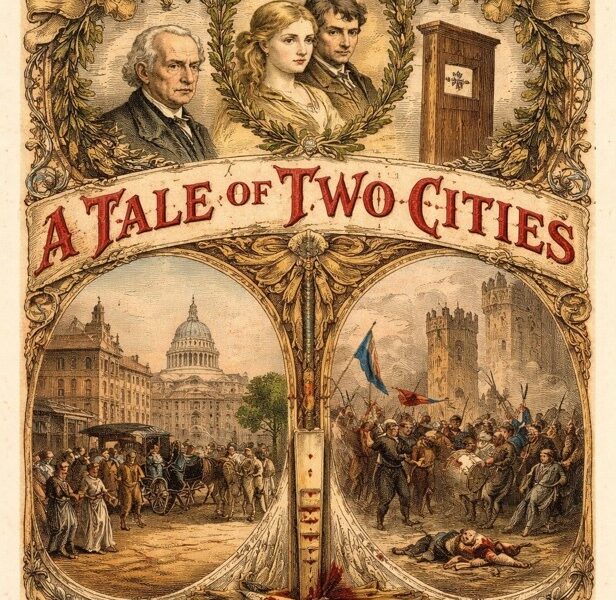
Bibliographic Details
Author: Charles Dickens
Title: A Tale of Two Cities
Year of Publication: 1859
Genre: Historical Fiction
Setting: London and Paris during the French Revolution
Introduction
A Tale of Two Cities is one of Charles Dickens’s most powerful and emotionally resonant novels. Set against the chaos and violence of the French Revolution, the book explores how ordinary lives are shaped by extraordinary historical events. More than a political or historical narrative, the novel is a deeply human story about love, sacrifice, injustice, and the possibility of personal redemption.
Summary of the Text
The novel follows the lives of several characters whose destinies are intertwined between London and Paris. Dr Alexandre Manette, once unjustly imprisoned in the Bastille, is reunited with his daughter, Lucie Manette, whose love helps restore his shattered mind. Charles Darnay, a French aristocrat who rejects his family’s cruel legacy, marries Lucie and seeks a peaceful life in England.
However, the outbreak of the French Revolution draws Darnay back to France, where he is arrested and condemned. Sydney Carton, a disillusioned English lawyer who closely resembles Darnay, plays a crucial role in the novel’s climax. His final act of self-sacrifice becomes the emotional and moral centre of the story.
Analysis of Themes
Sacrifice and Redemption
The central theme of the novel is sacrifice. Sydney Carton’s transformation from a wasted, hopeless man into a figure of moral greatness shows that redemption is always possible. His final decision gives his life meaning and stands as one of the most memorable acts of selflessness in literature.
Social Injustice and Revolution
Dickens exposes the cruelty of the French aristocracy and shows how long-term oppression fuels violent rebellion. At the same time, he warns against revolutionary excesses, suggesting that violence driven by revenge can become as unjust as the system it replaces.
Love and Compassion
Lucie Manette represents emotional strength and human kindness. Her influence brings healing, unity, and hope, demonstrating Dickens’s belief that love is a powerful force even in the darkest times.
Character Evaluation
Dickens creates characters who feel symbolic yet deeply human. Sydney Carton is particularly compelling because of his inner conflict and emotional honesty. Madame Defarge, on the other hand, represents unchecked vengeance, serving as a reminder of how suffering can harden the human heart. Lucie Manette functions as the novel’s moral anchor, embodying empathy and resilience.
Style and Language
Dickens’s language is rich, dramatic, and expressive. Although written in nineteenth-century English, the novel’s imagery and emotional intensity remain accessible to modern readers. The contrast between London and Paris strengthens the novel’s themes and gives the story a powerful structural balance.
Relevance and Contemporary Significance
Despite being set over two centuries ago, A Tale of Two Cities remains relevant today. Its exploration of inequality, political unrest, and moral responsibility speaks directly to modern societies experiencing social and political tension. The novel encourages readers to reflect on justice, power, and personal responsibility.
Personal Evaluation
What makes this novel enduring is its emotional honesty. Dickens does not present heroes without flaws or villains without reasons. Instead, he portrays humanity in its full complexity. The novel is both heartbreaking and hopeful, reminding readers that individual choices still matter, even during moments of historical chaos.
Conclusion
A Tale of Two Cities is a timeless literary masterpiece that combines historical insight with deep emotional impact. Through unforgettable characters and universal themes, Charles Dickens delivers a story that continues to resonate across cultures and generations. It is a novel that challenges readers to think, feel, and reflect on what it truly means to be human.




No Comment! Be the first one.